

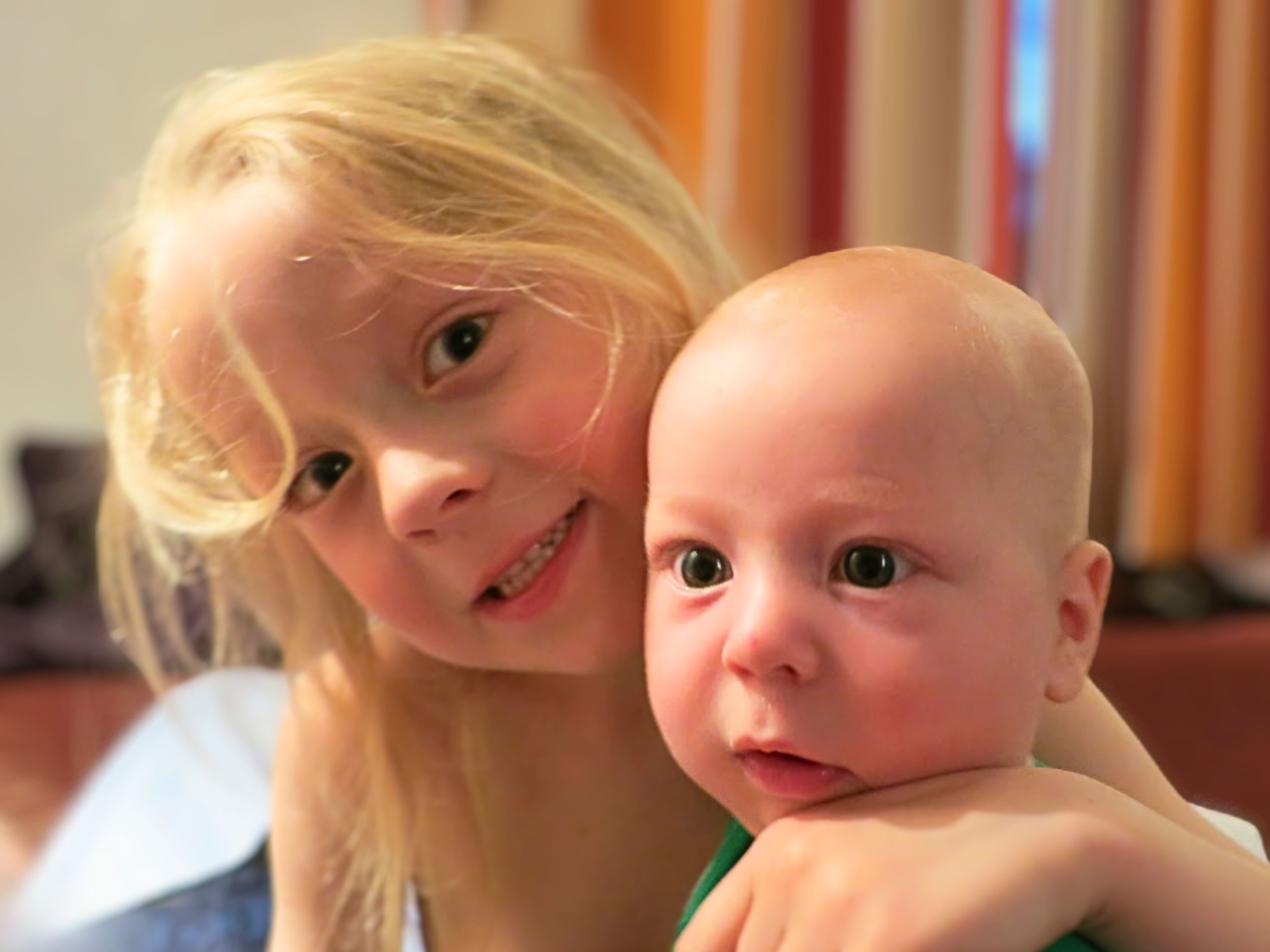
Can children be vegetarians? And should we let them?
An article about children's food choices, about protein and protein sources, about unnecessary grown-up worry, and about the freedom of small people to choose for themselves what they put into their bodies. Topped off with my own story as a vegetarian, a pescatarian, a meat eater and back again. Plus a lovely little (no, actually big) ray-of-sunshine story that started with a whole lot of chemotherapy and a whole lot of nausea, but ended ... with a small miracle.
Valby, 16 August 2012
Can you eat the cuddly chicken from the kids' show and the moo-cow?

Yesterday I once again met a woman who told me that her little son wants to be a vegetarian. She had told him that it is the moo-cow and the sweet little chicken we eat, and she got a prompt reaction. It is not the first time I have heard the story of children who quit meat when they find out what it actually is they are eating. And apart from these cases of ethical decisions in small children, it also seems completely normal to me to hear grown-ups say that small children go through long periods of not wanting to eat meat (or fish).
You can of course take all sorts of views on this, and you can certainly decide that it is a problem. My position is the same as with picky children. I don't think we should decide what children eat. We decide plenty as it is. On the other hand, I also don't see any reason to call the children's food choices vegetarianism, unless it is something you want to hold on to (for example because you think it is healthy, good and right). You can also just note that this is a food group the child would rather not eat – just as very few toddlers eat blue cheese, olives, sardines. It is what it is. If one day the child suddenly fancies a salami sandwich, there is no reason to correct them and say: But you've been a vegetarian since you were four!
So what about protein, how will they get enough protein?

This is the usual worry and objection. In reality, I think it is a bigger problem to get enough of the essential oils into the kids, and there are also certain minerals you actually ought to make an effort with. But that is another matter. Here I want to say something about protein, in a very down-to-earth way too.
Do your children get enough protein? And do you get too much?
There are different recommendations; the ones I have read and know put the minimum somewhere between 0.75 and 1.00 g of protein per kilo of body weight per day. Once again, I have my information first and foremost from Lisbeth Hagerup's good book Naturens vitaminer og mineraler (Nature's Vitamins and Minerals). (You can buy the book, in Danish, at Saxo.com if you like. As a reference book it has been a support to me for many years now, and it comes out in an updated edition at regular intervals.)
It is a trend in health circles at the moment that you should have lots of protein, and you probably should – but I would object that for many people (not all) breaking down animal protein is a strain, so that (over)consumption needlessly wears on the gut and the organs, especially the liver and kidneys. And it is a fact that Danes, on average, eat WAY too much animal protein. And I haven't even started getting worked up about medicine residues in factory-farmed meat, animal welfare and good karma. Because that is a completely different matter.
A child of 15 kilos (like my almost four-year-old daughter) needs somewhere around 15 g of protein a day. That is pretty simple math. Or 11.5 g, if you go by the lowest standard, which I believe is the WHO's.
Whether the children get it, well, you have to look it up – check the foods the children actually eat. I end this article with examples from our diet. There is no reason to copy out a nutrition table; there are plenty of those around. And really, it is a question of reading the label on what you buy and what the children enjoy eating.
Back to school: The basics of protein and protein sources

Proteins are made of amino acids, and it is true that animal protein contains all the amino acids needed to build a human body. BUT our organism has to break down the amino acid chains that make up the animal protein in order to absorb them and use them for maintenance and growth. So it is in no way better to eat animal rather than plant protein. It is the same process: the proteins have to be broken down first, split into simple amino acids, before they can be used.
There are 21 different amino acids. Most of them can be made from one another, but there are eight that can't. Those we have to get through our food. In this context it would probably get a bit too heavy to go into which ones. Animal protein (from meat, fish, eggs and milk) contains all the amino acids humans need. Plant proteins don't contain all of them, and so you have to do what is so elegantly called protein-combining.
You do that by choosing protein sources from two different groups, and it is no great art. Lots of completely ordinary standard dishes are built exactly this way. But anyway. The three biggest plant protein sources are 1. grains, 2. nuts & seeds, 3. legumes. If a meal contains two of these three sources, the protein intake is just as good as in a steak. For some people maybe even better, easier to digest and absorb.
Back to the children who won't eat meat. They are the ones this is about.
A long digression about our ever-changing diet in the Conrad family

Before I had children, I was a vegetarian. I have always preferred vegetables, bread and dairy, and I took the step of putting a word and a limit on it when it got to the point where I only ate meat to be polite when I was out for dinner. After which I would have to lie on the sofa, exhausted, with a stomach ache and a heavy head for at least a day, often two, to digest it. It took a lot of my energy and was completely unnecessary. If I called myself a vegetarian, I was spared the meat AND the long, awkward explanations.
My eldest daughter was a pescatarian for the first six years of her life (and for the first five of those it was just the two of us). So we didn't eat meat from poultry or mammals. Fish was a rarity; maybe once a week we went to the fishmonger. When I got married and had my second child, the food rules were dropped, so that no 'teams' would form in the family. My husband ate meat, and of course he should be allowed to. Chicken and bacon became staples in our kitchen, and now and then we bought an eighth of an organic calf in the autumn and made lots of slow-cooked food. The girl also loved salami sandwiches.
When I am pregnant, I get an insane craving for meat in the third trimester. Towards the end I eat more or less nothing else. So every time we have had a baby, it has been up for debate: what should our diet be now, after this meat orgy that nobody – least of all yours truly – wants to continue?
Our son Storm, who is six and a half now, eats almost no meat. He doesn't want to kill animals, and he doesn't like it – meat, that is. Not the taste, not the texture, nothing. He does happily eat salted and smoked meat, though: salami and bacon. Not much, not often – but when it suits him.
Silke, who is three, eats a bit more meat. She is generally just fonder of food and braver when it comes to new things. Light breast meat from a whole roast chicken, hot dogs and lots of bacon.
Liv happily eats high-quality slow-cooked meat. And she also really likes cheap ready-made Danish meatballs from Netto – with ketchup. Not much spelt there.
A miracle story in the middle of it all – only a tiny bit about protein, but in a way it is the background for my vegetarianism

I was lucky enough to come through the treatment for leukemia in one piece, but it was hard on my body. I am still getting back on my feet. Six months after the treatment ended, that is, last spring, I was still throwing up a lot and feeling really awful. I kept it secret from my husband, pushed it away a bit – the risk of relapse was quite high, and I just hoped I wasn't ill. When he finally found out and questioned me late one evening, with actual thunder and lightning, just like in the fairy tale, his worried face suddenly changed, and he said:
Cecilie, we've been here before.
It's not cancer. You're not ill.
You're pregnant.
Again.
I didn't believe him, and he had to cycle to Netto in pouring rain for a test. I took two, both positive, and didn't believe it. I went to the doctor, who took a sample, and I still didn't believe it. Since we had no idea when I had gotten pregnant (the illness had taken my cycle from me, and we actually didn't think we could have more children), I had to have a scan, and only when I saw the little guy lying there waving at me – only then did I believe it. It was very moving, overwhelming, and I am still – of course – deeply grateful.
Little Fjord was on his way. And once again, for the fourth time, I went through nine months of throwing up every day.
This spring, when he was small and newborn, I was still throwing up. Every day. Sometimes several times a day. After the birth it got worse and worse, and when we were on our Easter holiday, my (once again) wise husband said a very well-considered and correct sentence:
Cecilie, you really were better off when you were a vegetarian.
I stopped eating meat on the spot, and within 24 hours the stomach aches, the blood sugar swings and the vomiting were completely gone. That is why today I am – again – a vegetarian (with some fish on the side, which I tolerate just fine).
Do we get enough protein in the Conrad family?

I have now mentioned everyone except Fjord, seven months old, whose main meals are breast milk, oat porridge and bananas. And all this in order to say the following:
We all definitely get enough protein. We actually eat very differently, but then we ARE very different, and we are happy to be. In my early years as a mother, when it was just Liv and me, I did the math now and then, but I have stopped. I am not worried about my children's diet; I can generally see that they eat with pleasure, they choose quality and substance, they say yes and no without any problem, and they eat a very varied diet – even Storm, who would rather not eat too many different things or too much that is new.
The balance between grown-up control and children's freedom to decide what they eat
To finish, I want to repeat one point: we set the limits when we go shopping. If we buy something, it is because we think it is okay to eat it. Most of what we buy is raw ingredients, usually organic or at least local. Ready-made cheeses and salami, and semi-prepared things like smoked fish, ready-made fresh or dried pasta, shelled and maybe salted nuts and dried fruit also count as raw ingredients in our household. From these we make our food and put it on the table. What the children then choose to eat, that is up to them.
We are very wary when it comes to additives, or products that have been through rather too many processes since they were plants, milk or living animals. But still. Of course we buy ketchup, ice cream from the ice cream van and fig bars, rice cakes, crispbread and juice. We are not too fine for that. But we do it thoughtfully. Our choices in the supermarket (and online) set the limits for what our children can choose between. Once that is done, we think it is completely fine for them to choose for themselves what they want to eat. And nobody should try to force me to eat roast pork with crackling, or that trendy broccoli-and-raisin salad that was wildly popular once and that I simply think is horrible.
Conclusion: The answer is not 42; the answer is yes.

Children can easily be vegetarians, to answer clearly and concretely. Whether they are allowed to is up to their parents, up to some thinking about how much and how deeply we should decide over them. Nutritionally, there is nothing wrong with children being vegetarians, just as it is completely unproblematic if they drink water instead of milk (but that is another article). Children are small people developing at full speed, and for long periods they simply can't take new foods into their repertoire – at least not very many, and not if they look strange, are cooked together or are complicated. Which is completely fine. In fact, we grown-ups don't do it very often either. You can read more about this in the article on picky eating (in Danish), if you are interested. For now, I will just say:
Yes. Our children are welcome to choose not to eat meat. They can. They may. It is perfectly fine. Children should have the same right as adults to say yes and no when it comes to food.

Three appendices, supplementary lists, follow in the wake of this article:
- Some quick protein numbers for inspiration
- The list of protein-combined vegetarian dishes that are super easy and good
- The three exceptions we have to the children's freedom to choose what they eat
1. Protein calculations for inspiration
So now I am doing the math a little again, to show what I mean and to answer the worried mothers I have met. Maybe your children eat completely different things, and then you will have to do a bit of math yourselves. Or not, and just assume it is probably about the same.
- Storm weighs 20 kilos and needs 15–20 g a day
- Silke weighs 15 kilos and needs between 11.5 and 15 g a day
- Liv weighs 40 kilos and needs 30–40 g a day
- I'm not worried about Fjord; baby food is another matter.
Examples of protein content
- Rye bread – approx. 6.2% protein
- Brown whey cheese – approx. 15% protein
- Ordinary cheese – approx. 18%
- Tahini 17.7%
- Peanuts/peanut butter 24.9%
- Rolled oats 13.2%
- Milk/yogurt 3.5%
- Bacon without the fat, like all other meat, approx. 20%
- Pasta approx. 12%
- Eggs approx. 12%
- Chickpeas approx. 20%
- So a nice whey cheese sandwich of about 25 g bread and 10 g whey cheese gives (1.55+1.5) 3.05 g protein
- A serving of yogurt or milk with oats gives about (0.35+4) 4.35 g protein
- A bit of pasta, 50 g, gives another 6 g
- A handful of peanuts, 20 g – 4.8 g
- One egg, 50 g – 6 g protein
Look, this little list alone gives 21 g of protein of high biological quality. Only the peanuts need another protein source alongside, but they could just as well have been a peanut butter sandwich, and plenty of those get eaten at this address. You can easily choose to eat all sorts of other things; here I just want to appeal to people not to be afraid that children don't get enough protein when they don't eat meat. The list and examples above are completely ordinary foods in our kitchen and completely unproblematic for our children to eat and want to eat. I think we should look at what the children actually, voluntarily eat, and see if that isn't enough. Because it usually is.
And just to head off any objections. These foods are of course not the only thing my children eat (apart from the much-debated ice cream and cake); here I have focused on foods with a protein content of more than 3%. My kids of course also munch fruit and vegetables; but that is another story.
2. The list of protein-combined vegetarian dishes that are super easy and good
- Hummus contains chickpeas (the legume group) and sesame (the nuts and seeds group)
- Fried rice with chopped peanuts: rice is a grain, peanuts are nuts (or actually legumes)
- Tabbouleh – made from wheat, with chopped nuts in it
- Brown rice with soy sauce and gomasio (which is sesame)
On top of that, there are loads of combinations where dairy comes in and complements a plant protein source:
- Pasta with grated cheese, or well, really any pasta dish with cheese or milk in it.
- Pizza (we make it often, totally health-food style, with a tomato sauce with root vegetables and split lentils, a wholegrain base and lots of good cheese)
- Cheese sandwiches – a classic, a lovely classic. Notice, by the way, that there is exactly as much protein in cheese as in liver pâté and most sausages. On the other hand, there is often less fat, and for us it is healthier. We tolerate milk fat much better than fat from pigs and cows.
- Pasta with pesto, which contains pine nuts. Fresh pasta sometimes contains egg, but don't be fooled; it rarely means more protein. Strange, really. Still, you don't need to protein-combine pasta made with egg, since the pasta is then complete in itself. You can make your own pesto if you want to be sure of the quality of your proteins. Pesto made from almonds, peas, basil, salt, lemon and olive oil is deeply fantastic. And here you also get good plant protein from the peas.
3. The list of the three exceptions to the children deciding for themselves what they put in their mouths
- Fish oil (EyeQ), vitamin pills (Solaray for children) and calcium tablets (Dr. Vogel, Urticalcin) are a must, though you CAN get out of the vitamin pill if it tastes too awful (Storm, at times)
- You have to eat food before dessert.
- You have to take your medicine if you are ill. That includes painkillers, if you are in pain that needs treating.
Update 2023: Plant-based and gluten-free
Life is long, and as human beings we are constantly changing – for many years now we have lived mainly plant-based and gluten-free, but we have chosen to leave all my old recipes online so they can bring joy to others – I don't think you should edit your past :)
Written by Cecilie Conrad. Translated from Danish. The original article is available at CecilieConrad.dk.







Comments