


Couch parents: from a seated position, they correct and boss their children around. They are actually quite unpleasant to listen to. For everyone else around, too.
Fight your inner couch, and learn more about yourself, your children and being together
An article about our fictional enemy, couch parenting, and about how you help your children along by getting to know them, taking part in their reality and inviting them into your own. Number two in the series on couch parents. This one comes with no examples at all – sorry. I (luckily) haven't seen anything frightening lately.
At our house there is a short and loving telling-off between the grown-ups. It goes: 'Now you're being a couch parent.' In this article you can read about why that really is a term of abuse in our book, about our thoughts around the phenomenon, and about how we try to do it differently.
Live life together with your children
First of all, it has to be said: our life as parents of four children is not a pedagogical project. For various reasons we have had four children, and we live our life together with them. They are not trophies, nor business cards – and they are certainly not projects. We live with our children because they are our children. They are our responsibility, the great miracles of our lives, our family.
We are parents in a way that comes naturally to us, where what we say and do with our children is authentic and real. Of course we talk about how we want to raise them, what we would like them to learn before they grow up, and a whole lot about how to make everyday life work. But we are not technical about it.
All of this that I write on SpeltMor about children and childhood and the role and possibilities of parents comes from genuine wondering and questions we meet out in the world. And from a deep surprise I meet in myself when I sometimes encounter other people's reality. Against that background, it has come to make sense to share our point of view, our way of life, our thoughts.
We live together with our children, quite simply. We live our lives, all of us. Together. That is what it is about. At the same time, we have to guide our kids, be in charge of them and lead them on their way. I strongly encourage all parents to consider this strategy, so that home life is not a project and a battlefield. But of course, that is your choice.

The characteristics of couch parenting
Couch parents sit down while they raise their children. From a seated position, they try to interact with their children and help them learn how to get by in this world. They sit and shout, or talk very loudly, correcting and commanding. They are actually quite unpleasant to listen to. For everyone else around, too.
The couch CAN, of course, be swapped for a bench, or for being busy with text messages, grown-up conversations over coffee, or getting through soup-roast-and-ice-cream at a confirmation party. The point is: couch parents stay in their 'own' reality, stay in the adult position – ultimately on the couch – when they have time to be with their children. They have their grown-up reality, which they wouldn't dream of leaving, and at the same time they don't see the children's reality.

Despite this actually rather large distance between the parents and the children, and despite this absence of interest in the children, these parents want to control, raise, steer the children.
They use sentences that begin (and sometimes also end) like this:
- Come here!
- Stop that!
- You're not allowed (any more gummy bears)
- Just calm down a bit,
- You're always so noisy
- Be quiet!
- Don't hit your brother
- You're not allowed to ....
- You have to .....
Couch parents don't actually make much of an effort to connect with their children. They don't dive into the children's point of view, they see themselves as smarter, better, stronger, and they think it is perfectly okay to have an opinion on just about EVERYTHING the child does. Despite this massive absence of interest, and with it an absence of knowledge, experience and understanding of the child's reality.
Couch parents would like to see some clear results, but they are not really that interested in the process it is for children to develop. Couch parents don't make an effort to communicate with children in a way they can understand, and maybe they don't actually know very much about what it takes for their children to understand them.

Couch parents CAN be really good at getting their children to obey (while they are being watched). Couch parents show no deep respect for their children's integrity, and they often speak incredibly nastily to their children.
Get into the game, get into the now
The first thing you have to do to be – yes, now I'm actually saying it: better than the couch parents – is to get up. To move from your own world towards the child's.
If you feel a need to reach your children, maybe to guide their behaviour, you have to get up off the couch. It CANNOT be done well while you stay seated and carry on with whatever it is you are doing.
And then you have to be acknowledging, as always.

To be acknowledging, you have to:
- See the other person. Open your eyes and ears – and especially your heart – and notice what your child is doing, what they are absorbed in and busy with.
- Also notice what it does to you. What are you thinking, what are you feeling, what do you feel like doing?
- Show that you can see the child and their focus, take part in the child's presence and put it into words, so the child feels seen and understood (and, by the way, learns a lot of language and ways of using it).
- Share your thoughts with the child, tell the child what it does to you to be with them and see them.
You see, if you do this routinely, it can easily become a good habit. And if you do it also when the children are not disturbing/teasing/making noise/doing whatever isn't allowed at your house, you get, right away, a much more nuanced relationship with your children AND some far happier and more harmonious children.
If you do it when you correct them or guide them in other ways, you guide better, and you are heard. On top of that, you get the gift of experiencing a kind of presence with your children that you wouldn't have had if you had stayed seated and told them off.
I want to stress that even though this is a technical approach, it is really about a state of being in the parents: You must always remember to be authentic and clear.

You can't say "yes, that looks exciting" if you actually think it is deadly boring. Then you have to say "I can see that you think this is really exciting. I have never understood it myself, but if you want to show me, I would be very happy." Or – much better – you can see if you can find something in what the child is doing that you can authentically, sincerely say something constructive, praising and positive about.
This is actually a philosophy of life. A question of keeping your focus on the good and the beautiful, on what has love in it, what is exciting and inspiring and interesting – of being where there is presence and growth. So it is not simply a 'technique' for being with children; it is a life choice. Where you want to take part in your children's lives, understand them and connect with them. For real.
Being in the acknowledging position is just one way of moving in that direction.

Forbidden to forbid
In our family we talk to each other, we often say to our children. Because they shout. Or at least they sometimes talk very loudly. We are in an (eternal) process of teaching them to speak nicely and respectfully and, above all, one at a time. Because there are many of us, there is often a lot of loud talking, because several conversations are going on at once, or because you are not heard when several people are talking to the same person at the same time. But we don't say:
- Be quiet
- Don't shout
- You're being noisy
- You're disturbing
- Shut up
... or other negative things. We say: Wait a moment, my friend, I'm just listening to your sister's story. Or I'll hear the rest in a little while, because your three-year-old little sister can't wait to tell me what she has to say – hang on a moment. Or – when they talk very loudly – In our family we talk to each other.
In other words, we focus on the positive, on what we want. It doesn't matter that you're not allowed to shout. It is wonderful to talk together, and that is what we cultivate. So we don't forbid them to make noise; we talk with them about the quality of a relatively calm conversation.
Forbidding is a negative, limiting, exhausting, police-state-like way of interacting with each other. Instead of forbidding, you can choose to focus on what is allowed, and on what is lovely, desirable, attractive, fun, substantial, interesting. Forbidden to forbid means: put your focus and your energy on what you want – not the opposite. And see what happens.

Prepare the children and give them a proper explanation
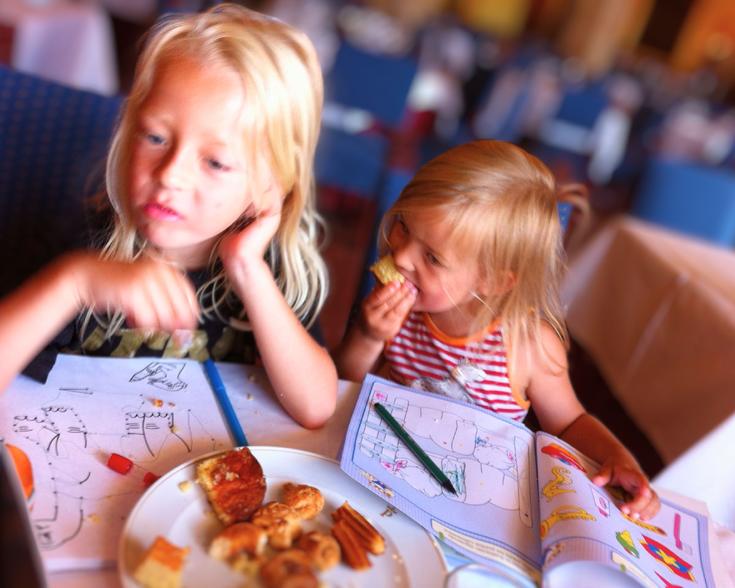
We have just come home from a 90-day trip around Europe, and our children have handled many different situations. Every time something has been new or demanded something special of them, we have talked with them about it beforehand. As far as it was possible. Otherwise, we have stopped and talked with them along the way. We are far from perfect, and we have no prophetic gifts; often things just happen, and suddenly you are in a situation that demands something special of the kids.
If the children understand what is happening, and why there are special social rules in specific situations, they can easily handle them. If they know what it means for everyone in the family to do what needs doing (visit a church, go to a wedding, eat dinner together on a lawn, pack up and go to bed, whatever), they cooperate willingly and fill their role with joy. They really do.
Oh, just relax a bit!
The couch-parent role is a total NOT in our family, and we think we do better than this horror picture. At the same time, our focus on this issue has taught us to relax. When we actually do sit on the couch, or text, or do something else grown-up, we admit that we are not there for our children, that we are not present (with them). It has made us aware that we then have to pay the price for our own absence, in the form of small injuries from falls, fights over puzzles, lost doll shoes (and the crises that come with them) and other trouble. We think it is perfectly fine to be grown-ups and do grown-up things even when the children are at home – but we leave the adult position before we really start interfering in what the children are doing.

The three-stage rocket: getting free of couch parenting
Couch parenting is a tendency all parents know.
Real, dyed-in-the-wool couch parents do exist, and they – like all other parents – do their best.
The problem is that they think they are on the right track. I doubt they will stray onto this website, so they are not my audience.
Everyone else – those who have deep respect for their children, who try to be acknowledging and listening and involved (and probably succeed most of the time), who take part, who are constructive and present – can also 'slip' and parent from the couch (or rather, from absence, and from the know-it-all position).

Here are three good tricks to finish with:
- Let the alarm bells ring if you are repeating yourself. You don't have proper contact if the child doesn't hear what you are saying.
- Put the mobile phone far away, or be honest about it (both with yourself and with your child) if you are really on Facebook/email/text/Wordfeud. And no – you CANNOT do these smartphone things while you build Lego; it is NOT the case that the child doesn't notice.
- Practise acknowledging sentences. Preferably when you can't sleep, or you're riding your bike or something. What could I have said there? This is not being dishonest and technical. It is practising communication, an important life task for all human beings, grown-ups too.
- and juuuust a number 4: Forbidden to forbid. It's a good one to remember.
In closing.
I simply find it very hard to end this article. So now it goes up on the site in its slightly fluttering form. I hope it can be used anyway; I think it can. Because 'perfect is the enemy of good'. This is good, it is important, and it is an eternal practice for us too.
Written by Cecilie Conrad. Translated from Danish. The original article is available at CecilieConrad.dk.









Comments