

Update: The recipe works really well, but I am now vegan and so no longer use gelatine – but that doesn't mean others shouldn't enjoy the recipe 🙂
I have lived for forty years on this planet with thick, chaotic, impossible chestnut-brown hair – apart from a single year when I was bald, and a few years after that when my hair grew back. My hair has always been impressive on the one hand (in quantity) but unruly on the other. I have never, ever had that shiny, smooth, beautiful shampoo-commercial hair that falls beautifully and drapes itself around your body in that sexy way. Instead it has been close to a haystack, tangling really, really badly – and I have been round every possible kind of shampoo, including rhassoul, hair treatments, hair masks, organic solutions and The Works.
Only now have I found out what is wrong with my hair. I have curls. Imagine that.
The change is big enough for anyone to see, and many people have asked what on earth I have done. Since everyone knows I wouldn't dream of going to the hairdresser. So here comes the explanation and the details. Good for both curly and wavy hair, good in general – but of course not as necessary if you actually have neither curls nor waves.

First of all
Drop the hairbrush and the shampoo. That sounds fairly boundary-pushing in itself; at least I was raised to believe that the only right kind of hair was hair a hairbrush glides happily through, and I have spent many sad hours brushing hair. In my last sixteen years as a mom it has mostly been the messy bun at the nape of my neck, which was brushed out every Saturday (20 minutes' work) before the hair was washed with shampoo and conditioner. Back into the bun before the hair was dry.
Well, the new thing is this: Let go of it. As in so many of life's other processes, letting go is the solution. The oils the scalp produces are meant to nourish the hair, and so washing your hair is a matter of rinsing it with warm water while you massage your scalp and in that way release the oils so they can work their way down into the hair. If you like, you can wash your hair in baking soda water: 1 tbsp baking soda dissolved in 1/2 L water, worked into the hair, left for a while and rinsed out.
Either way, I rinse my hair in water with a dash of apple cider vinegar, which replaces conditioner. Most of the time I don't use baking soda, only vinegar.
The hack for the curls is a treatment I put in my hair afterwards. I make it before I get in the shower, so I don't have to fiddle with it with dripping-wet hair, and one batch is enough for two or three washes. But then I do have a LOT of hair. I like washing my hair best in the kitchen sink in a tub – easier to manage, I get more water into the hair and use less water on the project. So when my hair has been rinsed in water with a little vinegar, I add the hair treatment.
It is important not to work against the curls but to allow them to form. So the hair must not be wrung (my preferred way of getting the water out) but rather scrunched. It must not be towel-rubbed or blow-dried either; it should just be wrapped in a towel, unwrapped again and allowed to drip-dry. My hair is very long and very heavy, so I put in a few clips or hairpins to hold it up a little. Otherwise the weight pulls the curls out of the top of the hair. Once it is gathered up a bit like that, it can get a blast with the hairdryer (otherwise it isn't dry until four hours later), but not to dry it, just to warm it through. Gently. Better not to, but then you need plenty of time to have wet hair.
When the hair is dry, it may feel a little stiff, but you just scrunch it a little, which breaks some of the bonds in the proteins of the treatment, and the soft, gentle feeling of clean, lovely curls comes back.
Any kind of comb or hairbrush ruins the curls, but it may well become necessary to comb the hair through now and then. Then do it either with wet hair or just before you wash it, so the curls can find themselves in the water afterwards. I stretch it as long as I can by gently separating the curls when I have time, a little at a time, and after two or three weeks it is tangled enough that I feel I have to brush it. I expect this problem will slowly get smaller. After all, I have only known my curls for a month or so, maybe two.
The treatment for the curls – the recipe
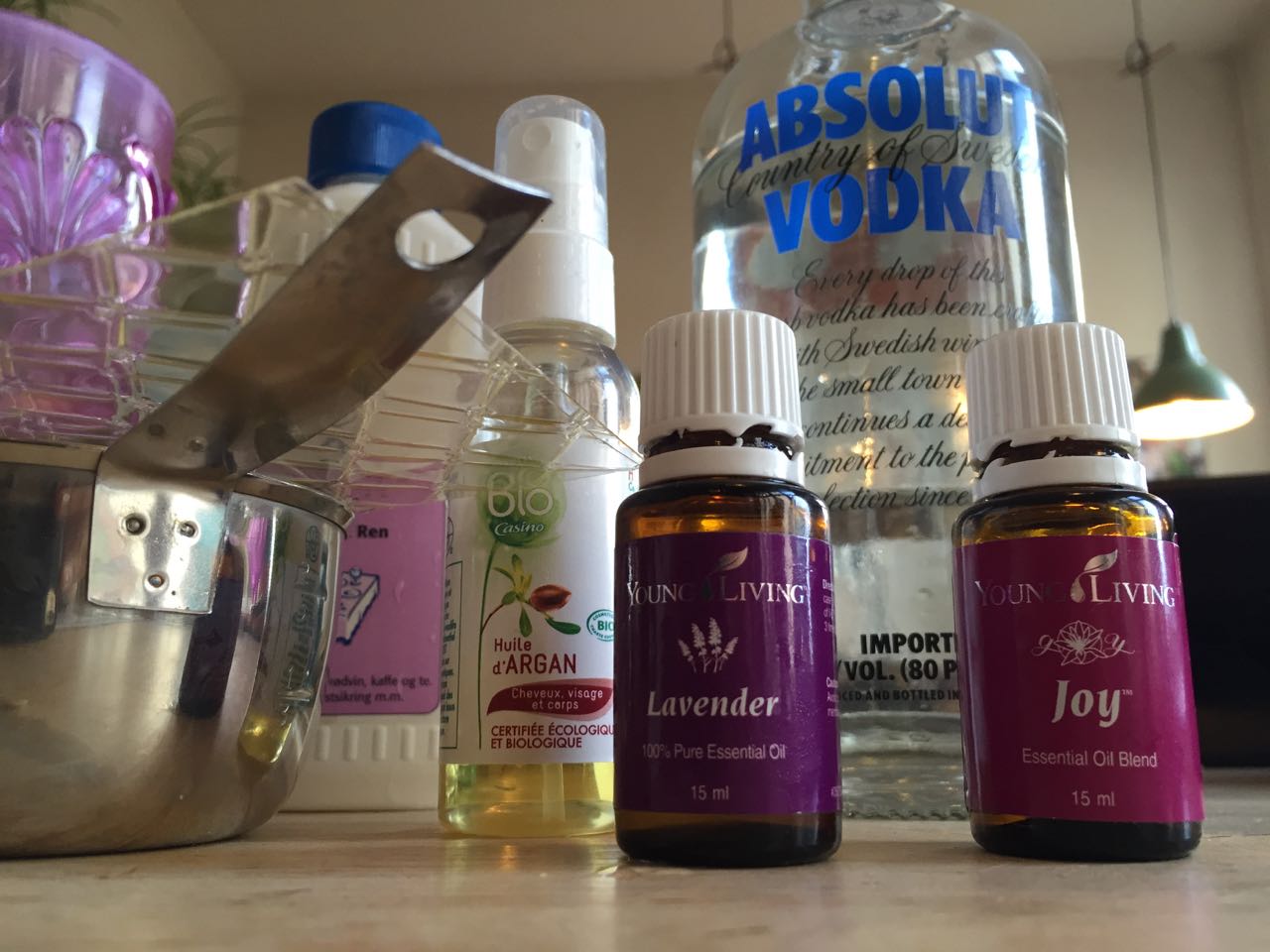
- 2 tbsp vodka (preserves, evaporates quickly)
- 2 dl water, one warm and one cold
- 1 sheet of gelatine, yes, you read that right, gelatine. Soaked in water for five minutes. Gelatine is protein, and your hair probably needs that.
- 10 drops of Young Living essential oil. I love Young Living's high quality, it makes a big difference
- 10 drops of Young Living Joy essential oil blend.
- 1 tsp organic argan oil
- 1 tsp pure vegetable glycerine. Glycerine is good at binding moisture. Your hair definitely needs that too.
How to do it
Dissolve the gelatine in the warm water, then add the cold. Add everything else, mix and use. It can go in a spray bottle, or simply be worked into wet hair. Some will go to waste, but if you use the kitchen sink and a tub, it is manageable. If you keep it in the fridge it gets quite thick, but on the other hand it keeps more safely.
In addition, by the way, I use my own hair wax on the ends, which are exposed, especially when you grow your hair really long. And I take essential fatty acids every morning (2 tbsp Oil of Life with vegetable GLA and evening primrose oil and flaxseed oil), zinc every evening and a whole battery of other supplements, which may well also have an influence on the quality of my hair.
Read more about essential oils, their effects and how to buy Young Living's oils at helendeolier.dk. I really find that they are of much higher quality on many levels, and so they make a real difference. For my wellbeing, for my children, for our quality of sleep, for my health, for our mood, for our meditations, and, well – also for my hair.
Written by Cecilie Conrad. Translated from Danish. The original article is available at CecilieConrad.dk.












Comments