

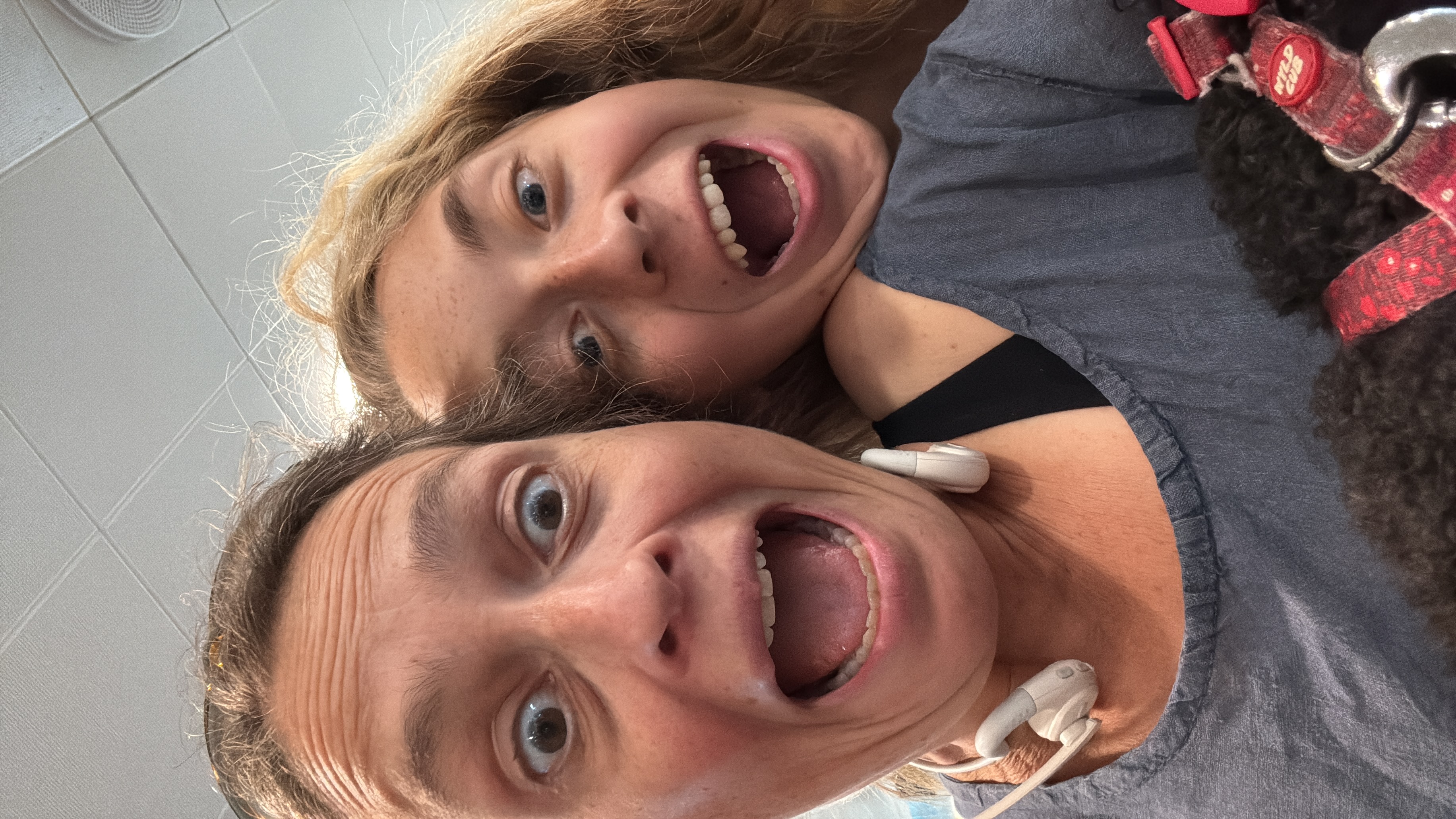
Yesterday I played GTA with my youngest son. The day before, I talked about psychopathy with my eldest. The two things have everything and nothing to do with each other.
When my son asked a couple of days ago if he could buy a new game, I said yes. I usually do. Only the really expensive games are the ones we hold back on a little. Computer games are a playground for our sons, a world to explore, a hobby, play, an education, if you like. When I saw what it was, I smiled and said: Well! GTA after all. Can I try?
Unfortunately, it takes several hours to download computer games, so I did not get to try it. Not right away.
But I did get to try the same joy of anticipation, the impatience. And then yesterday I got to try the game itself – a short story of being incredibly bad at controlling both the camera and the car, getting shot by the police twice and dying in an explosion once. It took half an hour.
In the context of our life with computer games, it was an epic half hour. It was walking the talk. Joining in instead of condemning, taking an interest in what the kids do, being together in life. Not being afraid, but being curious. Ready to have fun.
Once I was really afraid of games, and for four years we did not use computers. Not for social media, films or anything at all. Four easy years, but also four TOO easy years. From that huge distance to computer games to where we are today, I do not think the gap could be much bigger. Today I think computer games are fun, complex, part of life, full of challenges, stories, identifications, experiences, and that for those who have fun with computer games, it is just as it should be.
The conversation about psychopathy with my eldest son started from the philosophy and behavioural biology he is studying at the moment, both by reading Sapolsky and Harari and by reading science fiction by Sanderson. Who are human beings when you peel off the culture? It is a question that has been asked through the centuries in many different ways, a question that maybe does not even make sense in itself.
That is my take, anyway.
There is nothing natural in the human being underneath culture. Culture is not a layer that holds us together. The divide between the natural and the cultural is a construction created by a logic, and actually also by a philosophy – it has nothing to do with how things really fit together. Because there are no human beings without culture. So there is no nature independent of culture, not for humans. Human beings are culture-creating nature. The culture-free natural human does not exist. We are all formed – dannede.
By the way, that is one of my favourite concepts. Dannelse. It does not exist in my other language, English, and I am looking forward to seeing what ChatGPT does with it when it translates this in a moment.
My son and I talked about how it is natural for humans to share culture, natural for parents to pass on social and cultural codes by teaching them to their children, and that the way we conduct ourselves will always be social. Human beings will be concerned with the community, and there is a demand to take care of each other.
That is why the crime genre flourishes, and why the psychopath fascinates – because the first, crime, challenges the social order, the cultural codes, the idea of what is okay, and so gets us thinking about the system and adding nuance to it, while the second, psychopathy, frightens and puzzles us, because it lies so deep in our nature-culture, in what is universally human, to have empathy and care about the community. The psychopath, who does not have those built-in compassionate settings, puzzles us precisely because the rest of us have them. We cannot understand the psychopath, because stealing cars, driving straight into people walking on the sidewalk, causing traffic accidents and shooting at the police (and worse) is so completely foreign to us.
And then there you sit, playing GTA.
Apart from the basic navigation challenge, it was an interesting psychological challenge to experience how the criminal acts in the game were fascinating to work with, and how it was precisely the absence of reality that made it possible to explore a behaviour that would never unfold in real life. Because it will never unfold in real life, because it is foreign, mysterious and incomprehensible. When you play GTA, you play with this clear sense of what is okay and what is not, and you get sharper at being human.
It was fun, and I actually got a tiny bit better at steering. Even though it drives me crazy to control my camera and my car at the same time.
That was today's input. I actually got it written while I was waiting for my kids to be ready to sleep and for my bedroom to go quiet. One is reading a book, another is finishing a chapter in that very same GTA, and a third is asleep in a sweetheart's T-shirt. Tomorrow there is a birthday, and I am picking up my Challenge from 2023 again, to see if I can write a little every day.
There is so much more to say about the journey to playing GTA, about being in the world, about unschooling and gaming. So I guess it is just a matter of getting stuck in. Do send me a thought or two. Where are you all with gaming, adult content, participation, narratives, decisions on the children's behalf? Being a parent is a wild journey. Let us take it together.
Written by Cecilie Conrad. Translated from Danish. The original article is available at CecilieConrad.dk.








Comments