

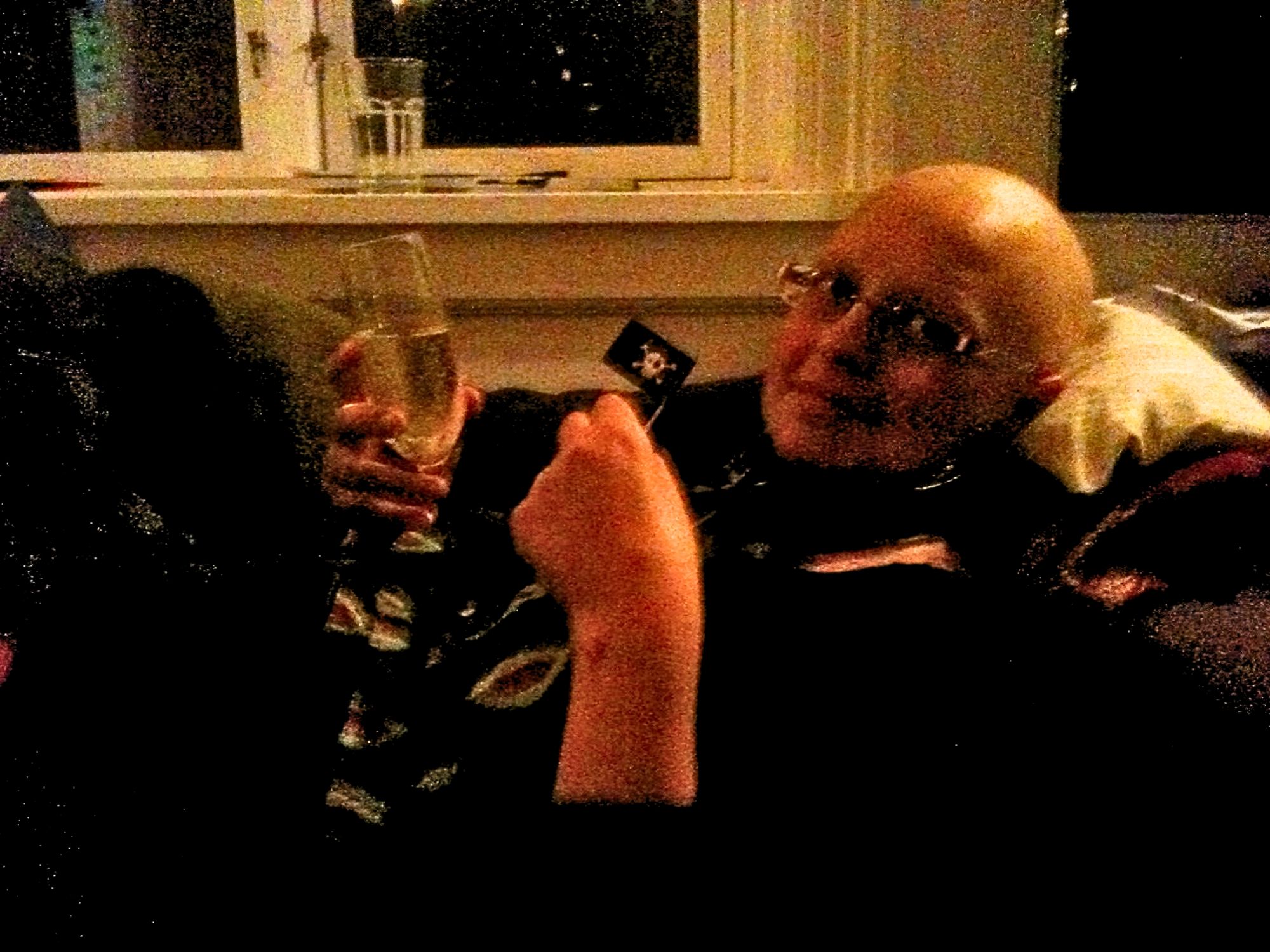
Champagne and a pirate flag on the evening after the last chemo.
The first days after the diagnosis, I was of course in some kind of crisis. Everything that happened stands out very clearly and yet strangely foggy for me. On top of the crisis, I was also, well, very ill. Or really it was the other way round. First and foremost I was very ill, and on top of that I was also in crisis.
One of the really lovely nurses who looked after me took the time for a good talk in the middle of the night and gave me four pieces of advice, four main points to focus on. She said something along these lines:
"Cecilie, there is nothing else to do but fight. I am here every single day, and I can see that the patients who give up, who sink into 'Oh no, I have cancer, it is so terrible, I am going to die' – they actually do die. Very quickly. The ones who stay lying in bed and give up from the start; they simply do not survive.
This is a serious illness you have, and of course I cannot promise you that you will survive it. But if you want to survive, you have to fight. You have to be stronger than you have ever been before, and you have to keep going, and you have to get through all of it. All the time, there are four things you have to do:
1. You must not give up. You have to fight, and you have to believe in it, and you have to keep the flag flying.
2. You have to eat. No matter what, you have to eat. The more you weigh, the better your chances of survival. You have to eat no matter how ill you are, no matter how nauseous you are. You must not lose a single gram.
3. You have to move. The more exercise you get, the better your chances of survival (and so you could see me toiling away on exercise bikes out in the corridor at Rigshospitalet and walking back and forth for hours until I had reached my 10,000 steps).
4. You have to sleep. If you do not sleep, you cannot get through it."
Okay.
In reality, my life in that period was very simple. A lot of people tell me they imagine it was one of the hardest periods of my life, but actually everything was very focused, simple. I am not saying it was easy – but it was certainly a very clear task in life that I had. And I had a simple strategy. It consisted of these four points.
Open your heart, my husband says – and I will try:
You must not give up.
At times this was difficult. But most of the time I had simply decided that I was a survivor. I survive until the opposite is proven was one of my slogans. I am going through the eye of that needle was another. I did not want to know anything about statistics, I just wanted to survive.
When I got the diagnosis, the doctor said: You have cancer, you have cancer in your bone marrow, and it is a disease we can cure. That was his opening line. And thank God for that one. Because right there I decided I wanted to be on the team that survived. He also explained, of course, that there were many variants, some worse than others, and that they did not know mine yet. And that without chemotherapy I would die within a very short time. And a lot of other things, of course. There was a lot of information to take in, really, but I chose this one: it is a disease we can cure. The rest would have to wait.
At times I wanted to give up. I am religious, after all, and when they put in my central line, I asked to be allowed to get off here; said something like: Can't I just be allowed to get off here, die right away and get it over with? It is the only time in my life I have had an actual answer to a prayer in words, crystal clear, with sound and without a doubt. Deep inside my dark of fever and pain and fear, a clear and very convincing voice broke through with a distinct: NO.
Hmmmm. Well. I thought, and thought that then the good Lord would probably also give me the strength along the way. I slowed the pace down to second by second, thought one breath in or one breath out ahead, and got through the long and very unpleasant operation. Afterwards I had a yellow plastic tube hanging out of the right side of my chest, a tube that would be used to fill chemotherapy and blood transfusions into my very weakened body, which would not be able to take all the needles. In other words, a deeply invasive piece of plastic that was going to play a central role in my survival.
Another time I was about to give up mentally. I just could not take any more hospital, no more chemotherapy, no more handfuls of pills morning, noon and night, no more numbers, no more blood transfusions, no more new fellow patients, no more politeness, no more personal ID number, no more hospital food (no more food at all), no more rides on the dusty exercise bike, no more nausea and Coke, no more fighting for sleep and earplugs, no more seeing my children in a hospital, visibly scared and confused, no more shaken relatives and their shocked questions and fear, but above all – first and last – no more chemotherapy.
Luckily my husband saw it and called my good friend, the wonderful priest Susanne Voss, who came and sat and talked with me about children and this and that – and about faith, which can be the light that switches on. And yes, then I fought a little more and found a small, quiet flame inside that could get me back on track. Out of bed. Clean the central line. Shower. Go for a walk. More chemo. In those days I had chemotherapy 9–10 hours a day, plus blood transfusions. I slept with the drip stand tied to my body, took it into the shower. It was there all the time – so much that when, after five days, I was to have less treatment and so got unhooked from it now and then – well, I walked around with it anyway, out of pure habit (and tiredness). Totally idiotic. But also funny. I even took it down in the elevator, for no reason at all!
You have to eat.
I ate. I lost quite a few kilos at the beginning, but got them back in the periods in between, when I was less nauseous. I ate bread; anything that is not hot does not smell as much and goes down. And oats with cold milk, ice-cold milk preferably. Filling and quickly over with. Marie biscuits are also a good trick when things are really bad. It was really difficult, especially during the chemo periods – but when I got a different kind of liquid chemotherapy between the big treatments, I was nauseous pretty much all the time. Coke gave some relief and much-needed calories.
The mucous membranes are thin, often bleeding and very sore, so on top of the nausea you are also fighting pain when it comes to eating, when you are being treated for leukemia. And since I had drunk a whole protein drink and thrown it up again early on, I simply could not get them down. It would otherwise have been smart.
Open your heart. Hmmmm. What can I say? I just fought. Like the other things, this was non-negotiable for me. I just had to eat. Sometimes it took three hours to eat two Marie biscuits, sometimes it went completely fine. I fought as hard as I could not to throw up, not because throwing up is that gross as such, but because then you had to start eating all over again. Which was very motivating.
You have to move.
Here too it was just a matter of getting on with it. I was lucky enough to get into a research program for three weeks, which in itself kept things going and gave me a good focus, even if it was the most deadly boring bend-and-stretch training. On the other hand, these researchers were some fun women, so fair enough. I got in because I was a fighter, I think. They had seen me sitting on that exercise bike day and night.
When you are being treated for leukemia, most of the time you have no immune system. None at all. Not one honest cell to defend you against all the massive attacks our surroundings actually throw at us. Only tons of pills, antibiotics and antifungals by the handful, poured down morning, noon, evening and night, hold the fort – as best they can. Getting a wound is life-threatening, because you cannot heal, and because it is a way in for the bacteria and fungi to the bloodstream. Once they are there, things move fast.
That is why you are not allowed out. You simply stay on the same hospital ward, and if you leave it, you are in principle risking your life. It is hand sanitizer in your bag and a mask over your mouth and nose, rubber gloves and the whole shebang. It is horrible. You should not take the elevator, you must not take the bus, not be indoors, not be anywhere there are a lot of people (which makes it quite hard to leave a hospital in the middle of the bustle of a big city).
So the exercise bike on the ward and the corridor itself are all the options there are. If you dare (and I did), there is also the whole of 'outside'. You can go for a walk, maybe even go for a run (I did not take it that far, though, there have to be limits). Sometimes I walked all the way home from Rigshospitalet – a walk that took an hour and a half. That is the same time as it takes to wait for the public patient transport for people without an immune system (meaning solo rides). The biggest problem was that I could not nip into a toilet on the way. I was not allowed to use public toilets, only the hospital's and my own well-sanitized one – and I could not pop into the bakery either, because that was being somewhere a lot of people go.
And once I had set off on foot, there was nothing to do but reach the finish line, get home.
Going home as often as I could was actually a strategy I came up with myself – a fifth point, so to speak. I found out that the more I could eat in my own kitchen, sleep in my own bed, play with my children in my own house – the more I could be Cecilie and not the patient with the ID number – the easier it was to get through all the hard things that time had to offer. I was 'allowed' to go home because I live so close to the hospital. Gradually I learned to go home without asking for permission. But that is another story.
I trained systematically, 10,000 steps every day, and every other day I did strength training. There was no way around it, and since I wanted so badly to go home in the hours when I was not in treatment or getting blood – I sometimes had to train with my buddy the drip stand in tow. Often, actually. The toughest were the times I did it while the chemo was running in. It took more willpower than you thought you had, I can tell you. But it worked. I actually managed.
The will to live is very strong.

My very last chemo
You have to sleep.
There is really not that much to say here. It is hard to sleep in a hospital, with people you do not know, and while you are in crisis, are ill, feel terrible. But you need to sleep to survive. Earplugs helped a lot. A few rituals around it, a bit of reading and then the words: BODY, SLEEP! And then I actually slept, almost on command. Even though I often had to be woken several times during the night to have my temperature and blood pressure taken. I thought that every minute I could sleep of this meaningless night without husband and children could give me a little more strength to fight to survive the next day. It worked. Quite often I actually got some sleep at night.
Coming home.
I also decided to go home. The first five weeks I was in hospital, and I was also very ill then. I had leukemia, pleurisy, pneumonia and a massive course of chemo to deal with.
In the months the illness had been developing without us knowing, I had become more and more weakened. Headaches, infections, a tiredness as if I had never slept and as if I had to move mountains – just to get out of bed in the morning. One course of penicillin after another, long days with the curtains drawn and a throbbing, pounding dark, dark headache, big handfuls of painkillers.
In that context, the diagnosis and the hospital were like a saving angel, it was like getting hope back: it was serious, and now at least something could be done. The treatment is harsh, and the first round of chemotherapy, which lasted ten days, was tough to get through, because I was also very ill at the same time, as I said. So I did not get out of the hospital. I suppose it also says something about how weak I was that they brought a walker to get me out of bed. That is where I drew the line, though – it would have been hard to push both that and the drip stand at the same time.
But once I had been home for a single night, we made a decision that I should be at home as much as at all possible. The hospital 'allowed' me to go home between all treatments, both when there were (rarely) whole days when I did not have some kind of treatment, and also between treatments that were spread over morning, noon and evening. Then I got early mornings and late afternoons and could maybe squeeze in three hours in my own home. Our whole network was busy driving me back and forth, my brother and my father especially did the heavy lifting here. Of course it was hard for them, but I am sure it played an important part in my survival.
Being at home is liberating. Being at home is being yourself. It is like wearing your own clothes, walking in your own shoes. In the hospital you are a public person, in fact you are hardly a person at all. Even though all the staff are very committed and kind and really, really do their best, there is no peace. Not once did I manage to meditate for 20 minutes without being disturbed, even though I was in hospital for half a year. And that is fine. In that context, the most important thing is absolutely that everyone survives, gets the care they need. I understand that completely. But for me, coming home was a solution. Getting out of the hospital and home.
Many people in our network drove me back and forth, put an incredible number of hours into it, and I am deeply grateful. I am sure it played a decisive role in my survival; it gave me the strength to fight my fight.
What did it come to mean?
The question of what it came to mean is hard to answer. I think maybe I have become quite cynical, harsh, thick-skinned – and at the same time I have become more sensitive, tolerant and ... yes, maybe more nuanced. I have gained a deep humility and a great gratitude, and at the same time a trust that is not self-confidence, but rather confidence in life. I really, truly believe that I – with good support from the Lord and from my network – can get through most difficulties without them becoming too difficult, and I know on a deep level that in every necessary action there is happiness and meaning and a way and a possibility, and that has made my life freer, happier, bigger.
But I HAVE also become cynical. A little. Sometimes I think people should just pull themselves together or stop whining. Yes, sure, it is no fun having a cold, but deep down you know perfectly well you will get better. What luck! What enormous trust in your own body! And that thing about complaining that there is this and that you never get done, never get round to. I think: It must be because you are doing something else, because it is not important enough. I am probably just the wrong person to complain to, at least if the urge is for pure complaining and not for finding ways and possibilities. Life is so precious, so incredibly precious, that I do not want to join the grumbling team, do not want to waste my time on it.
Funnily enough, it is actually quite easy to generalize from these rules of thumb: You have to believe, you have to eat, you have to move, you have to sleep, and you have to be yourself. These are the same five things that are vital whenever any goal has to be reached, in my experience. Exactly the same.
Written by Cecilie Conrad. Translated from Danish. The original article is available at CecilieConrad.dk.






Comments