


My inner pendulum: an article about raising children, ambivalence, growing as an adult, trust in your own values – and about my inner disciplinarian. With practical suggestions for methods, and a hint about the difference between trusting your own values and inflated self-confidence.
Freedom versus frames.
In our life with our children (which we don't call child-rearing), freedom plays a big role. I have written again and again about how much we think about avoiding deciding too much for our children.
At the same time, I believe it matters for children to grow up with clear adults who have faith in their own values and joy in everyday life. That is what other people call boundaries. In our family we would rather call it structure, integrity and everyday life.
I will give examples of all this, but first I have a little introductory point:
When we have tightened up for a while, made frames and rules and introduced new structures and rhythms, there typically comes a peaceful period, followed by a period where we let go. This means that we are never, ever done, never think we have found "the winning formula". Life with children, especially with many children, is very much a process.

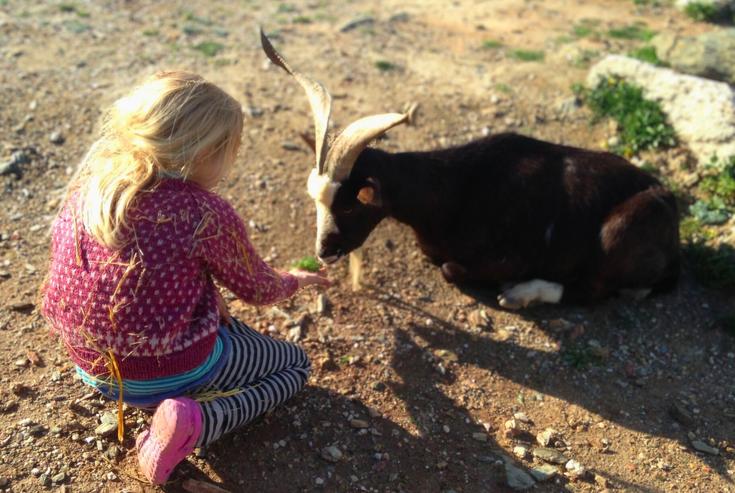
Storm says hello to a goat with big horns
Listening to development
The only thing you can count on with children is that they develop. And that actually requires adults who develop too, and an everyday life and a reality that are always up for discussion, open to change.
Besides, it's central for us to listen to our children – their arguments or feelings, their enthusiasm and protests, discontent and joy. We do our best when we set the frames and establish the rhythms, but if it doesn't work well, or the kids have grown out of it, our decisions are always open for discussion.
The saga of sugar, which you can follow here on the site with a monthly post, is an example of this. And actually also an example of how much context and development matter for the decisions we make.
The four articles in the saga of sugar
- July: Let go of the sugar ban and see what happens – if you dare
- August 1: Collective sugar panic?
- August 2: Are you giving your children sugar disguised as food?
- September: Sugar freedom – now with limits

Storm practising with a drill and taking things apart
Methods: self-confidence and analysis.
We use two "methods" quite systematically to find the balance between freedom and structure. One is that we raise our children with self-confidence. The other is that we think things through. (I know I say I don't raise my children, but it just sounds so affected to write "I guide my children" or "I show my children the way" or "I set the frames for my children". I use the word raise, but I don't work very much with actual upbringing in the classic sense in my everyday life with my family.)
1. Self-confidence.
We believe very much in our values. We have thought a lot, we have felt our way a lot, and we have been through a lot, and all of it has sharpened us in our basic values. As a consequence, I trust my own feelings. If I sense, feel, think or reckon that my children have watched too much TV, eaten too few vegetables, heard too few stories, need some cultural experiences, need to learn to stand on their heads, I believe it before I can argue for it. With the difficult themes – sugar and media use, for example, are difficult for me – I think and discuss with wise people (first and foremost with my husband, of course), I read and think more, and I feel my way forward. With self-confidence.
Under the motto: all parents do their best, and we do well enough. I lean on a fine Einstein quote: "The intuitive mind is a sacred gift, and the rational mind is a faithful servant." Not that I have read Einstein since my long-gone university years. I know this quote from this lovely RSA Animate, which tells something about how the brain works.
This is not the same as an inflated sense of self-worth, or an idea that I am all-knowing and can see through every element of childhood. Nor is it self-confidence in a general sense, because I can certainly be insecure too – but it is a decision to be confident in exactly this area, a decision that our values are well considered, well founded, well researched and thoroughly debated. And quite deeply woven into the choices of our life, big and small. That is why we can set the frames for our children's lives with confidence.
I would like to take this opportunity to stress, though, that I know my values are not the same as everyone else's, and that I find it completely fine that we have different values and therefore different lifestyles. I think it's totally fine, even inspiring and good for society as a whole, that we each sing our own tune. I am grateful for my freedom to be who I am, and glad of other people's freedom to be who they are. In other words, I don't think our way of doing things is universally right. But I am fairly sure it is right for us.

Storm and Silke playing on the car
2. Analysis / thinking things through.
When I find it hard to make everyday life work, or when I keep rumbling around with a feeling that "it's not good enough", or there's a lot of grumbling, trouble and dirt in the corners, I turn the "problem" into a practical problem. I write an overview. For each person in the family, I write a list of everything it takes for everyday life to be lovely on every possible level. It's quite a long list.
Then, as best I can, I weave together a daily and weekly plan, which I discuss with my wise husband, and then we put it into practice over a week or so. Then I know we are doing our best, and that everyone is taken care of in our everyday rhythms. Including the adults, whom I certainly put in my matrix too.
The more children we have had, the more important it has become to make these more systematic considerations, because problems, or development that takes up a lot of space, can easily take over everyday life. Toddler tantrums, for example, or a baby who has just learned to climb up (and keeps falling down), can easily take over the focus for most of the waking hours, so I lose the overview and the ability to vary things, and forget to read rhymes with the six-year-old and play smartphone games with the teenager. Or whatever else it takes.

Storm and Silke cutting carrots
The pendulum swings.
And so the pendulum swings between periods where we tighten up – decide all sorts of things to get a rhythm into everyday life that is good for everyone – and periods where we let go: allow all sorts of things and fly on the lift that a well-founded self-confidence and some good habits give. And that's fine, really. Our life is constantly changing, but I don't feel we are chasing after it; I feel we make conscious decisions based on deeply rooted values, and that the balance between periods where we tighten up and periods where we let go is like a mental breath, or a pulse.
I think, really, that I would be bored to death if I had figured it all out in advance and just had to start at one end of the list and carry on in the same beat from here to the end of my days.
And in this context I had better stress that we feel very sure of what is at the centre of our wishes for our children's upbringing. That goes for growing up as a process of development, and for its "result" in the form of the core skills and values we hope and wish our children will be really strong in when they reach their teenage years. See my article "Parenting was made by the devil".
The examples.
At the beginning, I promised to give examples of all this, but here at the end of the road I think it would simply be too much. The saga of sugar and my thoughts on screen time are good examples, and they are already on the site.
Written by Cecilie Conrad. Translated from Danish. The original article is available at CecilieConrad.dk.









Comments