

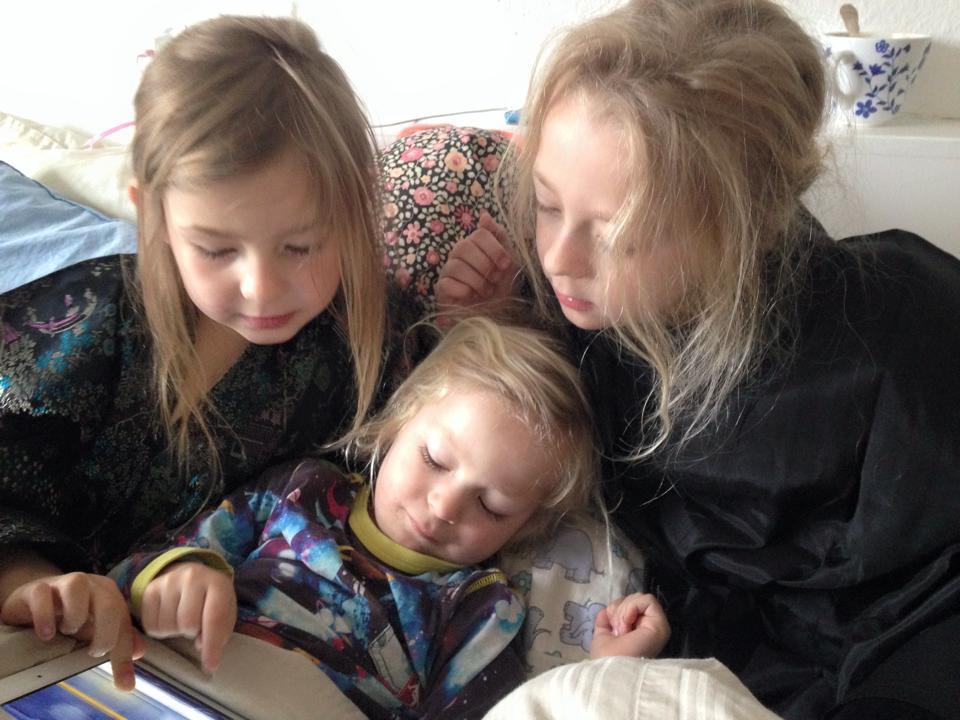
Silke, Storm and Fjord gaming
Take part in your children's lives and trust their choices. Play along, because it's fun, because it's challenging, because you get wiser. Game on.
There are all sorts of reasons to game.
And the fear of gaming is probably completely unfounded, as long as you, as in every other part of life, take a wholehearted stand on the quality of what is being played and find your balance in life as a whole.
I would actually like to write a rebuttal to all the scare articles going around, but maybe it is best if I just write a bit of ammunition for the parents who are needlessly worried. Because there really isn't much reason to be.
My aim with the articles about gaming is to free both children and parents, and to think outside the box about gaming. I am going to speak psychologist language, and educationese, and say some things that are not at the heart of what I actually mean, or that speak a language I find constructed, mechanized, results-oriented. It may help those who are worried, and it may open up some new perspectives.
So I want to stress that none of this is the goal of gaming in our family. It is a reality that lies in and around gaming, which I can point to, but we do not live a mechanized, controlled, results-oriented life.
We don't live for tomorrow, for standardized tests, for the final exams or a career.
We live to sink deep into the now, to be close to each other, to stay in life's starry moments and linger over what makes sense, what is fun, what fills the day, life, presence, togetherness up and out, so it shines. And I am saying this now as a disclaimer, because I want to be COMPLETELY sure there are no misunderstandings.
Many parents are worried about their children's education and development when they play. People write about "social skills", "intelligence", "reading practice", "schooling" in articles that scare parents into controlling their children far too much.

We take part and have fun together
There is even talk of "play competence".
Many – in fact most – articles are about everything the children miss out on, everything they don't do while they play.
Some even speak psychologist language and argue with synapses that don't form in the brain when you play.
So when I now explain why gaming is so fantastic, I do it to lay the fear to rest and free parents and children to enjoy life together.
I'll take on some of the main arguments on the opponent's home turf, and suggest a place to start when you want to learn to let go of control over your children's gaming. Instead of writing The Greatest and The Very Best Ever about gaming.

Eliasson's installation at ARoS, where you create the art yourself. The children take to it playfully.
False argument number one: everything they miss out on
Every time history brings something new, there is a very large group that gets scared.
Once, in better circles, there was a great fear that the Flemming books would corrupt a whole generation of boys.
Today it is a widespread misconception that children should rather play rounders than Minecraft. The first is constructive, the second destructive – according to the misconception.
The fear of the new may be natural, but in a world that is developing technologically faster than ever, we adults also have to realize that this in itself may not be a sign that the world is going to hell.
There were no mobile phones when we were teenagers either, but that actually doesn't mean today's teenagers are destroyed by growing up with a phone in their pocket (or hand).

At an art museum. Freedom to be who you are and see what you see.
In the same way, we have to understand that the games we played as children are not in themselves better or more right than the kind of play that can happen with new technology like tablets and computers.
It is obvious, of course, that any one-sidedness can be unfortunate, and if you game the whole livelong day and half the night, there is probably reason for concern – but then again, there is too if you play rounders from the moment you wake up until you drop, or if you do nothing but tidy up, clean and practise French verbs (although the last one is all of THREE different things).
Life of course needs variety. That's clear. But it is worth remembering that what steals the most of children's time is the adults' need to go to child-free work, and their obsession that all children must go to school. Now even all-day school.
When you live the urbanized life, children don't have much free time. They wake up, have to be steered towards being ready at a certain time, get sent off, and typically come home a few hours before they simply have to sleep.
In the little time that is left, parents often end up trying to curb the children's desire to game, because so much fear has arisen around this particular activity. But maybe sitting on the sofa with a batch of cheese sandwiches and a pot of tea and a tablet or three is exactly what is needed. Who knows?
For my part, I can at least say that I like to hang over my computer and watch a documentary or play or gaze at pictures when I am tired and need a break after a long day.

Being free to game when you want is also being free to write when you want.
But of course it shouldn't sound as if gaming is only something you are "allowed" once you have done your bit and the day is drawing to a close.
My argument is simply that what really steals time from children's free opportunities to unfold is the disciplined life in institutions. Not the few hours they (at most) get to play computer games each day.
And then there is also the fact that playing computer games is definitely a way of unfolding. You mustn't forget that.
False assumption number two: they become lonely, antisocial, bad at getting along in social situations
I get a bit tired of this kind of argument.
Playing computer games is in no way a lonely affair – just try observing a group of children playing.
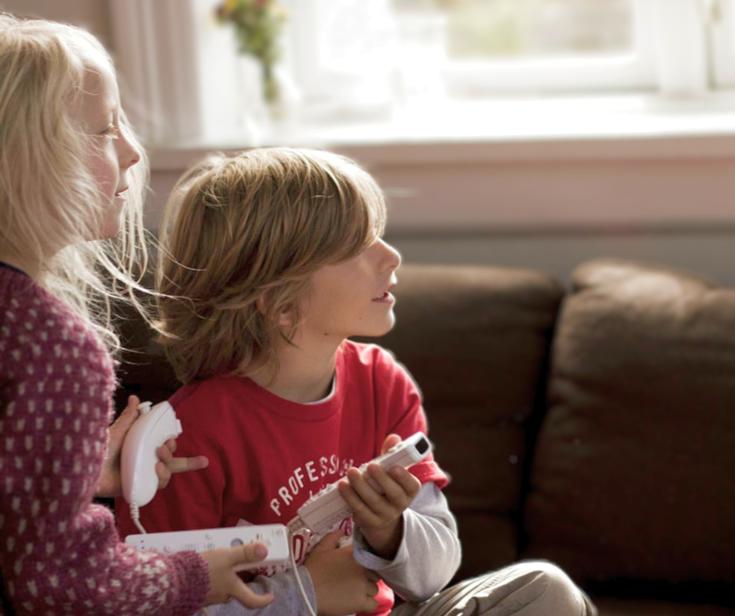
Playing a computer game is something you do together, an experience to share on an equal footing with all sorts of other experiences.
Playing a game together takes cooperation and conversation and goodwill, and something as wonderful as trust in each other. It doesn't matter whether it is a board game or a computer game; the psychology is basically the same. So it is quite simply a misguided argument.
If you have children who sit completely alone playing computer games, they can of course get disconnected from family life and the wider social life, and there can of course easily be a problem.

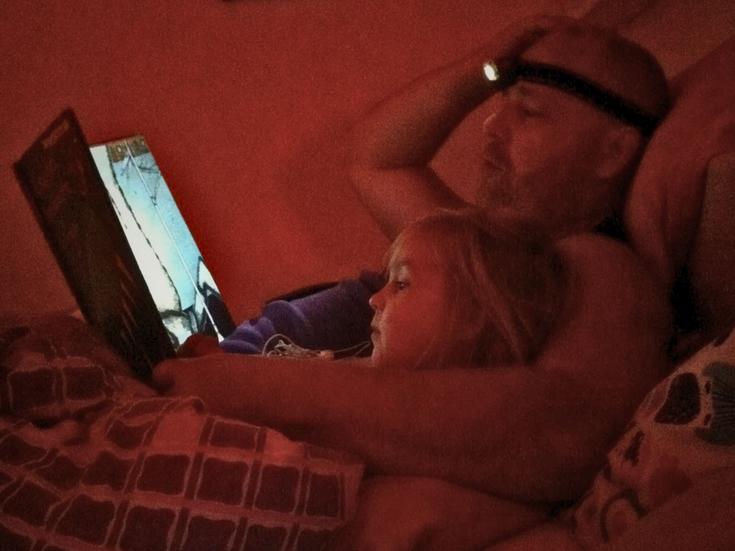
Here we are enjoying the sunset while we game a little. It's nice.
It is important for all people to feel connected, to be part of a community. So whether they shut themselves away behind heavy books, drawings or computer games for hours, it is a parent's job to help children who tend to isolate themselves to find their way into communities, to the extent their personality has room for it. Some people get more joy from, and have more room for, being alone than others. It is not as if very social and outgoing people are better than other people.
You see, the funny thing is that there are always some adults who dismiss the children's activity and say they should be doing something else. That it is too lonely or too zoned-out to play Minecraft or Harry Potter. The funny thing is that those same adults could basically just sit down and join in the game, and then it would no longer be a socially isolated situation. You could call it "showing interest" or "getting involved": in reality it is about taking part in your children's lives.
I think the core is here. I think many adults experience children as absent and unreachable when they play, because the adults can't join in, don't understand what is happening. It is easier to be with the children vacuuming, mowing the lawn or baking a cake, because those are activities we adults know. But if there were to be a little fairness, we could also choose to take part in the children's lives and take an interest in what absorbs them, so that in this way we get to be part of their lives.
This rules out neither cake baking nor even school. It is a very simple focus that can be applied for 12 minutes a day or implemented as a lifestyle.
And by the way, there IS no connection between violent computer games and violent people. Watch this if you were in doubt.
Well – actually, violent games are not what gets played in our home, because none of us like them, but I think the video is a fine illustration of how misguided the discourse around gaming is, and so it is worth watching. Even if you can't be bothered with violent games.
Unfounded claim number three: children get stupid from playing computer games
This argument is so stupid that I feel like giving up when I come across it. It is an expression of great ignorance, because computer games are of course a great many different phenomena, and so you can't generalize from Tetris to the whole range of computer games. And besides, you don't get stupid from Tetris in any way. Tetris clearly trains a particular ability to think geometrically, and in fact my Tetris skills are one of the clearest computer-game-developed abilities I can transfer to my practical adult life. Think suitcases, dishwashers, car trunks, bookshelves. My many hours of Tetris have in no way been wasted!
If there is a grain of truth in the issue – and there often is, of course – I would guess it is connected to large statistical studies showing that the more children play, the less they develop in academic subjects. But the thing is simply that the premise is that all the children go to school, that no account is taken of whether they play alone or with others, whether they are physically together with those others or in online contact, and that only classic academic skills are measured, on scales constructed by people who have never played a computer game in their lives.
It is likely that if adults got a bit more involved in children's lives, and had an eye for the cognitive development that follows in the wake of the games the children play, this worry could be eliminated to a great extent.
It is also likely that the statistical studies show a correlation which simply coincides with the fact that if you both go to school AND play MANY hours a day without adult involvement, well, then there isn't much time left to read the newspaper, have conversations, jump on the trampoline and otherwise have a varied life. But if that is the argument, school is the bigger problem – it swallows far more hours, and in school there is a LOT of wasted time. It is not as if you are being "filled up" all day long at school. Most of it is discipline and waiting.
I believe you develop from by far most games, if not all of them. Quite simply because you develop from challenges, and you can't be bothered to play games that aren't challenging. So if you can be bothered to play them, it is probably because there is something to gain.
If I am to free parents with a quick fix, there are also LOTS of games on the market that satisfy parents' need to be able to say there is "learning" in the games. Basically that is silly, because there is probably just as much to gain from all the other games the children choose to play, but okay. We have to be allowed to exist too, and if the children are going to school, it's also fine to have some shortcuts to some of the demands made there.
Take part in your children's lives and trust their choices. I hope it can set some adults free – free also to let the children play without adults involved – because it's fun, because it's challenging, because you get wiser, happier, more social, gain trust and self-confidence, develop all sorts of imaginable and, for us adults, unimaginable skills from it.
Update 2023. About a year after this article was written, we took a four-year break from gaming – you can read about that choice here (in Danish). And since life is changeable, we now happily game again – now with VR headsets and all sorts.
Comments
Here are some comments from when the article was originally published on my old blog SpeltMor.dk – all my Danish articles are now gathered here on CecilieConrad.dk.
Jytte Høj Hammer: Dear Cecilie! Gosh, this is good! I often lack arguments – and I actually got more here than I expected. Couldn't quite manage to read it all right now, because my head is tired. But I'll come back and finish reading! Thank you!
Camilla Moselund Toft: A headstrong seven-year-old who likes to go on adventures alone in familiar surroundings – yes, of course she has a mobile phone, so she can call for help or assistance when in doubt or in need. A highly sensitive 4-year-old who has a great need to be able to shut the world out – yes, of course he has some apps and games on mom's iPhone. I agree. I just don't think it is beneficial for another mother's 3-year-old who can only eat if he is sitting with the phone playing games. It is that thing about moderation again. Namaste
Cecilia Jarresø: Cecilie Felumb Conrad I can definitely see the benefits of it too. Probably the presence and the quiet most of all :-) But where the text above hits home best is the story about taking part. And for me it doesn't matter whether we make a bonfire or play Disney Infinity. We do something together, and I take part in their interests. And it should probably be added that I have a child who gets "overloaded" in social situations, but not when it happens on her computer, in her room. There she can be free, and doesn't have to look for facial expressions and body language, which she uses enormous resources to decode.
Written by Cecilie Conrad. Translated from Danish. The original article is available at CecilieConrad.dk.










Comments