

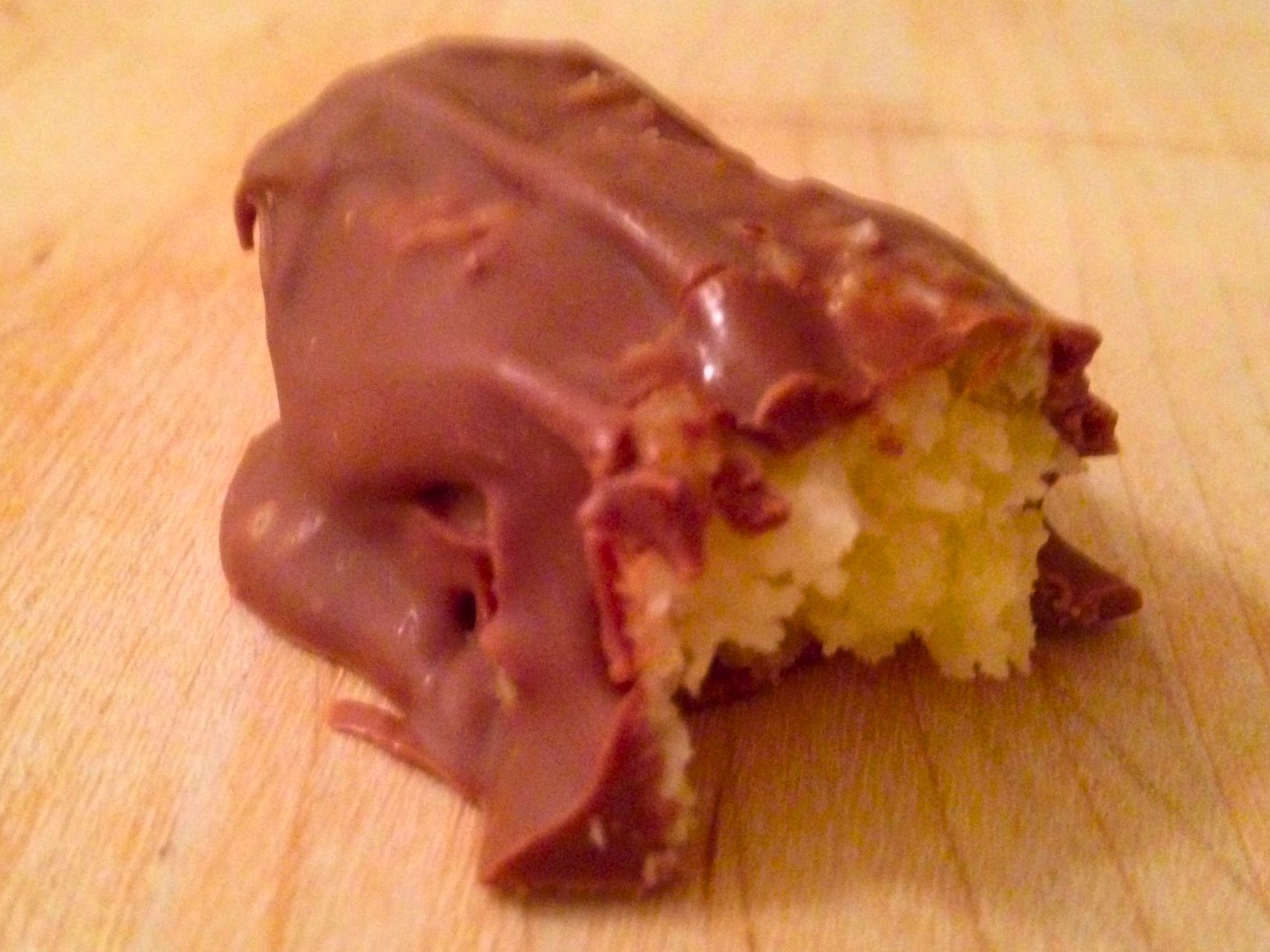
If you'd like to avoid maltodextrin, glucose syrup and dextrose and still want treats, it's worth reading on. Bounty is among our favourites, and one of the big losses of the diet we have to follow to look after our inner balances (by "we" I mean the most HSP-"affected" in the family). In our sensitive family, where every conceivable form of glutamate and glutamate-promoting acids triggers all sorts of problems – well, here homemade Bounty is quite a scoop.

There are lots of recipes out there online; Storm and I started from a YouTube video and guessed our way to the measurements. It was wonderfully cozy and a really down-to-earth school day, where we learned English, chemistry, Latin (the words for measurements), maths and home economics. Nice. But apart from that, you can just get going with making Bounty, without a lot of fuss and lecturing. I just wanted to share the idea of how much you can get out of it – beyond that ultimate healthiness that comes from dropping strange ingredients. Like syrup made from over-processed wheat, and coconut filling with soy lecithin and glycerol (E422), which is basically a by-product of soap production, and simply not something you really want to eat. Or I don't know if "you" do. We get sick from it at home, so we don't need to think it over too carefully. But I have to say, I try to persuade the less sensitive family members to also stay away from these mysterious ingredients, even if they may not be hit as acutely as Storm and I are.

Here are the ingredients in factory-made Bounty: sugar, desiccated coconut 21%, glucose syrup, cocoa butter, skimmed milk powder, cocoa mass, emulsifiers (E 471 soy lecithin), lactose, butterfat, whey powder, humectant (E422), salt, flavouring
Many recipes online use condensed milk, and there are also lots of health freaks who use Sukrin or xylitol. That's a story of its own, but I don't want it in my body.

So our Bounty is made from:
- 100 g organic butter from Naturmælk
- 1.5 dl organic whipping cream
- 1 dl organic cane sugar
- (and you can all smash me if I write organic again)
- 200 g organic desiccated coconut
- plus 100 g organic chocolate; Irma's own brand has no lecithin in the dark versions.

But you have to find a chocolate you like that isn't full of strange things. I had to compromise the first time and buy a milk chocolate from Lindt for the kids' light Bounty. It has lecithin and milk powder, but it's still far higher quality than the factory version. And entirely without those trippy sugar substances, after all. Also entirely without that insanely white, sickly sweet white beet sugar you find in shop-bought sweets. It's just *so* much better with cane sugar; it tastes fan-fu***ing-tastic. We think. But then again, we wash ourselves with baking soda.

Melt the butter in the cream together with the sugar so it dissolves. Add the coconut when it's completely hot, and mix and heat (without it frying) until it comes together. Put it in a square tin lined with baking paper, about 12x20 cm. You can judge for yourself how tall the bars should be. Put the mixture in the fridge for a few hours (at least three) until it has hardened. It's fine to leave it until the next day. Then cut it into bars slightly smaller than the size you want them to end up (there has to be room for chocolate).

Melt 200 g chocolate in the microwave, or however you know how to temper. I can only manage it in the microwave (strangely enough). I give it 25 seconds and stir. Then 10 seconds and stir thoroughly – and repeat until it turns liquid as I stir. It's never completely liquid when it comes out of the microwave – if it is, the chocolate has probably got too hot. Then I stir the chocolate for a minute or two until it has cooled a little – and then I dip the coconut bars in the chocolate so they get properly smothered. There is *nothing* Blomsterberg about my kitchen. It's not a stress project, but something we make because it *tastes* good. If you want it to look perfect, you can practise. I just do it as well as I can and put them on baking paper or a plate and into the fridge to cool. When they're cold and finished, they need wrapping, otherwise they get damp from being in the fridge. That is, if you can get the family to leave any overnight.

Update 2023: Vegan and gluten-free
Life is long and we are constantly developing as people – for many years now we have lived vegan and gluten-free, but we have chosen to leave all our old recipes online so they can bring joy to others – you can't edit your past :)
Written by Cecilie Conrad. Translated from Danish. The original article is available at CecilieConrad.dk.












Comments