

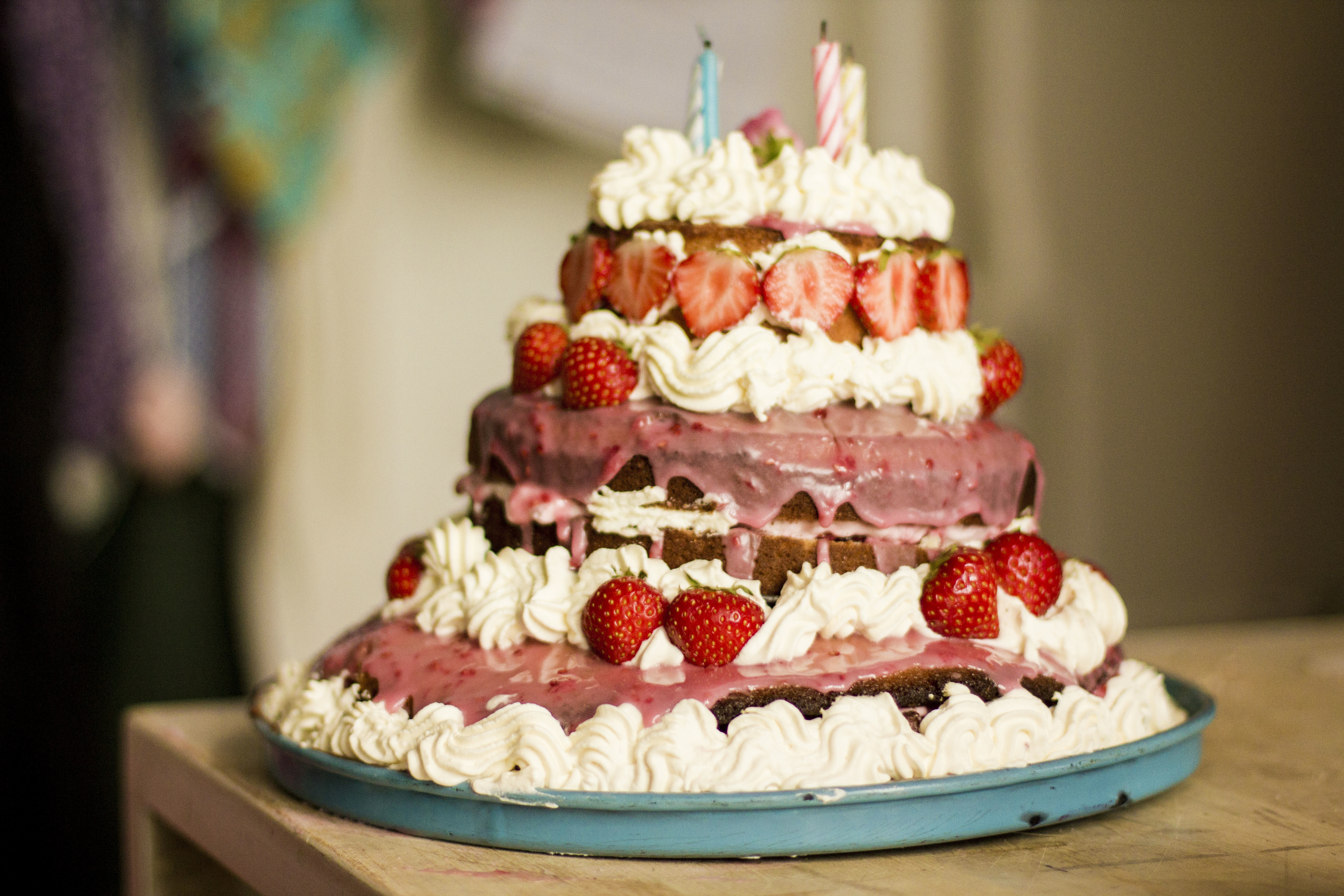
Layer cakes are, like champagne, something we serve to celebrate life's events. They are beautiful, often extravagant, beautifully decorated, and we all love layer cake. Here is a little about layer cakes for everyday and for parties in the Conrad family.
It happens – if I have just given birth or have cancer – that I buy ready-made sponge layers. You can make decent layer cakes from store-bought layers, but it isn't really any fun. It just ISN'T. So layer cakes are made from scratch in my kitchen, and here come all the recipes and tricks. The short version.

Sponge layers. See, the magic of sponge layers is that they have to be light, airy, sweet – and able to soak up some flavour from what you put between them. As with all other whisked batters, you have to give the whisk some welly, so the emulsion of the fat in the egg yolks holds and there is as much air as possible in the batter. The flour has to go through a sieve, and be folded in over two or three rounds, gently, with a big slotted spoon (or some other big thing). I make them without butter. Sometimes I bake three separate layers, sometimes I split one big one. It's a bit of a matter of taste.

A good tip: Learn to bake sponge layers BEFORE you have a birthday to host. Do as we do: celebrate half-birthdays. Hold a birthday for the rain, or the trees in the garden, or the teddy bears – find something to celebrate and bake a quick layer cake (that is, one you are allowed to eat the same day). That way you learn to bake sponge layers and your confidence is in place when the big day arrives and your son or daughter turns three.
Sponge layers, size about 23 cm (the diameter of the springform tin, or the size you spread the batter out to on baking paper)
Whisk 4 eggs with 100–135 g sugar. 100 if you are making a squealingly sweet filling, 150 if you are making a fresher filling (like raw raspberries, for example). Whisk for at least ten minutes at full blast.
140 g wheat flour, or a mix of wheat flour and rice flour, mixed with 1 tsp phosphate-free baking powder (in my world that's Skærtoft Mølle's) and spices if you like. This is sifted and folded into the eggs over three rounds.
Grease the tin with butter and dust it with flour. Pour in the batter and bake for about 20 minutes at 200 degrees (Celsius). Or spread it out in three rounds and bake each of them for about 7 minutes.
And then a little service for families smaller than ours: buy a small springform tin of only 15 cm. You shouldn't miss out on everyday layer cake just because you're an only child! Or a single mom, for that matter. The method is of course the same, the amounts are these: 2 eggs, 50–70 g sugar, 70 g flour. Bake for a little less time.

About the sugar
If you like, you can go further down in the amount of sugar, especially if you use both coconut and vanilla. It just has to be ordinary light cane sugar. A layer cake mainly tastes of the filling.
Variations.
Coconut layers: a little less flour, fold in a decilitre of desiccated coconut with the last round of flour.
Vanilla: always add vanilla, either vanilla seeds divided into sugar and mixed into the flour, or a liquid vanilla thingy (the kind with real vanilla seeds in a sugar syrup of some sort), or real vanilla sugar (not that chemical fake stuff). Unless you don't want vanilla flavour, of course.
Chocolate layers: only 100 g flour, but 40 g cocoa instead.
A spiced variation my kids love: 1 tbsp ground ginger, 1 tbsp ground cinnamon and 6 cardamom seeds (the black bits inside the cardamom pods) crushed in a mortar, and a little crushed citrus zest added to the flour. Yum! Especially combined with strawberry whipped cream, funnily enough.
For 'everyday' I may only split the cake once and put something fruit-based in between, usually crushed berries mixed with whipped cream. For everyday, a layer cake can be nice and done in no time, and we can celebrate something fairly spontaneously.

For parties it gets the full works. I don't like pastry cream, probably mostly because I have never had anything but that powdered product (forgive me, friends, if I have without knowing it). We use crushed fruit mixed with whipped cream; it oozes out everywhere and can't really look like it came from a bakery, but it tastes good and it's fantastic. And then we make chocolate mousse or chocolate cream. The mousse is here as a separate recipe. I make chocolate cream by bringing 1 dl cream to the boil, melting 100 g chocolate in it (off the heat), and letting it cool. When it is completely cold, I mix it with another 1–2 dl cream and whip it thicker. But it is a very grown-up taste that comes out of this. Mousse scores more points with kids.

When the cake is stacked (in the photo I have made three layer cakes in different sizes and put them on top of each other), it's time to decorate. And as Camilla Plum says: "This is where you can really let your bad taste run wild." If you want to. Flags and glitter and little figures and who knows what. Or simpler and more spelt-like: some flowers from the garden, some pink icing (icing with crushed raspberries in it), some pretty berries and a round of whipped cream through a fine piping tip. Abracadabra. Then it's lovely.
Enjoy, layer cake is a party.
Written by Cecilie Conrad. Translated from Danish. The original article is available at CecilieConrad.dk.










Comments