

Here is a string of games of the kind adults can understand children learn something from. Children certainly learn something from all games, but with these games it is easy to argue that they develop the kind of knowledge and thinking adults believe they know children need. In other words, they are some very safe games to start with if you still feel a bit of old fear about whether playing computer games is good or bad. The list follows on from my latest article about gaming.
I want to stress that I don't think you have to "learn something" from playing. I think it is fine to play just because you feel like it, just because it's fun, just because you do it together. But this thing about "learning something" is an argument adults often need to have up their sleeve, both for themselves and to use with worried significant others. So, fair enough.
Three games adults love.
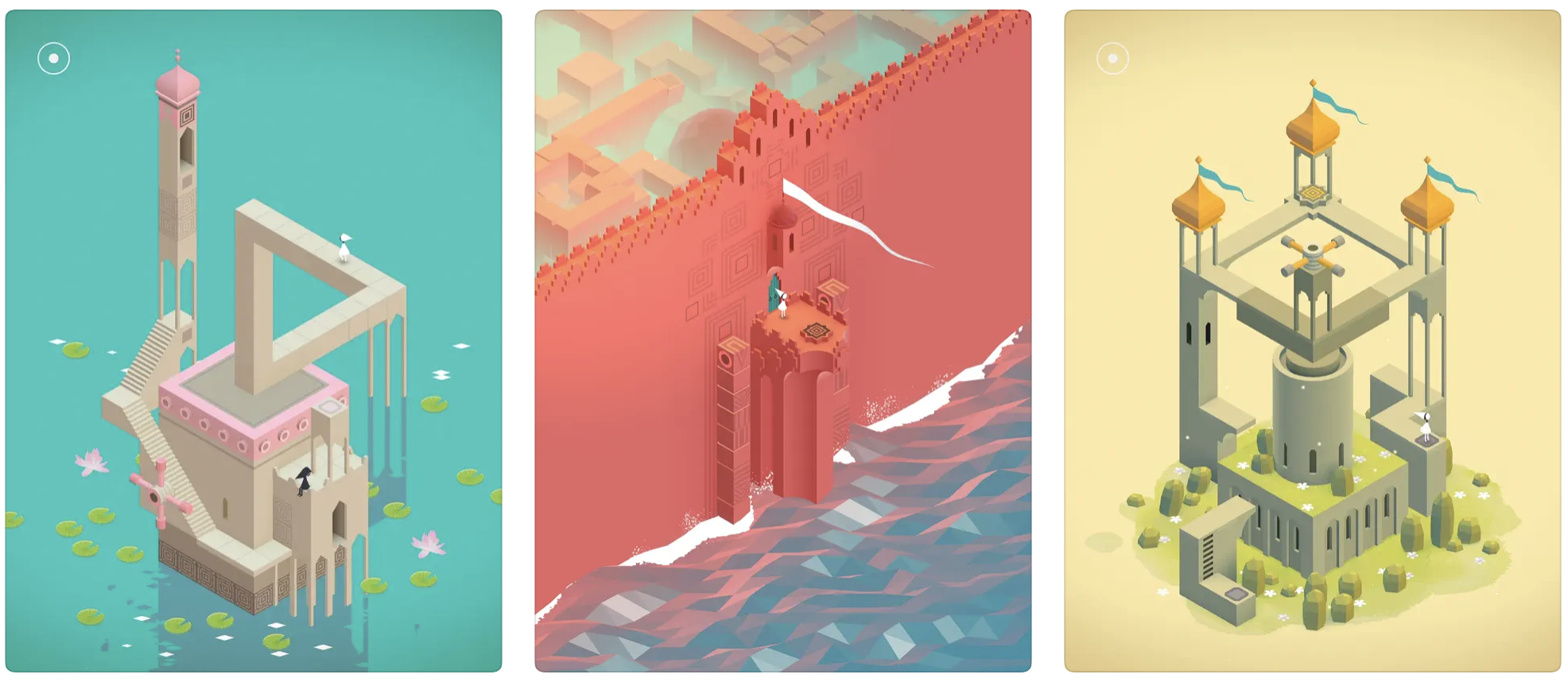
Monument Valley.
This game has won several awards and is recommended everywhere. Now I'm recommending it too. It is simply an enchanting and beautiful, mysterious and fairy-tale-like game. It plays with our logic and spatial understanding in a way that is surprising and wonderful. On the one hand you have to think logically, and on the other you have to find your way in this twisted universe that breaks the laws of both physics and geometry.
And in educationese: when your categories are challenged, you discover how the laws of physics and geometry normally underlie our experience of the world around us, and so it becomes natural to understand them better. That categories and assumptions can be challenged is healthy for the human soul, and there is no doubt that this particular way of challenging them puts the spotlight on mathematics, while it opens us up to thinking in possibilities, seeing beyond our own horizon, thinking outside the box. Always good.
Osmos

Osmos is a surprising and incredibly beautiful game that works with the laws of both biology and physics. The basis is that you merge with (osmosis) other elements in the game in order to grow, and that you move around by shooting mass out behind you (as in that kind of jet physics). The levels are quite varied, which is great fun, and after a relatively short time you move out into astrophysics and start working with gravity too – so that you no longer move around in straight lines based on the force you have shot out behind you, but are also affected by the mass of the surrounding objects.
This game has been a fantastic experience – it still is, actually, since we are nowhere near finished with it (there is a lot of content) – and it has given an intuitive understanding of the things we have been working to understand in physics, biology and astrophysics.
Oh, it is so insanely beautiful, that game. And it feeds an intuitive understanding of both astrophysics and biology. How cool is that?
Kami

Right now Kami is a craze in our home. It is a puzzle game where you have to think logically, see connections, try things out. There is a bit of an IQ test about it, and yet it is lovely.
Kami is quiet and calm and wildly, irritatingly difficult once you get some way into it. Our six-year-old daughter is the best at it. It is amazing what she can figure out! On the other hand, it is yours truly and one of my very best friends who are most absorbed by it.
Find KAMI here
Really good games for the very youngest – maybe from 2 to 5 years.
Montessori - Things that go Together

What Speltmor actually thinks: the game is in English, and all my children – even the youngest, who is three – are keen to learn languages, especially English, which you quickly develop a need for. The colours are beautiful, and although the illustrations are computer-drawn and a little too stylized for our taste, they are detailed, and as I said, the colours are lovely. That means a lot to us. Garish colours and exaggerated plastic illustrations make us switch off. But here it is fine. The tasks are simple and work with connections and categories in true Montessori fashion, and we have a cozy time with them. There is something quiet and simple about the game.
And translated into educationese:
Montessori pedagogy is a well-tested and gentle educational approach that takes the most common developmental stages into account, so the game is not just a categorizing game but is nicely built to stimulate the process the child is going through. There is an intelligent algorithm behind it, so the tasks follow the child's development, which is of course very good. Danish children learn English from it, since it doesn't come in Danish, but it is actually a perfectly good English game, as it mainly says simple words. All the tasks can be solved without understanding English, so you could say the language development is a by-product.
Here is the game in the App Store
Toca Boca Nature

The game is a bit like a sandbox. You build a world with water, forest and mountains, and discover which types of nature attract which types of animals. You sow seeds and study the animals. It is simple, maybe a bit too simple – but on the other hand very beautiful in its colours, clearly drawn so there is no confusion about the realities, and cozy to potter around in. My children have been frustrated, though, that you can't save your world. So you have to delete what you have created in order to try something new. But – you survive that. It is a fine game.
Find it here
Three really good games for slightly older children – around early school age – 5–8 years.
DragonBox

What I actually think is the same as the educationese in this case: we love mathematics in our family, probably mostly because I love mathematics. So a game that plays with logical relationships completely systematically is really lovely. With DragonBox the children start thinking systematically and understanding the balancing in algebra, so equations become obviously easy to understand when they get to the point of solving them with numbers.
DragonBox is a brilliant game, and it has a quirky, crazy graphic side that is really motivating. You have a little creature that grows a bit bigger every time you complete a task. Play DragonBox with your child and discover that you could have loved algebra if there had been iPads when you were a child.
Montessori Geometry

Again: in the Spelt family we are maths nerds, and so we love games that play with mathematics. Here it is geometry for beginners, and this game is detailed and fun. You toss shapes around and get a grip on all the categories, and you think in systems and connections. The graphics are nice, the colours beautiful, and the outcome is clearly pure mathematics – no nonsense: you simply get better at geometry from playing it. It starts at the beginning, so everyone can join in, even the youngest. But it is also fun for the slightly bigger ones – honestly, even yours truly thinks it is quite cozy to fiddle with.
You can find the game here
Lolas Alfabettog (Lola's Alphabet Train)

The only thing that is really wrong with this game is that at the end of a level you don't get to the party that the whole thing was about from the start. Lola drives a train and picks up friends (one for each completed task) because she is going to a party. When you have finished a level, you don't see the party. A short animation here would have given Lola's Alphabet Train a gold star in my book. But it is missing. So now you're prepared.
On the other hand, the game holds up well as one of the many alphabet games; it is simple and it works. You want to play it because there is variety in the tasks, and there is something cozy about it. For us Copenhageners it is funny that the soundtrack has a Jutland accent – quite exotic. But it is also lovely that the game comes in lots of languages, so you can use it to learn the alphabet and a bunch of words in the other languages you are learning (for us it is English and French). All the language versions are included in the price.
We have had the game for a couple of years, and we keep coming back to it. The illustrations are not the very loveliest, but they hold up, and are catchy enough for the game to be worth playing while you are absorbed in letters. And it isn't very expensive either.
So there are no more excuses: Game On, and have a good weekend!
Written by Cecilie Conrad. Translated from Danish. The original article is available at CecilieConrad.dk.










Comments