

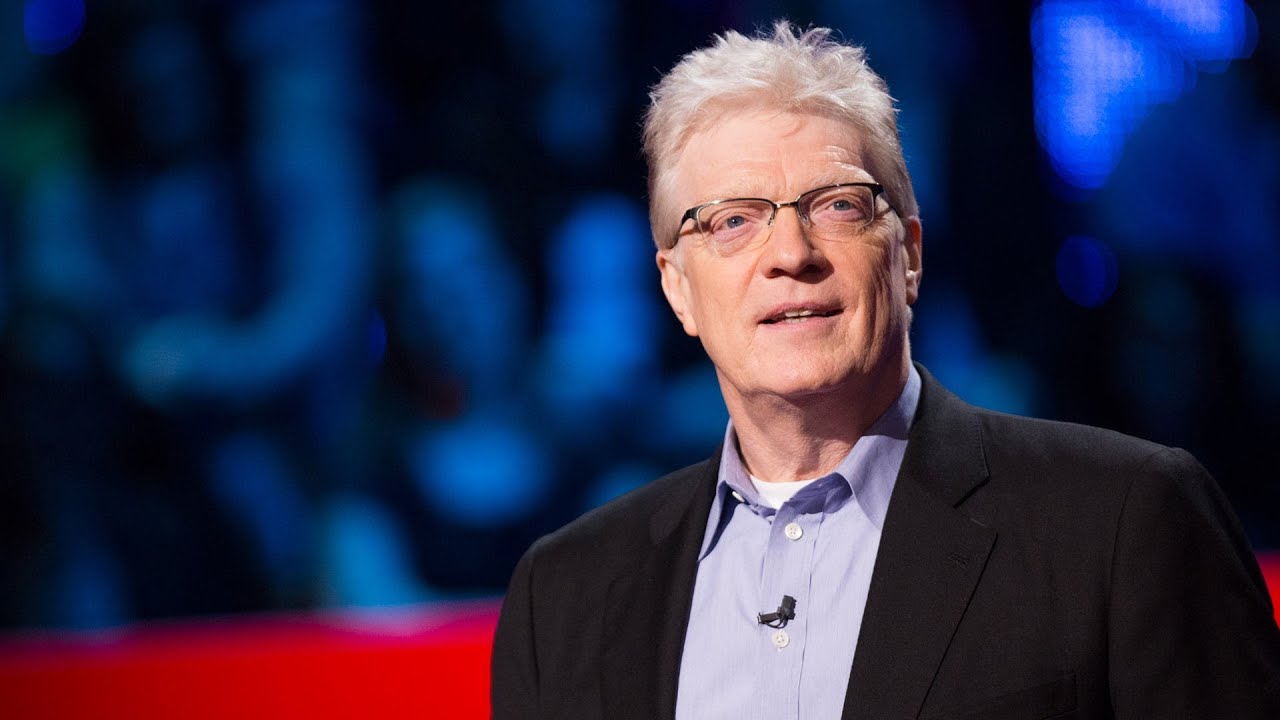
"Most children with ADHD have nothing wrong with them. Nothing, that is, except being children."
– loosely translated, this is one of Robinson's provocative points in this hard-hitting critique of the American school system (in practice, of the school systems of the whole Western world). Luckily he doesn't just point fingers; he also points forward, towards possibilities and development, towards everything that is needed.
Robinson builds his critique on three principles by which human life flourishes – and which are so clearly not represented in the way Western schools are built. Watch the 19 minutes of gripping TED yourself, or settle for my highlights below. I think the man says a lot of things spot-on, although I like the first TED with Robinson better, the one turned into an RSA Animate, where he goes through the whole gene pool of Western schooling and why and how a paradigm shift is needed.
This talk is actually titled: How to escape education's death valley. Or something like that. But I have chosen to focus on the positive: what it takes for people to flourish, for us to live and learn and thrive and unfold.
The three principles by which human life flourishes, and so also by which children develop and learn – in my interpretation.
1. All children are different.
He jokes a lot about how you never, ever mix up your children and wonder who is who, and he says serious words about how insane it is to build a school system and a set of teaching requirements that must be the same for everyone. This point is grist to my mill, one of my most important criticisms of my (psychologist and parent) colleagues' attempts to build a model of childhood. The mistake always seems to be that the model has to apply to all children.
Once we acknowledge that all children are different and have different personalities, needs, potentials, motivations, interests, boundaries, trigger points, exhaustion thresholds, favourite cheese sandwiches and sleep needs (in other words – you name it), there is room to open our eyes and see what is at stake for them, where they are, what they need, and how we can best, most respectfully and most gently help them along the path of this earthly life.
2. People (including children) are curious by nature. "If you can light the spark of curiosity in a child, they will learn without further assistance (very often)."
See, here we have another of my hobby horses. All people, most of all the young ones, the energetic ones, the crazy ones, the creative ones, learn all their lives. Curiosity, interest, motivation drive the whole thing; it is the engine of learning, as Robinson nicely puts it.
When we answer all the many thoughtful questions our children ask, take part in everything that occupies them and engage in their talents – then first of all we get very busy, and become much, much wiser, more skilled and stronger ourselves – but at the same time we come close to them, and get a real human relationship built on respect and shared experiences, rather than the guardian role of upbringing that project parenting (or the teacher role under the national curriculum goals) has built in.
My inner motto is: let go and let the children find their education themselves; all things come to those who wait. A bit like how I didn't train my children to walk either – I just waited and saw what happened – I don't make a curriculum to teach them to read, speak several languages, write stories, solve equations, understand mussels, photosynthesis, Renaissance art, sew trousers, bake bread, ride a bike – well, you get it. There is no bucket list, no curriculum – just life as it is lived: forwards and with joy!
This in no way means that I don't care or that I am indifferent. Of course I have some thoughts about what is good (or necessary) for them, and sometimes I buy relevant equipment (books, bikes, art supplies, computers) with a view to some skill developing. Of course I do. I even push to get somewhere with learning this and that (learning to ride a bike, for example, sometimes takes a lot of adult support), but I don't do it from a ready-made curriculum, and I don't do it on the basis of the child's ID number; I do it when I find it right in the child's life and in our family's life. And if it doesn't catch on, there is no force. This is probably the most important thing.
"Instead of curiosity, we get compliance," says Robinson, and that is exactly what I fear. I wish for my children that they can keep their curiosity, and never give it up in order to obey instead. And I believe it is possible to build a school system that can do this too. It takes a fair bit of rethinking, but I certainly don't think it is necessary to homeschool to achieve this desirable development, this state. Look at the Freinet schools, for example. They can. As long as the parents don't expect them to teach to the national curriculum goals. But that is another matter, of course.
3. People are creative; human life is a creation, an eternal, forward-moving shaping of existence.
That is why human culture is so varied, so much in change, so interesting, so much in motion.
"We all create our lives in this restless process of imagination and alternatives". Education ought to awaken and develop and refine these capacities for creativity, but instead we have standardization. Standardization kills creativity; standardization is hopelessly dumbing when it comes to creativity. We can use standardized tests if they make education easier, improve it, focus it – but instead we have ended up with education that focuses on the results of standardized tests, teaches to standardized curricula, and works with standardized methods. It is – no more, no less – IN-human. Deliver us from it.
We need 'the creative subjects', we need art – because art touches the human soul. But we also need the traditional academic subjects, even the sciences, to be learned, interpreted and taught creatively, impulsively, intuitively, with engagement and heart and curiosity – not by grade levels, systems, ID numbers and standardized tests.
Another fine list Robinson includes in this TED is what you can see built into the school systems that don't have problems with dropouts, and that actually know how to create an environment where children and young people learn something while they are there (for some reason, it is always Finland they bring up as the ideal).
1. Children are seen as individuals, and teaching is therefore individualized
In Denmark, in practice, you only see this at certain independent schools and with a few more or less anarchistic teachers – at the Freinet schools, the very foundation of all teaching is that it is individualized. Everywhere else, I think, the individualization of teaching is being stuffed on top of an extreme uniformity. A school system that works should engage the children's individuality, their creativity and their curiosity.
2. Teaching has high social status.
Everyone agrees that the teacher's job is meaningful, creative, insanely important, an art form. So there is respect around everyone involved in school. Cool.
3. Schools are left to do the job themselves.
There is no state deciding what school should be and how it should be built; the system is not based on control and command. Oh, yes. Yes! Exactly! Learning and education are something that happens in classrooms, in cooperation between teachers and students – or in life as it is lived, in cooperation between people in general. It is not something that can be decided and managed from public administration.
I have to say, with Robinson, that there is surely lots of wonderful learning and education going on in schools here and there, but that it happens in spite of our school system.
Death Valley
Life happens all the time; and when the right conditions come, life will flourish. As Death Valley did the one time it rained there. I think it is a really lovely image Robinson uses here, and I think it translates easily to life as parents at home, too: remember that your children (and you yourself) are organic, living, soulful people who flourish and thrive when they are seen as individuals, keep and cultivate their curiosity, nurture and challenge and unfold their creativity in every area of life – and are not controlled and corrected, measured, weighed and assessed.
"I wanna make a revolution."
A Shubidua hit from the eighties, when I was a child, is now ringing in the back of my head, and I will loyally end this article with the wish for revolution, just as Robinson ends his talk. My manifesto, my wish for revolution, is broader than a school-system revolution, though: I wish for – and I work purposefully towards – a revolution in how we see childhood and parenthood, a release, a setting free, a liberation if you like, for parents and especially, most of all: children – so that we can all get to live as the individual, curious, creative and loving beings we have always been. So we can move from "doing" to "being". That is absolutely crucial.
Phew. A mega-long sentence that was meant, quite simply, to point to a clear focus.
Where to begin?
Well – start with this TED. Watch it. Laugh at it. Then watch the other one, the RSA version with Robinson. Then you have spent half an hour. Then decide on one, just one area of your life with your children where you can let go, create freedom, quiet, room for curiosity and creativity, where before you were – maybe – a bit too controlling and grown-up. Give it a shot for a week or two, and see if it doesn't spread; flourish, grow. I certainly believe it will.
Written by Cecilie Conrad. Translated from Danish. The original article is available at CecilieConrad.dk.





Comments