

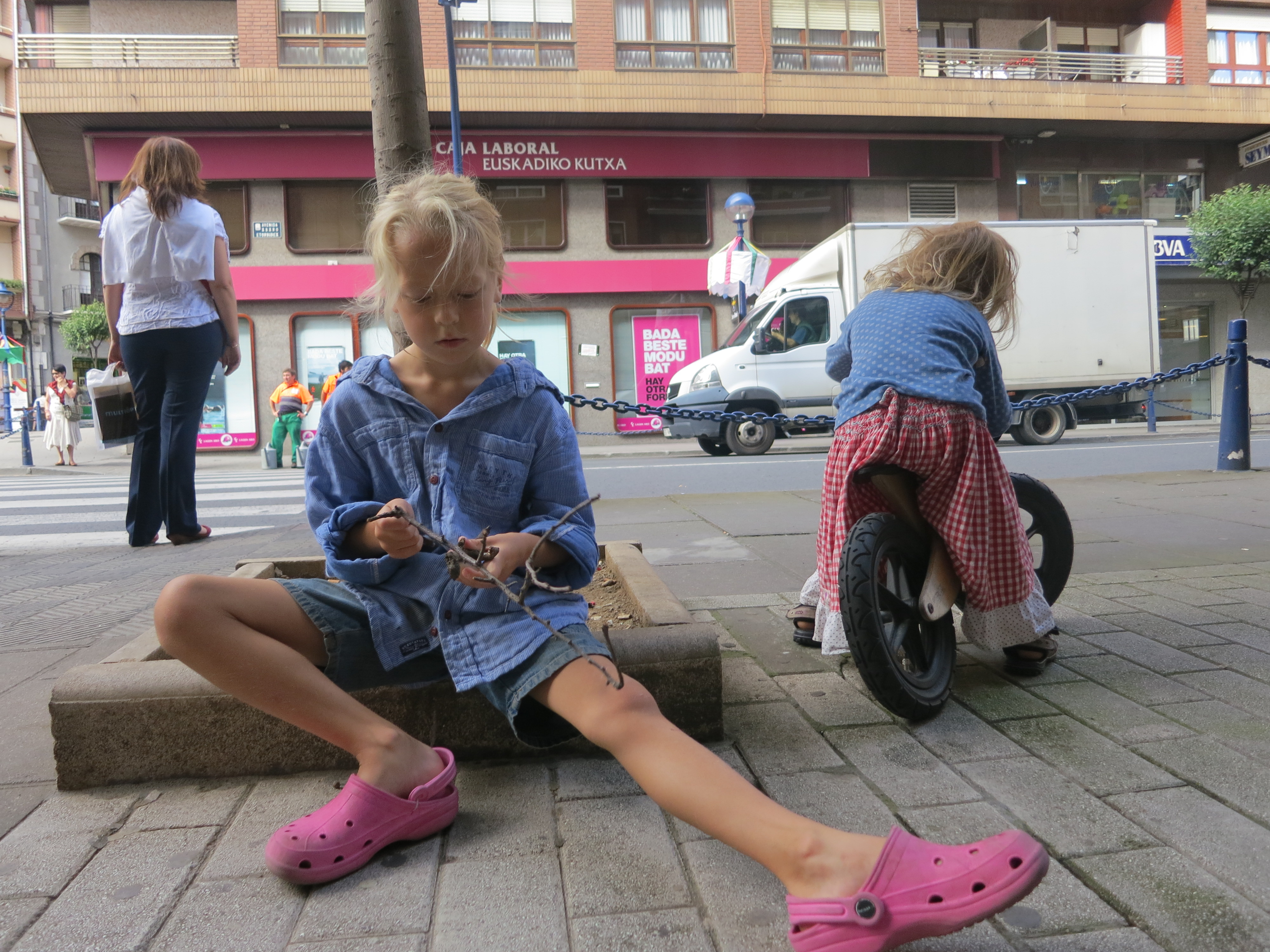
Taking a walk somewhere ugly and having a really good time
In Portugalete they have moving pavements. The Bilbao suburb runs down towards the river, and it is very steep. The streets are pretty narrow, there are parked cars everywhere, and going uphill takes muscle. So those moving pavements come in really handy for a family with small children like us.
Besides, it's fun. It's a toy in the middle of the street. The locals don't quite get it. They just stand there as if it were completely ordinary and didn't feel like being in an airport in the middle of a town. But we were all in; we laughed and fooled around and ran backwards and moonwalked and 'cheated' out on the pavement, and almost took an extra ride all the way down (on foot, they only have toys going up), just because you can.

An ugly city
We should have done that. Instead we took a walk along a main street, in the middle of some Monday-morning bustle of the nasty kind. It was the hard and boring side of city life, in the lame way. Ugliness, bad air, cheap cr*p in the shops, closed stores (there is a crisis in this country, after all), not one honest café, not one lovely bakery, not a single playground – so no reason at all to be there.
There is always a meaning ... And yet. First, we remembered why we are not travelling to the big cities of Europe on this trip. Big cities are basically pretty lame when you travel with lots of small children. Unless you are well prepared and know what you are doing. They are not good for just going for a walk in, just hanging out in. God's free nature is a better recommendation (there you only need to be well prepared with water bottles, food, rubbish bags, nappies and so on – it's a lot easier).

Second, we found a second-hand shop that was having a sale. So for a really minimal price we got clean clothes, since we couldn't find a washing machine. Because public laundromats apparently don't exist in Spain. At least we haven't seen a single one. Only laundry services, where you drop off your clothes, and then hotel service. The latter costs a small fortune, by the way – what are they thinking, charging 5 euros to wash a T-shirt for a mother of 4? It would cost us more to get one set of clothes washed per person than the total price of the room and breakfast. Insane, really.
There is always a meaning
This is a little saying that means a great deal in my life, and there is a little anecdote attached to it.
When I was in hospital with AML (acute myeloid leukemia), my husband asked for all the help and support for me that could be found. So he also asked if I could talk to the hospital chaplain, Christian Busck. Strangely enough, he arrived at exactly the same time as my good friend Susanne Voss, who is a priest too. And Christian said that in his whole career he had never before been one of two priests gathered around one sickbed – before he took his leave, promising to come back.
Before that, we had managed to talk a little about it all. I had said – and it is true – that for me the shock of life's fragility was not that big. My life has always been in God's hands, and it still is. A life-threatening disease had taken over my bone marrow and was sending fake blood around my veins, so that any little bacterium or fungal spore in the wrong place could, in principle, kill me within a few hours. I was insanely miserable, and had actually been so for a long time – but now I knew what was going on. Everyone wanted to talk to me about how shocking it was that I might die, and I had to say, because it was true: 'I know I am going to die. I don't know when it will be my turn, but I know that my life is in God's hands. It always has been, and it is now too. I believe there is a meaning and a connection, and I know I will never understand it. God has a plan, and it is not my job to understand the plan. My job is just to be able to play my part in it.'
And that was when I babbled a bit about meaning, because of course I was in crisis, I won't deny it – and then I babble more than usual. To which Christian answered something wise and much more precise:
"I don't think you can say there is a meaning behind something. If I believed there was a meaning behind everything I see in my work, my cassock would be up for sale. But I believe there can be a meaning in something."
He didn't say any more. He changed the subject to the number of priests at the sickbed, and found something better to spend his time on. So you have to work out the rest yourself.
*If you are interested, you can read more about "the meaning of it all" in my articles (in Danish) about being a cancer survivor!
Written by Cecilie Conrad. Translated from Danish. The original article is available at CecilieConrad.dk.





Comments