

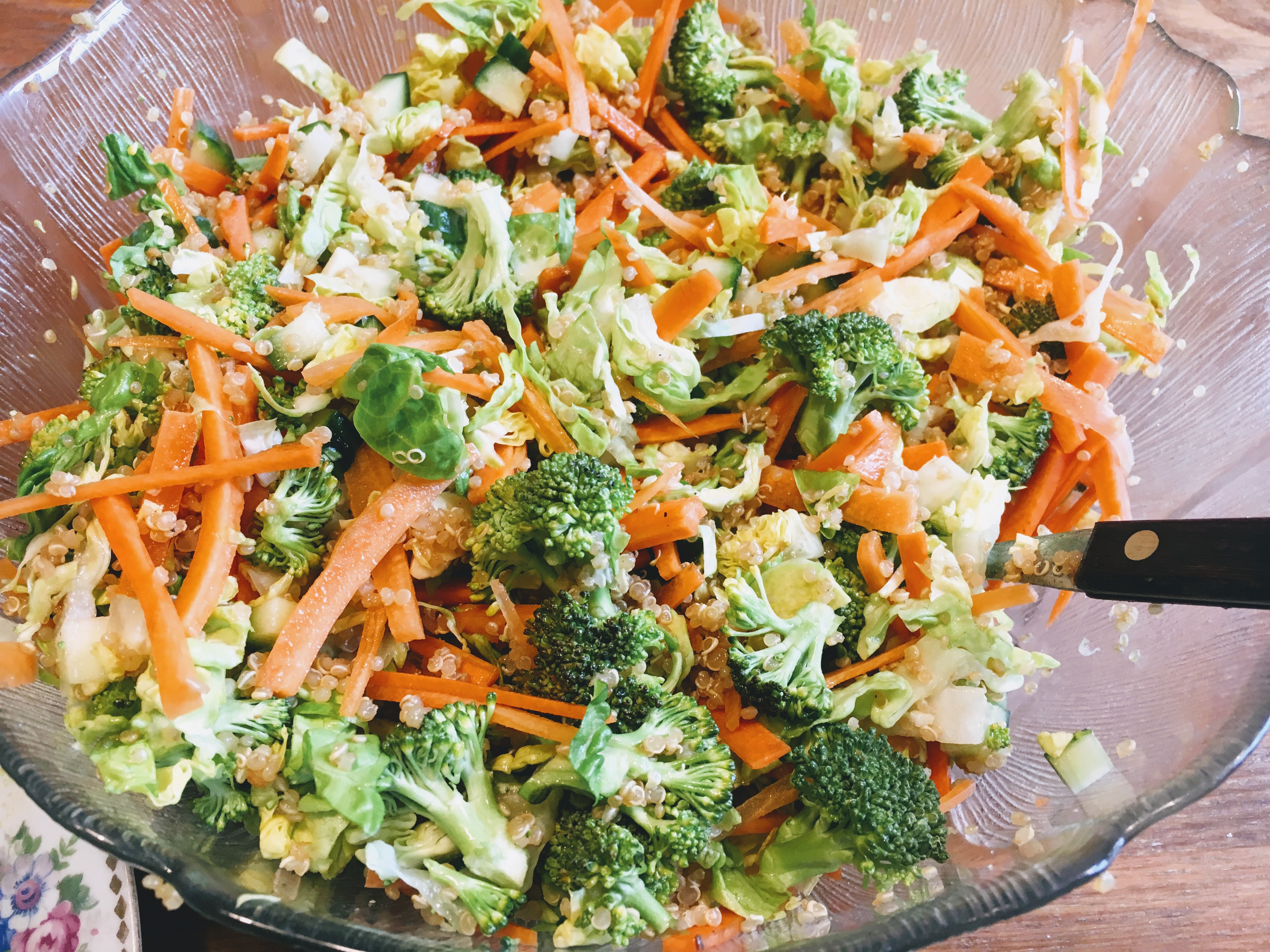
There are three core principles that I think everyone should learn to cook by. Especially salads. Salads as in a bowl/wok of mixed bits and pieces that taste good together and make a full meal. Salads that nourish the soul as well as the body.
I could probably write miles of lines about the ingredients, balances and benefits of salads. About the pleasure of broccoli, raw or steamed, about choosing chillies and lemon zest, about the balance of crisp versus soft, about protein combining. But. For now I think three core principles, combined with the article about protein ("Can you be a vegetarian when you're four?") and the article about listening to what your own body needs ("Can you find your way through the health jungle?"), together give a pretty good starting point.
The recipes on speltmor.dk make sense as inspiration, as reading material – and in reality you can only float freely around building these love salads if you have a good foundation of many ideas in your head. Ideally a pile of experience too. So while you learn to build salads from cravings, with love and in a state of joy and confidence, it's perfectly fine to make salads from recipes. Perfectly fine. Because they are some lovely salads I build after all these many years. And the ones that aren't lovely don't become recipes on the site.
Here come the principles.

Principle number one: Listen to your cravings.
Put into the salad what you feel like. What your body is calling for. Read "Can you find your way through the health jungle?".
Principle number two: Add large amounts of love.
Salads should be built in a good mood, a good spirit, with love. That doesn't mean you have to cuddle your broccoli, but that a bad mood and bad vibes in your kitchen sink into your food and 1. cut you off from your connection to what you/your family need, and so to how the food becomes good in every sense of good, and 2. make the energy field around the food collapse, so it becomes stressful both to make it and to eat it. Find the good mood or eat a cheese sandwich instead.
Read: "Do you have enough time?" – if you want some good arguments for skipping the cooking.
Principle number three: Make it up as you go.
My salads are never planned and shopped for. My salads are built one ingredient at a time. Or maybe they start with three cravings, and I construct them from there. In my world, a good salad mainly contains the following:
a. vegetables; they don't all have to be raw. Some of them should be filling, like cabbage and root vegetables
b. something dressing-like. Sour, salty, hot, fat.
Anything goes. Fat can be: cream, olive oil, eggs, all kinds of fermented milk, even butter, crushed anchovies, oily fish. Sour: lemons, apple cider vinegar, pickled vegetables, pickles, balsamic, kombucha, preserved lemons. Salty: fish sauce, sea salt, soy sauce, salted fish. Hot: chilli is a favourite here, pepper, garlic; raw onions/spring onions/leeks are also in the hot spectrum, and herbs with a kick, like fresh oregano, can also give a salad a punch.
Maybe read "the very, very best salad dressing in the world" to start in a (good) place.
c. protein. (Edamame) beans, fish, lentils, nuts, eggs. And yes, meat. Why not. There are lovely chicken salads, the classic Thai beef salad (which in its classic version badly lacks greens) and lots of versions with bacon. Make sure to buy really good-quality meat; just spend some money here. It's money well spent. Learn to eat the cheaper proteins, so the budget balances anyway.
Yes. That's it. Get going and gain some experience. Or start from some of my salad recipes and find your way from there.
Update 2023: Vegan and gluten-free
Life is long and we are constantly developing as people – for many years now we have lived vegan and gluten-free, but we have chosen to leave all our old recipes online so they can bring joy to others – you can't edit your past :)
Written by Cecilie Conrad. Translated from Danish. The original article is available at CecilieConrad.dk.






Comments