

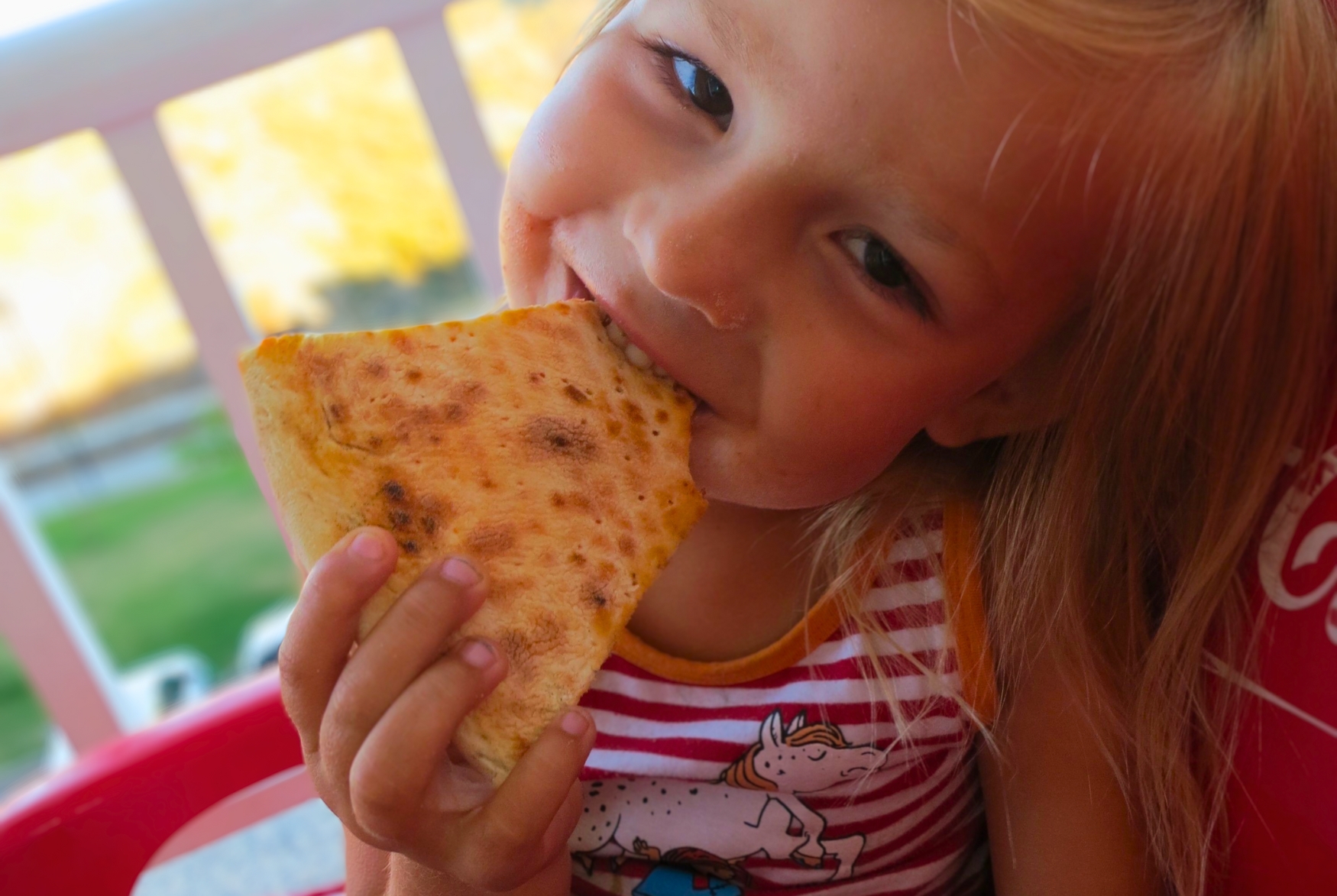
'What do you do with picky children?' a friend asked, just before we left for our 90 days in Europe. 'Give them something they like', my husband answered. But later he said I should write something about it on the blog, because even though it's simple, it is of course also very complicated.
I'll try it as a list, so it doesn't get long, complicated, chatty and rambling. The list is in no particular order. After that comes a short, focused analysis-and-inspiration version of a way to solve it, and finally the very simple, very short version (so do scroll down if you can't be bothered to read a lot).
Each point on the list will, on direct request or when I find the time, be expanded into an article of its own for those who feel the opposite way: those who do want to read a whole pile about how we approach the theme: Children eat. My very wise husband believes that a lot of people would like to read a whole lot.

Fjord has started to eat and drink things other than breast milk
Fourteen good tips, shot from the hip:
1. Give them something they like.
2. Don't give them only desserts
If they get nothing but sugar, they will be malnourished. If there has to be a phase with lots of desserts, you can choose the ones that are food + sugar – cake, ice cream, pancakes, jam, fruit porridge, whipped cream, chocolate milk, biscuits, cookies, milkshake/smoothie. And not chemicals + sugar, which in my book is a no-go and should be strongly limited.
3. If there is something you don't want them to eat (too much of), don't buy it
4. Children between about one and a half and seven are not picky, they are conservative.
They prefer to eat what they know and what they understand. (You probably do too, if you're honest: How many different dinners do you put on the table in a month, and how often do you buy something at the supermarket that you have never bought before, never tasted?)
5. Anorexia
It is an extremely rare illness among children under 9. Give them food, and they will eat.

Storm and Silke drawing over breakfast at a lovely castle hotel in Spain
6. No blame,
No starving children in Africa, no threats, no scolding (of course we can't live up to that ourselves, but we try). A good mood makes a good appetite; love, hunger and salt are the three best spices.
7. The shared meal
The meal around the nicely set table is an attachment ritual that supports your togetherness as a family and gathers you after a day spent working apart. Maybe this isn't when the child actually eats. That's okay. Then there are oats and Barbapapa later (or before).

Our children often sit on our laps to eat, the bigger ones too.
8. There are eating days.
On those days the children eat six or seven times what they usually do, if they are allowed to. There are also the days when they drink two glasses of juice and eat one rice cake.
9. And the general nugget of wisdom:
The best solution to a problem is often to stop seeing it as a problem. (A large part of the world's population grows up on a diet of either cornmeal OR white rice OR yam porridge – and they grow up too.)
10. And another general nugget:
The perfect is the enemy of the good.
11. And then the hope:
Not many 25-year-olds eat nothing but pasta with ketchup and oats with raisins and milk. Pickiness is a passing phase, a time in life – and it is more about the children not having the surplus to let anything new in, in this area. And why should they? What's the rush?
12. Drop the restrictions around food
If you want the children to eat. Let them eat with their fingers. Let them eat cold cuts without bread, bread without toppings, yogurt for lunch, hot food early and late, seven eggs a day, anything at all, as long as it is food, as long as it is sensuous and joyful. Set a beautiful table, beautiful at child height: glitter, pretty plates, napkins, platters, pirate flags, candles. If you can be bothered. Or have a pique-nique on the living room floor on a beautiful scarf. We have made lots of food suns, and porridge portions that looked like figures, 'soldiers' of rye bread, towers – yes, lots of strange arrangements. And we have eaten in every possible place in our house. Not the whole flock in the bathroom, but only because it's so small. Most of the kids have been served food while they were in the bath.

Mmmm – watermelon
13. Maybe teach them to give thanks for the food
In our family we thank God / the universe that we have food. BEFORE we eat. While we don't believe in the old "Finish your plate, the children in Africa are starving", we certainly believe in our children learning to appreciate that they belong to the part of the world's population that can count on getting food every day. They should give thanks for the offer of food, for the fact that it is on the table in front of them. Whether they eat it is up to them. And we don't do it every single time we eat – we do it when there is time and calm and the energy for it.
14. Consider what the problem actually is?
What change in your child is it you are wishing for? And can you imagine that it might come by itself, if you let go and let the child develop quietly, in their own time? Maybe you are asking too much of yourself and your child right now.
And the short version
Why is it a problem? Pickiness is, I suppose, an unwillingness to eat something you don't like, or an unwillingness to eat something you don't know. How often do you do that yourself? Pickiness is often a problem that only exists because parents have some completely unrealistic expectations of the child's ability to adapt around eating, especially compared to the parents' own effort when it comes to teaching the child to eat different things in different situations. Sometimes the problem is really a question of discourse: if the child could just say it in a polite and respectful way, there would be no problem. But have you taken the time to teach your child that?

We try to all stay seated for as long as possible.
So the short version is: Try to reconsider
1. Whether there really is a problem?
2. Whether you have taken the time to solve it?
3. Whether you actually know what the problem is about? (is it about which foods your child eats, or the speed at which they eat them? Is it about how to behave when you are offered food somewhere else, or maybe about how you talk about food? Is it an unwillingness to eat certain foods, and is there perhaps a sensible reason for that?)
4. Who is it, actually, who thinks there is a problem? (my experience is that it's often not the mothers / fathers themselves, but the kindergarten, the mother-in-law, the girlfriends, the public health nurse – yes, even the newspapers, who define that there is a problem)

And if you can't be bothered with the analysis, there is still hope
A. Let go: The only thing you can count on with children is that they develop. It takes really serious neglect and abuse to make children stop developing. So if you let go now and let things be for a month or two (just follow tip no. 1), you can be completely sure that your child will have developed, and that things will therefore have changed.
B. Shift your focus: Drop the idea that the problem is a problem, stop focusing on it, talking about it, trying to change it and solve it. Do something else. Concentrate on something else. Spend your energy on something else, forget it, drop it. Find something more important, more fun, bigger to work on. And I bet you the pickiness stops being a problem. Maybe set a reminder on your phone two or three months ahead, and see if it hasn't changed completely, both for you and in practice, when it goes off.
Written by Cecilie Conrad. Translated from Danish. The original article is available at CecilieConrad.dk.










Comments