

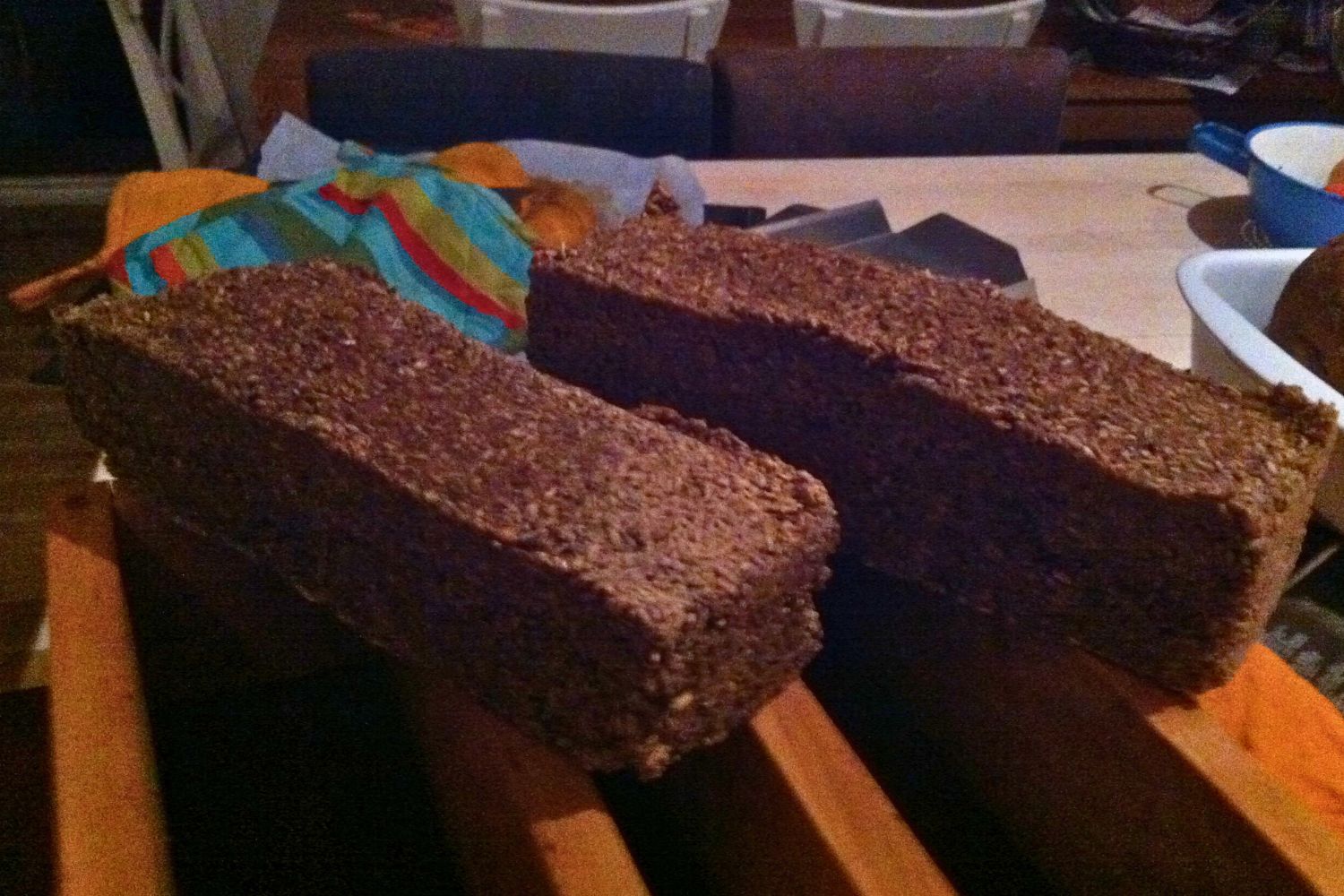
Punker-Nickel (as we call it) is the most awesome rye bread in my repertoire, my kids' top favourite. Pumpernickel is rye bread baked for a very long time at a low temperature. The result is a dense bread, very sweet and usually quite strongly spiced.
Five fantastic arguments for pumpernickel:
EASY TO ABSORB
Pumpernickel is baked for a very long time, which makes the bread easier for the body to break down, and so the nutrients are easier to absorb. So pumpernickel is just fine for slightly sensitive children's tummies. Lovely.
IT'S HEALTHY
Pumpernickel is basically rye bread, and we Northern Europeans are built with rye bread engines. Eating lots of rye bread makes you strong and does you good. I don't need to argue for rye bread, do I? Pumpernickel is just slow-baked rye bread with spices.
IT TASTES INSANELY GOOD
If you like it. But you do. Or you can learn to.
IT'S QUITE FUN
The thing about it baking for a crazy long time, and the smell spreading everywhere. And wrapping it in all that tinfoil, until you buy those tins. It's different from usual, kind of magical. In a way?
THE KIDS LOVE IT
Pumpernickel just tastes better than rye bread, so they put it away in large quantities.
It's a good idea to get one of those old-fashioned rye bread slicers; it makes it easier. That is, once you're hooked like us.

About slow baking.
The bread first rises for 12 hours at 50 degrees (Celsius) in the oven, and is then baked for at least 12 hours at 100 degrees. You wrap it up so it doesn't dry out. First you use a loaf tin with baking paper (over the top as well), and then you wrap and wrap it in tinfoil, so no moisture can escape. Three layers will do.

Once you've been bitten by pumpernickel, and your eco-karma hurts enough over all the aluminium you keep throwing in the bin, you buy a couple of tins from Aurion, wooden tins with lids. Job done. They may well cost a bit. Maybe you can wish for them for Christmas?

Don't take the timing too seriously, by the way. You can easily bake at 50 for 16 hours, or 10, instead of 12, and at 100 degrees for 24 hours instead of 12. Think of 50 degrees as rising time, and 100 degrees as baking time of at least 12 hours, preferably more. Enjoy the smell as it spreads.
It is very hard to cut freshly baked pumpernickel. It has to be completely cold to cut easily. It totally crumbles otherwise. But it tastes fantastic. I was once told that the long baking time at a low temperature makes the sugars in the rye caramelize, and that is what makes the bread so sweet. Anyway, it is something quite special. Quite specially lovely.
When I bake pumpernickel, my recipe doesn't quite fit the two tins I have, so I juuuust bake an extra, slightly smaller loaf in a small tin. They rise a little, so you need to leave some space free in the tins, maybe 25%.
Pumpernickel – and now for the recipe itself.
I have a KitchenAid, and the amounts here are for ONE KitchenAid bowl – I always make two at once, and that fits two Aurion wooden frame tins, and a small cake tin. Not logical. But it works for me.
The basic recipe
- 7.5 dl water
- 1.2 dl sourdough
- 1 tbsp salt
- 1 tbsp honey
- 1 dl flaxseed
- 800 g cracked rye kernels
- 300 g rye flour
- 150 g wholegrain wheat flour

Spice mix – standard:
- 1 tbsp toasted whole coriander. It's important to toast it until it smells fragrant; it doesn't work untoasted
- 1 tsp caraway
- 1 tsp fennel seeds
- 2 whole star anise
- a small handful of citrus peel
- 1 tbsp cocoa

Spice mix for autumn:
- 1 tbsp whole coriander
- 1 tsp caraway
- 2 tsp fennel seeds
- 1 star anise
- 2 tbsp rosehip powder
- a small handful of citrus peel
Spice mix for Christmas:
- 1 tbsp whole coriander
- 1 tsp caraway
- 5 cardamom pods, opened and the seeds crushed
- 2 star anise
- 5 cloves, crushed
- 1 tbsp cinnamon
- 1 tsp allspice
- a small handful of citrus peel
I run the spice mix in a coffee grinder together with a splash of rolled oats, just to get it to go round properly. Some spices do need a little crushing in a mortar first, though, now and then. It's fun to experiment with your own favourites; my lists are just for inspiration.
Just mix the whole lot together in the stand mixer, and put it into well-paper-lined or well-butter-greased tins. You can't entirely count on the flour, so if it is very thick, add a little more water. You have to experiment. Very few people, me last of all, can do everything on the first try. That goes for bread too. You have to make your own experience. And then bake as described above. By the way, it's no disaster to take it out (and wrap it in a couple of towels or a duvet) if you need the oven for something else for a couple of hours. Best after rising, though.
Sourdough is easy enough. Just get a splash from someone you know and feed it (rye flour and water). Or make it yourself: stir rye flour, honey and water into a thin batter, and leave it out for a couple of days. Uncovered the first day, covered after that. When it bubbles, it's a sourdough.
Update: Vegan and gluten-free
Life is long and we are constantly developing as people – for many years now we have lived vegan and gluten-free, but we have chosen to leave all our old recipes online so they can bring joy to others – you can't edit your past :)
Written by Cecilie Conrad.
Translated from Danish. The original article is available at CecilieConrad.dk.












Comments