

🇩🇰 Originally published in Danish — automatically translated
On the 30th of March 2026, we stood in front of a door in Wittenberg in eastern Germany, somewhere between Leipzig and Dresden or thereabouts, and it was raining. Cold, too.
Was it a kind of pilgrimage?
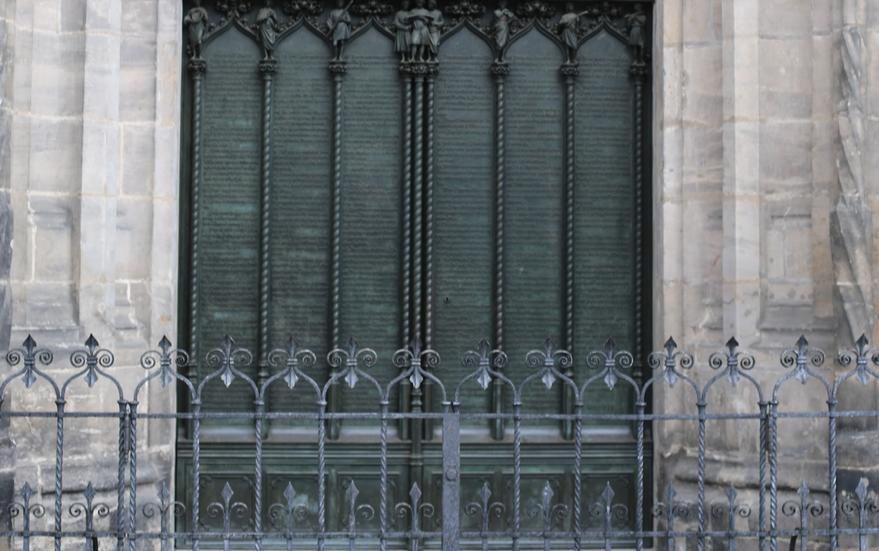
The door in Wittenberg is not the door you travel to see, because it no longer exists. It's a strange thing, what we travel for — what is actually at stake. To stand in Wittenberg and look at the place where, in 1517, there was once a door on which Luther nailed a list of more than ninety ideas for change — that is a particular thing. Even though the door is no longer there. There is a new door now. With the ideas on it. A door you are not allowed to walk through, because today the entrance is through a renovated building that was once perhaps a castle but today looks like something from the 1980s. You look at the copper door. You take a picture.
You walk around the building, through other doors and into the church. Luther's church. You take one more picture — of the statue of him.
But there is more to it.
It is the story. And History.
And it is magnificent.
The Reformation is an upheaval, a shift in European history that has brought us to a place where it may be very difficult to understand what was actually real for people before it. But that is not quite it.
Luther thought something, and did something with it — and there are many things one can disagree with him on, just as there was much he said that fell on fertile ground. But that is not quite it either.
More than anything, what makes that church door, that walk in the rain, that detour on the way to Prague — what makes all of it worth it — is connecting yourself to the Big Picture. I have hiccups as I write this, and they anchor me in something so now-and-here-distracting, something so bodily as an involuntary spasm that comically interrupts — and that, precisely, is what our travels are about.
Standing in front of the door in the rain, stepping inside past the well-renovated and reasonably ordinary church, reading your way through the exhibition about Luther and his time, seeing the original painting made by a contemporary of his — all of it is about being in the world and tying your knowledge to something in the body. I will remember the rain. The 1980s colours in the coats of arms running along the choir in the church. The little info-display telling us that only seventeen people from Denmark had visited this place before us — since they started keeping records five or ten years ago.
This is the thing. This is what is epic.
Epic because to this place we can attach a story about History — a story that, despite its elements of free invention and elements one can only distance oneself from, is also the story of a man who is learned and well-travelled and sees the foolishness, the self-deception, the greed, the injustice, and the sheer absurdity in the way the church wielded power. Particularly the oppressive idea that you could buy your way out of purgatory — and the perversion of those pieces of paper being treated as equivalent to doing good deeds or receiving the sacrament. That is, to behave decently and with love for your neighbour, and to take part in the sacred rituals.
It is the story of a man who turned that insight into a series of proposals. Hey, can we talk about this? A story about standing up for what you actually believe — a story about holding thinking and conversation in high regard. For me it is the story of Luther saying: if you cannot point to where this is supported in our canon, and cannot argue for it coherently, then I will maintain that I am right.
Fair.
A story about running away and going into hiding, because you have been cast out.
Ninety-five proposals for new thinking, for reform — nailed to a church door, ninety-five invitations to conversation, to dialogue, to development — got the man sent into exile. He sat hidden away somewhere, pressing on in secret, translating the Bible into German. Not a small piece of work.
And the rest is history, as they say. Not so important.
We tied our own life story, the experience, to the story of a man who somehow fought for love of neighbour and for justice, and who, despite all his many flaws, only ever wanted to talk things through. And if that is not entirely true, it is still true for us.
"All stories are true; but this one really happened, if that is what you mean" — a main character says in The Name of the Wind — and here is a clear example of a story inspired by History, where the truth-value lies in the interpretation. We take this part of the story with us, and anchored the Reformation into a day of life. A day with rain, with hedge-trimmers in the park, sandwiches in a break in the weather, and many hours of driving.
Because ahead of us lay a month in Prague.
Like that.
Not so much pilgrimage as connection. Grounding. And a choice about which version of the story we take with us — and what we want to do with it.
We will certainly get to know Grundtvig, because standing on Luther's shoulders is our own hero-priest, carrying the same bundle of faults and confusion — yet entirely important, entirely wild, entirely wonderful.
I wonder which day of our life it will be when we finally put down roots in Grundtvig's story? I have been working through the story of his life in the book Frederik by Kløvedal for a very long time now — I stall too easily with that book — and it will clearly not be that day. But perhaps it can point the way?






Comments