

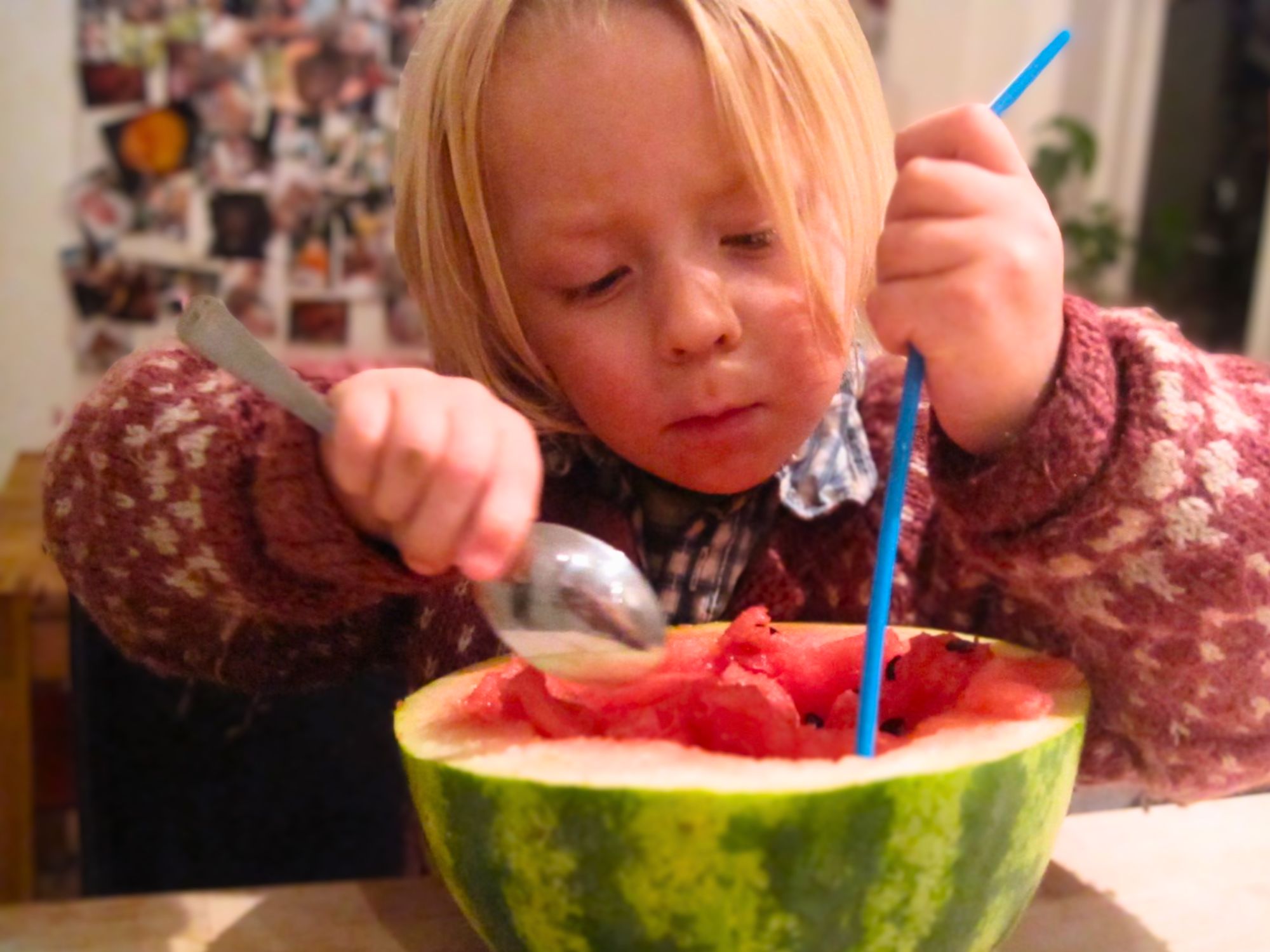
A meta-outburst about how children are categorized and instrumentalized as small machines. For once not particularly constructive – just an outburst, in the hope that it might shift the discourse a little.
A fight against adult power and structural violence, against consequence-based parenting and reward pedagogy, and a cry for help when language drowns me in discourses that keep this endlessly unhealthy view of children in place. All because I happened to watch a bit of TV.
Good night and sleep well
Recently I came across a so-called child expert on the internet who had opinions about children's sleep, and I got downright scared. It has made me want to write something I think is deeply important. It was, of course, a representative of that unpleasant 'method' which says that children must be in bed before eight o'clock, sleep in their own bed, ideally in their own room, and if they don't want to, they must cry themselves to sleep until they learn to stop crying themselves to sleep. And they should get little rewards, and must not be picked up and cuddled, and you must never, never 'give in'. I am on the team that thinks the book "Good Night and Sleep Well" ought to be both burned and banned, and that everyone who has happened to read it ought to be forced through a brainwash in the form of a counter-course in real reality. To put it very sharply.
(I will refrain from linking to said expert statement, since I would rather not point fingers. And I write about both the internet and TV because I read an article online that belonged to a TV programme, which I then fast-forwarded, because I literally could not bear to watch it.)

When are you big enough to be a person?
Of course, it is about the fact that it is sheer, unadulterated madness to treat small people that way. But it is even more about the view of humanity behind such thinking, which is deeply unpleasant. In my eyes, downright dangerous. Because the reality is (I actually dare to believe this), as Dr. Seuss wrote many years ago: "... after all, a person is a person, no matter how small".
The quote became world-famous when Horton was made into a film – and with good reason.
My article could stop here, if it weren't for the fact that the other attitude is so insanely widespread in our society that I think it needs more resistance.
The attitude that turns children into slaves, children into machines, children into problems and projects. I cannot say it nicely, because at its foundation it is very, very ugly. I don't really think there are many (apart from certain professional types who apparently do believe in this mechanical view of children and think that the use of force is fine) who, in the depths of their hearts, mean these things. But there is a sad discourse that makes it real in the advice people give each other, and so in the reality many children end up living.

Language can be dangerous. Watch what you say.
Adults talk a lot about methods and techniques. What technique do you use to get your child to sleep? How do you control their screen time? These are common opening questions in conversations between parents. I meet them often myself, and get asked – respectfully enough, really – because I have many children, many years of experience and a degree in the field of childhood. The problem is that the premise is completely wrong. My children are not machines that I can use techniques on to make them work, and that I have to control. And neither are any other children. So it is not okay for me to use power to act out some principles that live inside my head.
Books are written, TV and radio and websites are made, and thousands of conversations are held about these subjects on this completely, completely insane premise. And this article will, in all humility, try to smash that foundation of the debate about children.
So back to Dr. Seuss: "... a person is a person ..."
In my article about couch parenting, I have already said it: in the language you can hear this disrespect for children, which does not show up in our relationships with any other people. Or sometimes it does, but then we are talking about racism or some other ugliness towards minorities or difference, and that is a little different. And the problems are many. I will take them from the more practical, common-sense angle – because of course you could also come at it from a more philosophical, biological, religious, psychological or educational angle.
1. First of all, 'children' are not a homogeneous group. It is just as wrong to claim that all children are a certain way as it is to think that all redheads or women or Dutch people or people in their fifties are a certain way.
2. Second, children are not machines. It is not our job to adjust them, stuff systems into them, control them.
3. Third, it is rather unappealing (to put it mildly) to manipulate children (and everyone else) to the degree that these discourses encourage.
Here I can quickly scrape phenomena like these off the surface:
Giving children rewards for doing something they really don't want to do / are afraid of / resist. Basically, it is buying their submission – or trying to, because children are smarter than that (all people who can feel their own feelings are smarter than that): they know perfectly well that the system is that they are supposed to do something that goes against them, and then pretend to be happy with the reward, because the reward is meant to symbolize love. Maybe it actually does symbolize love. But that is exactly what has gone off the rails in the whole reward system.
Making children believe that the adult project is the children's need, for example by saying: Now you're a big boy, you're WAY too big for a pacifier, those are only for babies. And in doing so, talking down about children who are younger, making it a value to be bigger (in age) than others, telling the child it does not love something it actually loves, and manipulating a reality into being that does not resonate with the child's experiences and feelings. That last part is probably the worst, although the whole thing is pretty dreadful.

On moving away from negative energy.
Well. I actually have a policy of saying something about what I find good and true instead of criticizing what I find miserable and unlovely. In this case, I have simply found it necessary to (try to) point at the premise I think all parents should distance themselves from.
So again: "... a person is a person ..."
The thing is, these children have been placed in our hands. We are morally, relationally and legally obliged to take care of them, and we do it to the best of our ability and conviction. I have no doubt that all – all – parents do their best, and that most of them do what they do because they truly believe it is for the good.
The difficulty is that we find ourselves in a cultural situation where a very, very large part of the discourse around life with children rests on this instrumentalized premise: that the child is a project to be project-managed by the adults. A machine to be developed and adjusted and controlled in the 'right' direction, and that the parents' success can be measured by this machine's performance – for example the ability to sleep through the night in a bed in a room alone, scores on various tests (at school, say), the amount of vegetables eaten, the speed at which motor and cognitive skills are reached, the age of reading, and so on. In other words, tests of what the child can do, not attention to who the child is.
TV programmes like Supernanny are a very clear symptom of that kind of thinking, and both the thinking and the way of communicating spread like a virus across the Western world. Oh – how on earth do I say this without it turning into aggression? I actually don't think I can. I think I'll shut up now – and say it again:
"... for after all, a person is a person, no matter how small ..."

What I have learned, and what I would recommend:
1. Notice how the language around life with children easily becomes instrumentalizing, mechanical, controlling; how it ends up being about project management, power, control, methods, techniques, strategies. The awareness alone creates the meta-position that lets parents distance themselves from the unhealthy premise and return to respect, freedom and love.
2. Try pushing back a little. I am often asked about sleep, and I have to answer that I don't get my children to sleep. I help them get to bed when they are tired, until they are mature enough to do it themselves. That is something completely different. My four children have very different needs when they are tired, and very different ways of sleeping, because they are different people. The only thing I allow myself to decide is that we, as a family, try to sync our daily rhythms so we sleep at roughly the same time. Otherwise there is too little room for the adults to get enough sleep. It is a practical consideration, needed for the adult energy to stretch far enough – not something we make the children believe is their individual need.
3. Take up the acknowledging, listening position. In every situation, including the ones you think you understand without listening first. Be forgiving and full of love, and move away from negative energy. Power, yelling, scolding, conflict – they leave very ugly echoes and spread through your life in an incredible way. It is about letting go of all that, and trusting that life as a parent is a gift. Not a task. And that all members of the family have equal rights. Though not equal responsibility and overview, of course.
4. Be insistent about what you believe in. It is central to find core values and hold on to them. When you trust who you are, it becomes much easier to keep your focus and to tell, explain, draw other family members towards healthy, strong values such as: respect, exercise, light, presence, love, attention, focus, time in nature ... well. Those are some of mine. But I sincerely think everyone should find their own.
Let me hear what you think?
How about you? Has the instrumentalized parent relationship hit your family? Have you ever been told that everything is ruined if you skip brushing teeth just once? That children must do this and that and the other, or that some manipulative fix works? I get really scared when I see experts of that kind speaking in all seriousness in the mass media. Think of how many people actually believe them. And how many poor children have to cry themselves to sleep, learn to obey, believe that love is little plastic rewards, learn that they are not heard unless they obey (and even then they are not really heard). I hope there is something we can do. Any suggestions?
Written by Cecilie Conrad. Translated from Danish. The original article is available at CecilieConrad.dk.










Comments