

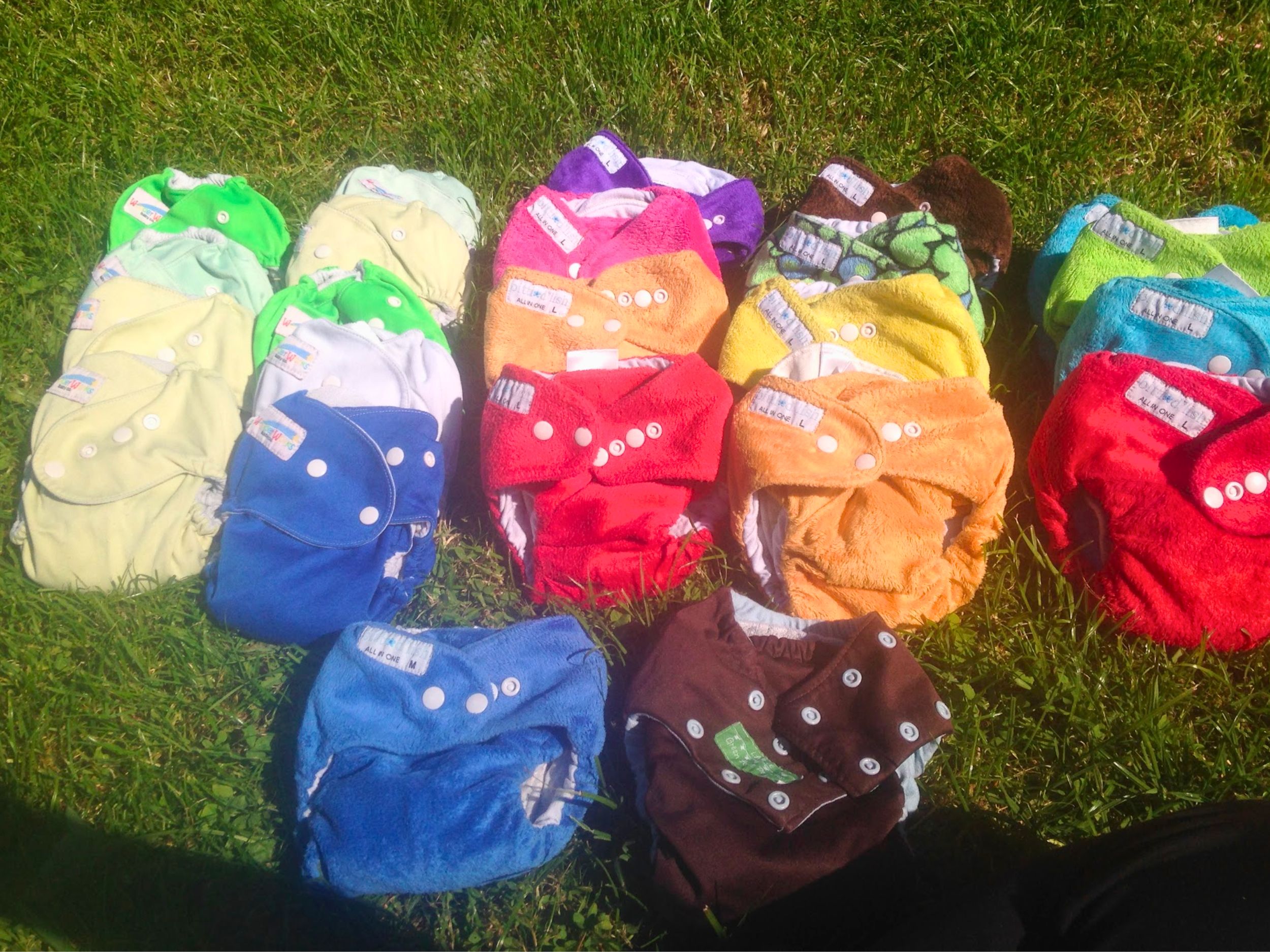
We use cloth diapers for Fjord. The fitted kind, with snaps at the sides. And why is that?
My waste karma and the switch to cloth diapers
First of all, there's the waste karma: when I was expecting number four – suddenly, surprisingly and miraculously – there were three changes I more or less demanded of my husband (not that it was necessary, I have a very sweet husband): I wanted a driver's licence (and preferably a car too), I wanted a coffee machine that could make a good caffè latte at the touch of one button, and I wanted us to use cloth diapers for the baby. I simply COULD NOT have any more disposable diapers in my karma.
The life cycle of a disposable diaper: a heavy burden on the environment
I don't know if I believe in karma. But in my wake, then. Disposable diapers make up almost half the household waste in a family with two children, one of them in diapers. Disposables are made largely from new materials (the so-called organic ones too), from chemicals that are downright dangerous in direct contact with skin, and producing them uses a lot of energy and clean water, while of course creating a lot of pollution, both in the factories and in transport.
Use and throw away – the quick way
Disposable diapers are also part of this attitude we have in the West, that things should just be easy, fast and cheap – at any cost. And the cost is that we are destroying the planet we have to live on, and that our children have to live on; we are destroying the air we have to breathe, we are misusing resources and, really, people too (think of the poor working conditions in the not-so-rich part of the world). There are old computers lying in the rivers of Ghana, and a disposable diaper thrown into nature takes somewhere between 250 and 500 years to 'disappear'; but it is so full of chemicals that it doesn't actually disappear. When you can no longer see it, it has washed down into our groundwater and polluted our soil.
We have learned to clean up our cities, and we have a fine waste system where it all gets collected and burned; but we also live an urban life in which we relate completely unrealistically to the fact that waste is a problem. And the biggest waste problems we create in the West, we happily export to other parts of the world – or else they are 'invisible', like air pollution, water pollution. Things look clean and tidy here, because we have made it look as if we hardly create any waste at all.
This quick fix is strangely paradoxical, because at the same time there's a tendency towards stress, and for lots of people to find everything so difficult. Especially babies in diapers – people talk about that a lot: Phew – ha! We have babies in diapers! is a kind of: 'So you can probably understand that everything is very hard.'
The transformation of the cloth diaper: from clumsy rags to comfort

Cloth diapers have come a long way since we were kids in the seventies and the first disposables really hit the market. Back then you used a square piece of fabric that you folded into a diaper, and then a good lanolized wool cover on the outside to keep it waterproof. It was a hassle, it fit badly, it leaked and it was annoying.
Today a cloth diaper is more often a ready-sewn piece of clothing made from good materials; and it lasts for years. They have developed snap systems that let you use the same diaper for children of all sizes, which you have to try before you believe it.
Cloth diapers can go in the washing machine, and they come in versions with a semi-waterproof layer that makes them just as leakproof as a disposable. They are beautiful, they are soft, and they are much healthier for children's skin.
Is it a hassle?
Well – I suppose you could say using cloth diapers is a hassle. Our experience is the opposite.
Cloth diapers are easier, because:
1. You always have diapers, you never have to remember to buy them, and they don't take up room in the trunk when you shop.
2. Your child learns to tell you extremely early; Fjord started being very clear about when he needed to pee before he was a month old. As a psychologist, it felt like crossing a real line to put him on the potty (think of all the stories about early potty training and later mental illness – surely a myth, but that's another matter). But it was probably MORE of a line crossed for Fjord to pee in his diaper and not be heard.
3. We do laundry anyway; a wet diaper doesn't need a boil wash – it can easily go in with an ordinary load, as long as you don't pack the machine too full (there has to be enough water for it all to rinse properly). So it isn't really an extra laundry problem.
4. There are no gross, smelly poopy diapers in the bin, or by the front door (where lots of people drop them to take out next time they go).
5. You don't go through endless foam wipes and plastic bags. Although at the moment we actually do use those disposable wet wipes to clean Fjord. Not great karma, but nobody is perfect.
6. Children get out of diapers much earlier. So IF you feel it's more of a hassle now, remember that the total amount of hassle goes down considerably.
7. Both you and your child get a completely natural relationship with the toilet and the potty; it isn't something that has to be sneaked in with great delicacy later.
Cloth diapers are better, because:
1. The environment.
Since you are doing laundry anyway, it doesn't make much difference whether there are a few diapers in the machine. I don't think it adds much to our laundry at all. So it's definitely a very big environmental benefit that we use cloth diapers.
2. The allergies.
A lot of people start using cloth diapers because they discover that their children can't tolerate disposables. When some children are sensitive enough to develop an allergy, that's one thing. But nobody actually knows very precisely what those fancy disposables do to our health. They haven't been used for very long, historically speaking, and the new materials they use simply haven't been around long enough to know. Cotton, we know what it is. Nobody gets sick from it. Some people even argue that the chemicals (those little beads) inside the diapers disrupt hormones. Could they be one explanation for why so many people can't have children these days? I have no idea, but I'm not taking the chance any longer.
3. Far less waste.
The urban human's waste karma is pretty sick, even though it is almost invisible to the naked eye (if the eye stays in the city).
The downsides of cloth diapers
The biggest downside is that it costs a fortune to buy a good stack of cloth diapers and get started. You can get cheap cloth diapers from China, but then you don't really know what they are made of. The good organic ones of Western European quality cost between 130 and 250 Danish kroner each. At our house we need about 18 diapers for things to run really smoothly and never run dry (roughly three to four days' worth, I guess). That's more than 2,000 kroner if you buy the cheapest ones. And then you risk that they suddenly don't fit well, and you have to go out and buy new ones. There are lots of models on the market, and it takes time to find your favourite.
There's a good second-hand market for cloth diapers here in Denmark, both on dba.dk and slyngebarn.dk; there you can usually get them for about half price. Otherwise, you can do your own math: 3,000 kroner to avoid bad style when it comes to the environment, to teach your child a natural relationship with the toilet from the start, to never have to remember to buy diapers, and to skip the ongoing daily expense. You can keep adding to the list yourself.
Another obvious downside is that the diapers have to be washed.
If you think that's a problem. I do one or two loads a day no matter what, and wet diapers just go in with the ordinary laundry cycle. You can set up all sorts of systems (we don't); the smartest is probably the one with a fabric bag (an old pillowcase works fine) in a bin. Then you throw the whole bag in the washing machine and don't have to touch old diapers until they're clean again. They find their own way out of the pillowcase while the machine runs.
Actually, I see it as a huge advantage that the diapers can be washed, because that way they become part of a system that is running in the family anyway. So the fact that they can be washed means I save a step: I don't have to buy them, haul them home and carry them into the house. Super smart.
Fjord's potty training: a surprising bonus of cloth diapers

For us, the big surprise was that Fjord told us right from the start. Fjord is our fourth baby, so we hadn't expected such a big surprise about baby life. But with the cloth diapers on, and our attention on his baby language, it was no problem at all for us to hear it when he told us he needed to pee. Since he was about a month old, we have been able to save about half the diapers. He uses the garden, the toilet and the potty. Only now, at seven months, when he has learned to crawl, has it become a bit of a dribbly business again; everything is so exciting that he can't quite concentrate on remembering to tell us. But if he's on someone's arm, in the high chair or in the stroller, he tells us. He doesn't pee while he sleeps – although at night I often lull him back to sleep so that he pees in his diaper (but that's only because I can't be bothered to get up; he wakes up to pee absolutely consistently).
When we feel fairly sure he doesn't need to poop, we sometimes skip the diaper itself, if there aren't many left in the drawer. Whether you wash a diaper or a pair of wet pants hardly matters.
A good trick is to put your child on the potty every time they wake up from a nap. Everyone needs to pee when they wake up. Babies too. Potty or toilet or garden; whatever works. Say the word 'pee' while they go; Fjord is seven months old and can say: "pee", "hi Dad" (ej baa), "Dad" (baaa) and "Silke" (his big sister's name) – and maybe also "food" (mam-mam-mam-mam! very insistent when he's hungry).
How to get started with cloth diapers: my personal advice
I would so love to have a cloth diaper rental system, but I think it takes a lot of logistics. Instead I recommend buying 5–6 diapers and trying them out. Itti Bitti D'lish or Tutto, or Swaddlebees, are the best, I think. It's a matter of taste, of course.
If you just swap out half the disposables that way, you have halved the whole problem. The waste karma, the strain on the environment, the impact on your child. At the same time you start encouraging your child to notice when they pee, and to remember to tell you. It's a really lovely thing to do.
Written by Cecilie Conrad. Translated from Danish. The original article is available at CecilieConrad.dk.









Comments