

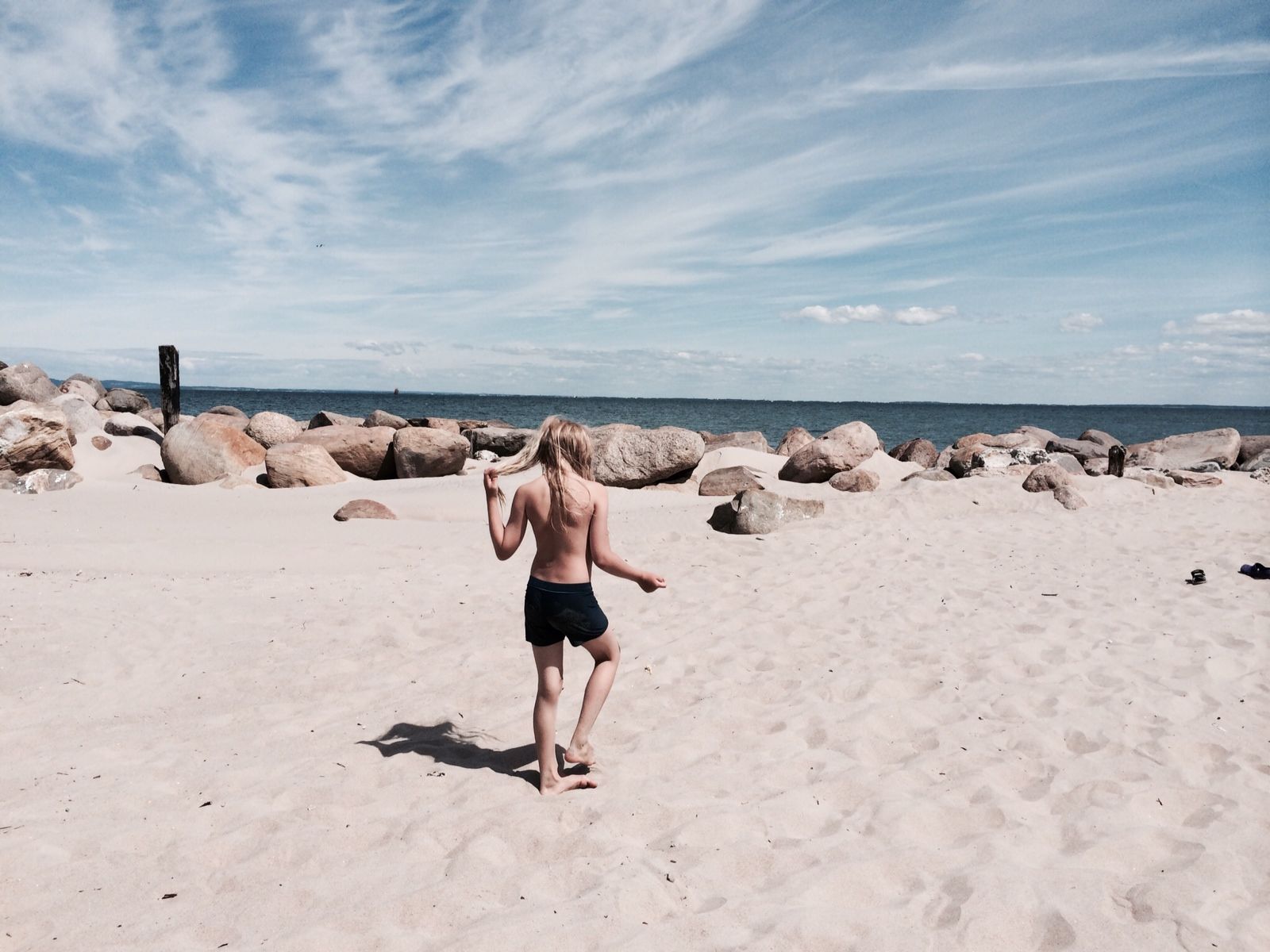
I want to stress that this is far from the whole story of homeschooling in our family, which first and foremost lives on a premise of mutual respect, where we listen to each other, respect each other's differences, support each other's passions and interests, and answer every question.
Religion
We are Christians, and in religion we do Christianity. We read Anne de Vries' children's Bible ("Børnenes Bibelbog" in Danish), which is a fantastic children's Bible with great coherence. It is very religious, but it is not dogmatic, and not dramatic either. It is lovely. Lovely in tone, lovely in form, lovely in what it includes and leaves out. We read a chapter five days a week while we eat breakfast. That is on weekdays. On weekends, when Dad is home, we usually do something else over breakfast.
Math
The level of ambition in math is high. The children who are two and a half, almost six and eight and a half are in kindergarten, first grade and second grade respectively. The youngest may stay in kindergarten for a few years in a row; we'll see. We count, practise times tables, practise the names of the numbers, study why on earth the numbers in Danish (and other languages) are called what they are called. And then we follow a math program called Matematrix. There is no special reason for it, other than that we had the textbooks for fifth, sixth and seventh grade lying around, and our eldest boy found them very interesting. After we had tried to read them several times, we agreed to go back a bit and start from the beginning. And bought the Matematrix books for first grade. It is a decent enough program; we think a few of the exercises are set up illogically, and then we make an extra page where we set them up more logically, so they make sense to us.
We usually do one, sometimes two pages in the math book on the days when we do this kind of schoolwork. In principle we always do – except when we take time off. Which means we don't take time off from school on Sundays or in the summer holidays, but we do if we are tired, or go on an outing, or travel to Italy. Or if the weather is wildly good and all we feel like doing is jumping on the trampoline. On the other hand, we actually do quite a lot of schoolwork when we are sick.
For math we also use Pixeline's math games and the iPad apps Lola's Math Train (1 and 2), Abemat and Tællespillet.
I don't teach my eldest daughter math, since she has passed the Danish school-leaving exam and clearly isn't very interested in math. That may change. We'll see.
Danish
We have used Alkalær's easy readers, ABC posters and all sorts of easy readers (we have a big collection). We use the "Min første Danskbog" program (My First Danish Book, which is called My Second Danish Book in second grade and so on) from Delta, illustrated by Maj Rørup – chosen because we like the drawings. The illustrations mean a lot for the atmosphere. We don't make a big deal of handwriting, but we have a really cozy time with the other exercises.
The two middle children, five and eight, read from a reading-practice book every day.
In Danish we use Alkalær's "Søde ord" app and "Bogstavspillet", and Lola's ABC Train.
Literature
We are currently reading Butterfly Valley (Sommerfugledalen) by Inger Christensen. One or two poems a week. At the same time, we are studying butterflies in our natural history lessons. My eldest daughter reads a major literary work of her choice each month and writes a little about it in a kind of synopsis. She is also working on writing a novel, a collection of modern fairy tales and a collection of short stories. I am writing a book about home education together with some of the seasoned home educators (not that it counts as literature, but it counts as showing that written language matters). We naturally read lots of different children's books and comics; it would be a bit silly to start writing a list. We have a very large collection of children's books, both fiction and non-fiction.
My eldest daughter reads constantly, in Danish and English, so in reality there is lots more literature in her life – but I can't fit everything into an article like this.
English
For English we watch children's TV programs from the BBC and use the app Pili Pop, where the children pick up vocabulary and, little by little, sentences. They play Pili Pop every day for about fifteen minutes (they decide how much themselves), and we watch a BBC program two or three times a week. We also talk a lot about words in other languages, but English is the only one we try to learn systematically.
World history
We read "Børnenes Verdenshistorie" (The Children's World History) by Nils Hartmann. One spread about five times a week. I read aloud, and the conversations that follow take us far and wide.
Natural history
The children ask so much about nature, and we read and study and look things up and discuss and dry flowers and look through the microscope. It is exciting. We use lots of different books and a few websites. Danske Dyr is a good site, and the Danish Ornithological Society does a good job too. We live right by Damhussøen, a lake where the birdlife is rich.
Geography
Through both natural history and world history, we get around in all sorts of ways in the atlas, the globe, star charts, maps of Europe and maps of the world. And the concepts that go with them (lakes, rivers, oceans, mountains, continents, capitals, borders and so on). This more or less happens by itself.
Latin
Together with my eldest daughter, I am studying Latin. We read Lingua Latina by Ørberg, use Visual Latin by Dwane Thomas, plus a grammar and a dictionary. Naturally it rubs off on the other children, that we walk around practising verbs and saying strange grammar words and talking about vocabulary and so on.
I prepare almost nothing
Of course I think about what I am doing and why I do it, but actual preparation isn't really a thing. Now and then I print something out for us to read or play with.
Yes, short and down-to-earth. In reality I would much rather tell all the other stories, but this is relevant too, I suppose – the practical, the concrete. Finally, I want to say that this is never ever forced down my children's throats; that this practice has grown out of the process that life is; that we are in it together, thriving on learning, living, playing – also in the organized way. In the organized periods. Like right now, at the moment.
The pot of gold
This is not a dogma, and we are not following a plan I knitted together in the dark of winter and am now forcing down my children's throats by hook or by crook. This is what makes sense here and now, for us. You can choose to organize home schooling in many different ways, and I am certainly not an advocate for any one way being right for everyone. But this is what is good for us. This is what makes sense, and what we feel good about.
I would almost argue that this is our freedom. Because we are nerds! We just LOVE books, studying and getting wiser, digging in and investigating – both in books and outside. So this, the part of our life that fits so neatly into the school way of thinking, is one of the ways we live – and if it ever becomes forced, unpleasant, rigid and angular, I can promise you we will do something else. In a different way.
Because that is the pot of gold in choosing home: that from day to day we can arrange ourselves so life makes sense. For all six of us.
We grow throughout life
Today we live very differently. There is nothing homeschool-like about our life any more. But this is how we started – and we feel my old articles should be available to others taking the same journey as us. Life is lived forwards, but understood backwards.
Written by Cecilie Conrad. Translated from Danish. The original article is available at CecilieConrad.dk.






Comments