

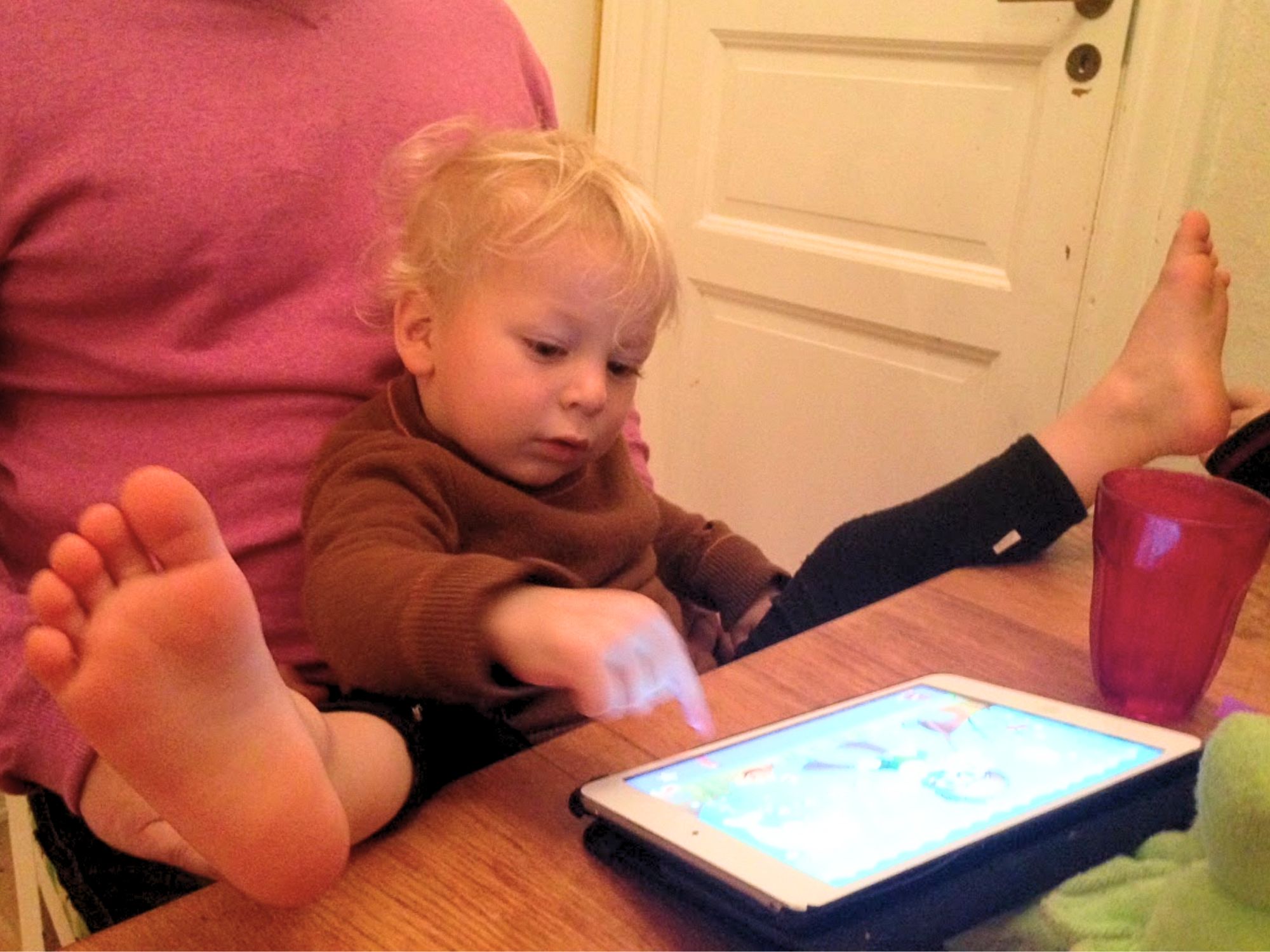
Apps for small children – "learning apps", games that make you smarter
Update: This is an article from January 2014. Many of the games can no longer be found, but some can – so we have removed the old links and can only recommend that you google the games you would like to try yourself.
Here is a list of the iPad games that I feel sure our children get smarter from, and that the very youngest can join in playing. Because quite a lot of people have asked by now, I am sharing it as an article here. That way I don't have to repeat myself too much. Disclaimer: I am sure you get smarter from many more games than the ones mentioned here. Feel free to chip in in the comments with the ones you know, and why they are good.
Good iPad games for little ones (from as young as 1)
In our family we have a fairly relaxed attitude to how much our children play computer games. In our family, wellbeing comes first. So there is no policy saying how little or how much you may play, but there are usually some limits, set for wellbeing reasons. To get balance, both in each person and in the family as a whole. In our family we don't use institutions, and on an ordinary day our children can easily play computer / iPad for five hours. No problemo.
And there are insanely many good reasons for doing so, but that is *not* what this article is about. We actually have the website onlinelæring.dk (which is very much worth a visit), but here it is about apps for the littlest ones. And the apps that adults clap their hands at, because the children "learn something". Children probably learn something more or less no matter what they play, but ... you get the picture. The classic virtues. The alphabet, reading, math, language, geography – that kind of thing.
On to business: the list – work in progress, here are my top of mind. Tomorrow, when I find my iPad, I can check what is actually on it. But here is something to start with.
Fusentasterne have done well. There is a free app: Ordspillet (the word game). Very nice. With words and sounds. The animals are the biggest hit. A good way to learn to use an app at all.
Then there is Farvespillet, Bogstavspillet, Talspillet and Tossekassen (the colour game, the letter game, the number game and the crazy box). Tossekassen is not something we have enjoyed, but the other three have been and still are really good. Bogstavspillet still holds a challenge for the children who are just about to learn to read – but it can be played and is fun for the very youngest. Each game contains three or four different games and is worth every penny.
Farvespillet is cosy, and you learn the names of the colours and how to compare them. You can colour in drawings (with a very boyish-humoured fart-splat sound), catch little mice (catch them in the right colour) and, I think, something more.
Talspillet. Count to ten. Count to twenty. In different ways. And a song. Sounds deadly boring, but it is really nice. With very nice graphics, very nice sounds and a monkey that shouts yahoooo every time you finish counting. Lovely game.
Bogstavspillet. Learn the letters, learn to write a little. With balls with letters on them that you move over into jars. The easiest level is incredibly easy – even Fjord, who is two, can join in. The hardest actually requires you to be able to write five-letter words. Again, lovely graphics.
Lola's Math Train and Lola's Alphabet Train. They come in a free version with the easiest level and a paid version with a bit more challenge. Both come in many different languages (and you only pay once and can switch freely between the languages), so pretty cool for multilingual kids (and Morten – I'm not sure about Cambodian, or whatever it's called).
ABC balloons is fun too: you have to pop the right balloons (be able to recognize letters). Balloons are always fun.
Matemaslik is also a counting game that gives a good feel for numbers and quantities. And then, well, it's candy ...
Abemat probably needs adult help for most children under five. But it is cosy to be the adult who helps. Nice game. Free, I think.
The game Hundreds is fun for children and adults alike, and gives a fine feel for proportions. Very intuitive. Very compelling.
For the slightly bigger ones, I can only warmly recommend DragonBox 12+, an absolutely amazing learn-equations tool. It also comes in a 5+ version, which we haven't tried. Very fine pedagogy, compelling, and completely old-school classic: learning to solve equations. It costs some money. Worth every penny.
Yes. That's enough for today. A little something to start with for most people.
Written by Cecilie Conrad. Translated from Danish. The original article is available at CecilieConrad.dk.










Comments