

Mariager Saltcenter – Salt of the Earth: A Story of Calm and History
"You are the salt of the earth" – a story from Mariager Saltcenter, with my absolute recommendation.
There is a deep calm in my muscles, a peace that is hard to understand. Ten hours ago, I was floating around in the Dead Sea pool at Mariager Saltcenter, and that is where it comes from, the calm. From the warmth, from the vital, mineral-rich salt from deep under Danish ground, from the warmth of the pool and that light, silly feeling of floating in a strong salt solution matching the salt concentration of the Dead Sea. But maybe also from a meaningful day, full of experiences, in a beautiful place in Denmark.

Mariager Fjord is a pearl of beauty; you are left in wonder – the little town's cobblestones, half-timbered houses and roses, the incredible light over the fjord, the silence and the big sky. It is not hard to understand that faith has been strong here for many years. Mariager means Mary's field, Mary's land, and this fertile, beautiful – yes: blessed – harbour no doubt inspires a reverence for life.
A rainy day is a museum day. Mariager Saltcenter is a good choice.
When the Danish summer offers rain over this beautiful spot on earth, the Saltcenter is the obvious choice. We were already living in the flipper bus, in the light of the beautiful, quiet harbour, so it was easy to find the big museum, which sits right on the harbour in total idyll. And when I think back over those ten hours, the most striking thing is that we experienced and experienced and experienced for four or five hours – forgot to eat (and got pretty low on blood sugar, not recommended), forgot to look at the clock, and when the museum closed at five, we still didn't feel done with it at all.
All four children, aged 2 to 15, found enthusiasm and engagement, and the grown-ups definitely got wiser. And happier. So, the short version up here at the top: the Saltcenter in Mariager is worth the drive, and worth setting a whole day aside for. Even if it isn't raining.
The slightly longer version tells of a museum rich in detail, old-fashioned museum atmosphere nicely blended with all the newfangled fantastic-o-matic ways of presenting things that didn't exist when I was a child.
The treasures of the Saltcenter: from exhibitions to salt cellar collections

On the first floor, we wandered again and again through a classic signs-and-pictures exhibition, nicely decorated with art in salt stone and models of salt molecules and underground formations. Our eldest daughter could tell us that she had just taken her physics exam in exactly these processes – when salt dissolves and ionizes, so the water becomes electrically conductive. And the signs and pictures from the Loire Valley gave us yet another good reason to drive back to Chateau Ponsac, where you can buy the best pain au chocolat aux amandes, and to swing by the mouth of the Loire and the original salt pans on the way. That must be wild to see in real life.
Even though we went through the exhibition several times, at different children's paces, we most definitely didn't take it all in.
The science of salt: a journey through ions and crystals

Because it was hard not to be carried along, enthusiastic, to an incredible collection of salt cellars. Sounds a bit uninspiring at first, of course, but actually all six of us stood stock-still over the many possibilities, shapes, traditions, little works of art, materials – and not least the joy of recognition when we saw a salt cellar we had seen before at a relative's house, or in a summer cottage, or on a trip.
And then we had to go back, again and again, to the model of the enormous salt formation that apparently lies underground and is just ENORMOUS. The model compares this underground salt to a church, and it is overwhelming, this sense of scale. You are tempted to say holy.crap.that.is.a.lot.of.salt.
In the cinema and on the ride at the experience centre
Late in the afternoon, we watched the film about the history of salt, and I am still amazed by this phenomenon – the human need to extract salt and the almost absurd solutions that have existed in earlier times. Like burning seaweed and extracting salt from the ashes (with water). Maybe very healthy. But it doesn't sound nice to a salt person like me. I love good salt, I definitely eat far more than the health authorities recommend, and I am 100 percent sure it is good for me. Imagine being stuck with that black salt. Imagine how incredible it really is that the Earth was created (or evolved) in such a way that there are enormous stores of this divine substance under our feet.
There are actually two films running in the museum cinema. A short, seven-minute one, where the whole seating section moves like a ride at the fair, while you imagine what it must have been like to ride the underground tracks in the old salt mines. To be honest, I didn't see that film myself, because my eldest son panicked at the idea of being strapped in and shut in (a sliding door closes while the first film runs) – but the rest of the family told me all about it, vividly. That it was okay, but that it is actually the more informative twenty-minute film afterwards that is worth coming for.
It is actually surprising that a little information film, or documentary if you like, can speak both to very small children and to us grown-ups. Everyone in our family (2, 5, 8, 15 and 39 years old) was absorbed for all twenty minutes, and everyone got noticeably wiser from this well-presented, information-heavy film. It was out of sync, the editing was maybe not all that sexy through a filmmaker's eyes, and some elements were probably a bit overdramatized for my taste (especially the part about how you can die from too little and too much salt – I don't like that scare-you stuff). But I would still CLEARLY recommend seeing the film – maybe even as one of the first things you do. Unlike us.
The boiling hut: where the salt is made

The water is pumped up from underground into pans that are heated, so the salt crystallizes.
In the boiling hut in the outdoor exhibition, you can see the original method of extracting salt, where salt water from underground (in this case salt water produced by pumping water down into the salt pocket underground and drawing it back up once it has dissolved enough salt) is slowly evaporated, so the salt crystallizes. First it floats beautifully on the surface, and when it gets too heavy to rest on the surface tension, the crystals sink to the bottom. These are the crystals we salt connoisseurs love to crush between three fingers, every single time we eat.
We as in I. I, who always carry salt in my bag, have now tried messing about with salt boiling myself and understood these processes by taking part in them. The hut is cozy, atmospheric, with oil lamps on the walls and a quiet around the boiling – and at the same time, this is actually where Mariager Sydesalt produces gourmet salt for sale.

Here it is – the finished salt
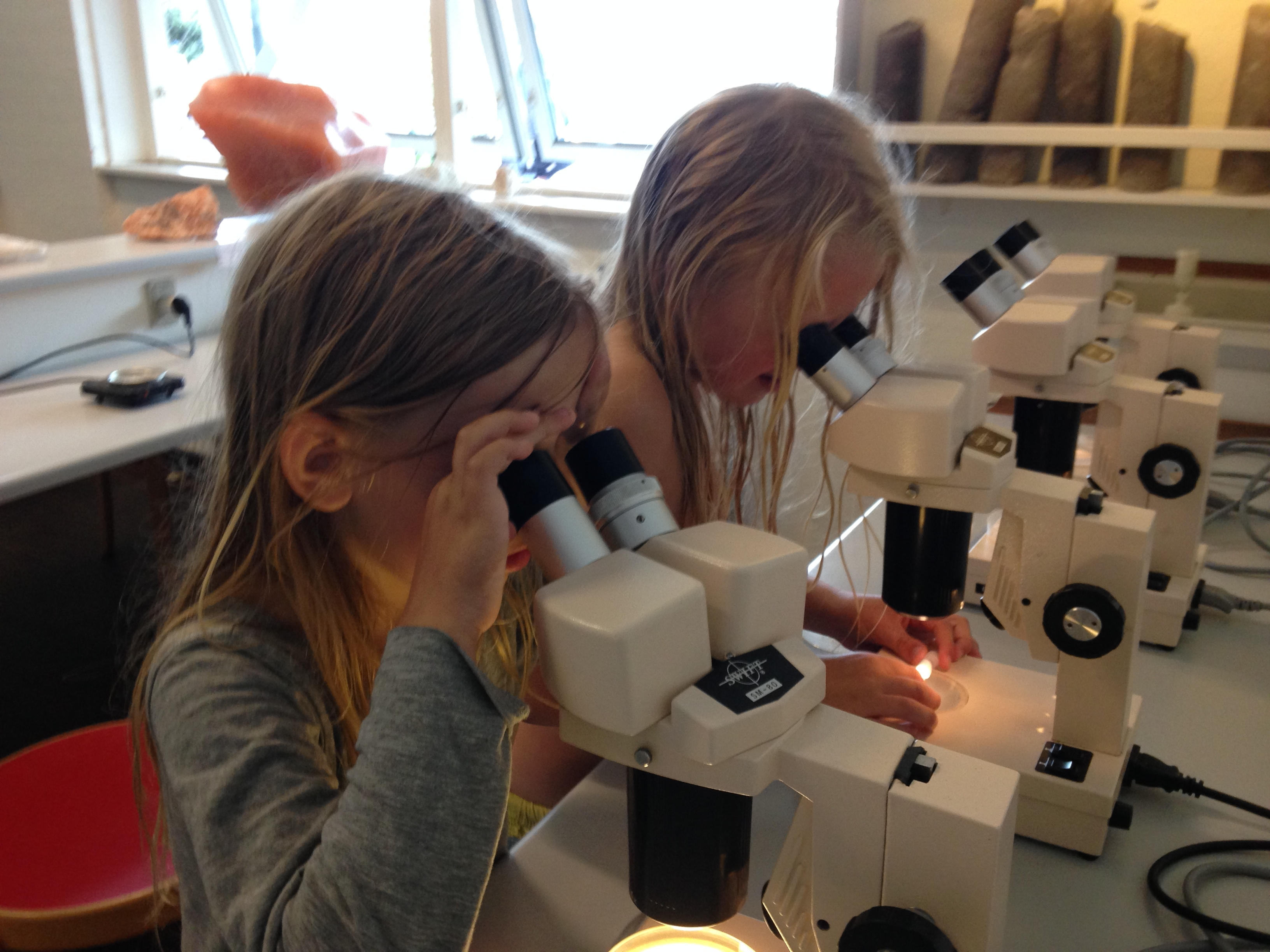
In the laboratory you can get teaching (we didn't make it to that), and evaporate a small amount of salt yourself. To take home in a little plastic tube. We played with the processes in there for a long time, and looked through the microscope at crystal boiled salt and at "ordinary" table salt (which is round and completely different), and at various stones in the exhibition in there. We could have wished for a few more explanations of all these mysteries, which can be very hard for children to access – especially the two aged 5 and 8 had many more questions than I could answer. So now we have to go home and study crystals and salts.
Child-friendly activities: learning through play and discovery

Silke tries a manual water pump
The Saltcenter has an outdoor play area with water and a bouncy pillow (so remember dry clothes for small children, so you don't have to run around saying careful and no all the time), and a lovely, not too expensive restaurant, which we would have used if we hadn't simply been so busy being at the museum that we had no time to eat. We had an ice cream after the Dead Sea experience, and drank a whole lot of water.
On the first floor there are two big wooden board-game things, which were fun, along with some welcome chairs where you could sit and rest tired legs. The youngest had a little nap, and the grown-ups got a lovely rest while we enjoyed the view over the harbour and the rain over the fjord.

And there are lovely things to play with when you need a break.
The Saltcenter is worth more than a single visit, and you really should set the whole day aside for "just" that.
I would like to see the whole museum again. I have no doubt at all that we will come back to the Saltcenter and to Mariager. Because it was truly surprising how many hours this experience filled, and even though the youngest burned himself on the boiling stove (clearly our own fault), and the second-youngest got low on blood sugar (because we forgot to give the children lunch in pure excitement), we returned to the flipper bus well satisfied, well informed, well entertained and in balance, once we had shopped for souvenirs and said a polite goodbye.
Practical info.
The museum is on the harbour in Mariager, not the least bit hard to find. There is plenty of parking, and it is easy to bring a stroller and be allowed to park it somewhere indoors. Prices and opening hours are always safest to check on the museum's website. In the souvenir shop you can buy herb and spice salts, and "pure" boiled salt – plus, of course, all sorts of other things: creams and bits and bobs with salt, teddy bears and stones, books and treats.
When we were there, they had a treasure hunt – always a really good way to get children going at a museum; they get around and get engaged. It was simple and very easy to "solve", but it was great fun. There was a little reward for everyone, which I find classy. It is always so pointless when it ends with filling in your name and email and waiting to maybe be drawn as a winner.
Appendix – "You are the salt of the earth: but if the salt have lost his savour, wherewith shall it be salted?" is, of course, a famous quote from our Lord Jesus Christ. You can believe or not, but there is no getting around the fact that salt is powerful on many more levels than everyday life points to; that salt is much more interesting than you would think; that salt offers far more thoughts and experiences and reaches much further than you might have imagined. And the fact that this very quote from Big J was the first thing I saw when I came up the stairs to the exhibition tells me – someone who most definitely believes – that I have arrived at exactly the right place, that the people who built this museum have understood more than most. Thank you – for a truly exciting day.
More impressions from the day

There are pools with the same salt content as the Dead Sea. A wild experience.

You feel every little scratch on your body – but it is so worth it!
Exciting to see how salt was produced in the old days. Boiled salt!

Crystallized salt on the surface

A fascinating experience

Salt in such big heaps that we had to play on it and with it.

And of course we had to end the day with a new potato and the boiled salt we had helped make ourselves.

And to round off the day, we met a duck :)
Written by Cecilie Conrad. Translated from Danish. The original article is available at CecilieConrad.dk.









Comments