

The story of a journey through Europe and the reflections on wealth, existence and being that it brought with it. Read about being super rich, about daring to choose to be happy, about the Stone Age, the sea, the people, perfect timing and trust.
Would you like to be super rich?
Many people look up to the super rich. There are so many "get rich (quick)" courses online, and most people in the modern world would at least wish they had just a little more money. Preferably a lot more money.
There is almost more hype around the super rich than around film and sports stars, especially the ones who became super rich super fast.
The super rich are, of course, the ones who have so much money, for one reason or another, that it is not a thing for them to think about what anything costs. The ones with a yacht and villas in the plural and so on. The ones who often show up in commercials and in films. And of whom there are actually a few in real life, too.
If we challenge the concepts a little, put things a bit into perspective and try to think a little for ourselves despite the massive influence of the consumer society – what does it actually mean to be super rich?
The weeks we share stories and reflections from here are the first two weeks of September 2019, when we travelled road trip style from Denmark to Spain. We have reflected on value, wealth and resources, and – wouldn't you know it – we have become wiser. Life is an amazing teacher, and travelling makes it obvious that every single day we can become a little wiser.
Another main theme has been the wingbeat of history, and that has been really fun. The journey, life, the places, the people, the experiences have given good soil for new understandings of how human life has developed in Europe, and actually in general, too.
In this story you can come along on the journey, both in terms of where we have been and what we have experienced, but also, very much, in terms of what it did to us and what we learned. It is a special frame, this nomadic life, with very special gifts and lessons to follow.
Morning on Moesgaard Beach

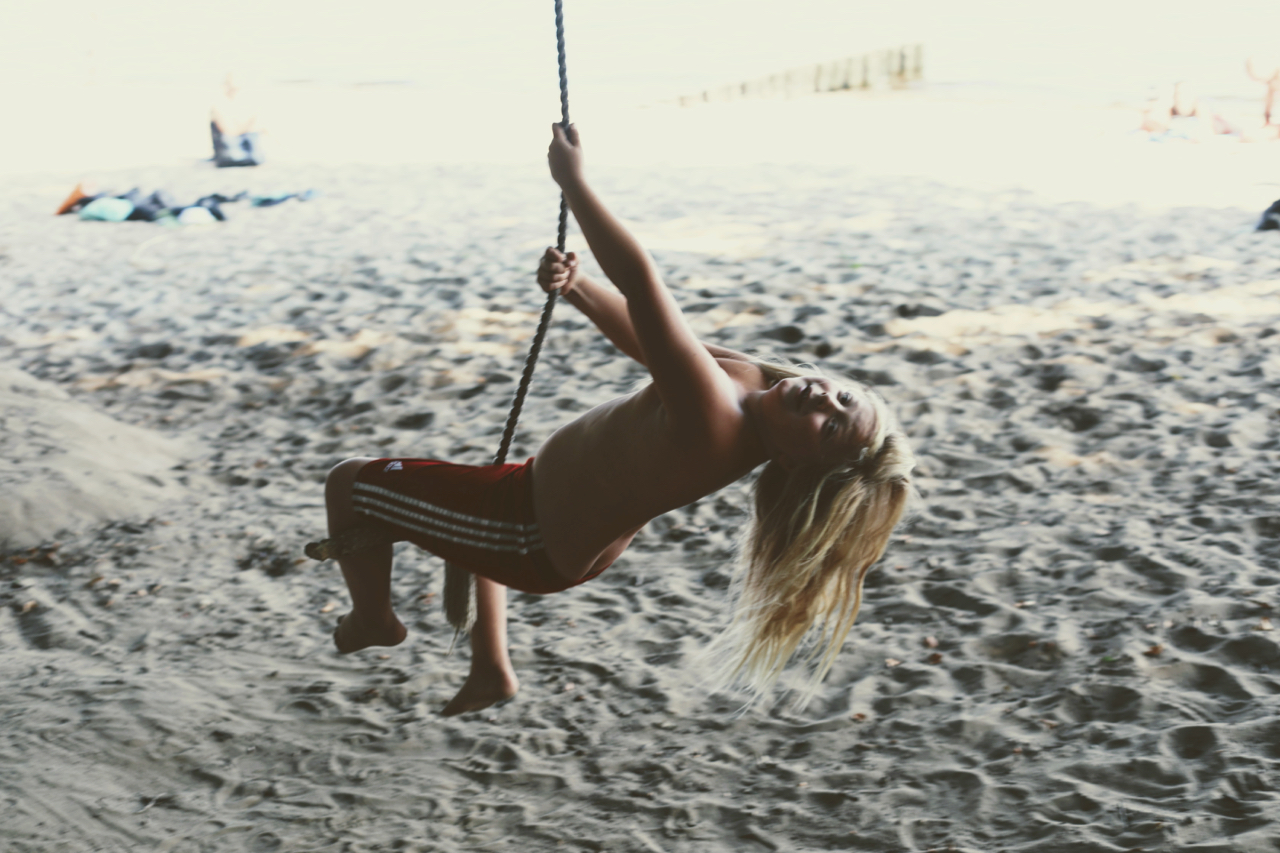
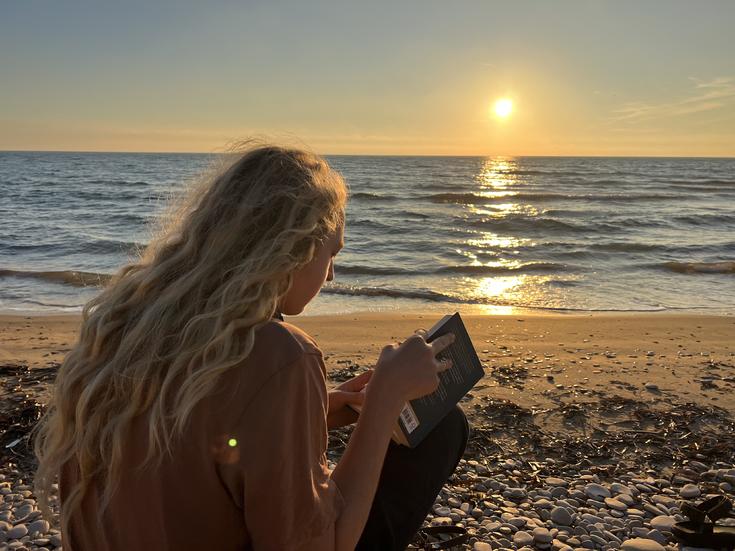
Recently (not exactly in the weeks I am writing about, but quite recently) we woke up on Moesgaard Beach. Sunshine, silence and waves (and wasps) framed the morning coffee, a run and breakfast. We always take it pretty slow in the morning. Everyone has their own rhythm, and the space to be yourself, read a little, meditate a little, play a little is valuable. On Moesgaard Beach it is the obvious thing to take a walk along the water, look at the seagulls, hold hands for a bit. So that's what Fjord and I did. Barefoot in the sand, early in the morning. Lovely.
Waking up on a beach is simply wonderful. All the light, the seagulls, the fresh air. The porridge did attract quite a lot of wasps, but it was fine. It turned into a breakfast dance. A morning on the beach also invites you to jump in the water, and it is really practical to do the dishes in the sea. (We only use biodegradable soap or no soap at all, of course – in this case none.)
The Stone Age and me

There is something very real and true about spending your morning by the sea. I feel like a primal human, the primal woman, the primal mother, I feel my tribe thriving, I feel I was made for the wind, the sand, the water. Knowing full well that I am listening to music on my wireless speaker and have a camping stove so I can make morning coffee. Of course. It is not a survival project or an attempt to recreate this or that historical period. It's just us, on the beach.
Still, it puts us in touch with the fact that there is something fundamental about being by the sea, something truly, liberatingly lovely. And the life of a travelling human being is in itself a strong teacher.
The basic needs, whether that's a trip to the toilet or matcha in the morning, have to be covered, prioritized, organized. It is an interesting journey to get to know yourself – what is important and what is possible – when life unfolds a bit more … primitively.
And the sea is a solution. Clearly. The beach, the light, the waves. Being able to bathe yourself fresh and awake and clean, rinse all the mugs and plates in plenty of water, wander back uplifted – it is a lot easier than camping dishes and washcloths, and absolutely more real. Wonderful.
Moesgaard: Immersed in the Stone Age

An hour later we found ourselves at the wonderful Moesgaard Museum outside Aarhus. Wow, what a well-told museum. Absolutely amazing exhibitions, soaking up evolution (the photo is of a wax figure of an early human, based on the find of a skull) and history in the most wonderful way. The first time we were there, we stayed six hours and barely had time to eat. The second time was three days later, because we just couldn't get enough!
Anyway, an hour later we started at the beginning: the Stone Age. Having just had that fine, primitive and also uplifting morning, the Stone Age was absolutely interesting. Imagine carving all your own spoons, imagine tanning hides to be able to make shoes, imagine being ancient at 35.
But imagine, too, living close to everyone you know, out in nature. Moving with the seasons, being in your basic survival with meaningful experiences, family, dogs, fire, sky and sea – your whole life.
Not that I wish to go back to the Stone Age as such. But I am truly glad for my life, also when it is primitive, and I think I learn quite a bit about need to have and nice to have from living and studying the basic life on the same day.
Road trip in Europe

This past week we have been on a road trip in Europe. We set aside roughly two weeks to travel from South Jutland to Barcelona, which might sound like a long time to drive about 2,000 km, but for us it was rather a short time. In reality it was the perfect time. Because we have chosen that our timing is always perfect. It is a state. It is not about luck, and not about happy-go-lucky optimism either, but about what you might, in all humility, call divine timing. More about that below.
Road trip, weeks 36 and 37
- AABENRAA
On Sunday we drove from Aabenraa to Neustadt near Hanover. From inspiring, lovely friends to inspiring, lovely friends. - NEUSTADT
Monday and most of Tuesday we spent with our friends in Neustadt. Pool, apples, conversations, play, trampoline, playground. - BUTZBACH
On Tuesday we drove to Butzbach near Frankfurt. The Disney princess experience with Thai food - BUTZBACH
On Wednesday we explored the well-preserved town of Butzbach, drove to Mainz and studied the art of printing. Slept by a lake in a forest. - MAINZ
On Thursday we regenerated by the lake all morning, then drove to Burgundy and spent the night in a cozy little wine village: Morey-Saint-Denis - BURGUNDY
On Friday we went on a wine tour: vineyards, celliers, fields of vines. Visited the local wine collectors' shop. Drove to Puy de Dôme, slept in the mountains. - PUY
On Saturday we enjoyed our morning as always, despite the morning cold of the mountain, and drove to Midi-Pyrénées, to Thil, where we also, as it happens, have inspiring, lovely friends. - THIL
On Sunday we enjoyed the wild luxury of being in the sunshine in the south of France in September, and being together. With each other and with our relatively new, fantastically good friends. We stayed four lovely days here - HOME TO THE BUS
Oh, how lovely to finally return to our tiny house, our friends, our usual life. The feeling of being home is magnificent and can, luckily, be found in more than one place on the planet. More about that in the next blog post, actually.
Friendships and languages

Our first stop was near Hanover, where we have close friends. The family is a grandmother, parents and three children, who are homeschooled. These people are uplifting and inspiring to spend a few days with, and as we left we set an intention to have at least fourteen days to share next time. The feeling is mutual, you see.
We can thank Chris and Doris Attwood's deep insight into human life for this text being far more reflective than usual. Chris Attwood is my good, good friend, and his wife feels like a sister. I am deeply glad for this relationship and can warmly recommend Chris's books. He is a wise man.
These days in Neustadt near Hanover were the first outside our home country in a while, and the languages came into play again after lying a bit more still for a long time. The family speaks German and English, so we communicate in English. But Grandma only speaks German, Low German even, so there are certainly challenges for the adults, who speak fluent English but somewhat more limited German.
The kids can play together just fine. Our children understand most things in English by now, so it was easy for them to play here, where all the children have English as their mother tongue, and easy enough to join other conversations too. Altogether we were – the whole flock – pleasantly surprised by how much German you actually understand when you haven't learned it (yet). And right away we started learning German. Because – well, we want to talk to everyone else too. Starting with Grandma.
Divine timing

Let me just return to that claim about divine timing. I think it needs some explaining.
You see, many people have read about or seen the documentary about The Law of Attraction. And many drop out, find it simply very, very annoying. But the truth of the matter is that if you can get deeply enough in touch with yourself, truly be who you are – and connected with your life mission and your God – then life is like a river, and if you flow with it, there are no limits to what can succeed. Then you CAN actually manifest anything.
But it is NOT because I personally, with my thoughts and wishes, create changes in the universe. Rather, it should be understood like this: I have placed myself in the current, become part of the energy, and so my dreams and wishes fit completely with what God has planned for me, and the harmony is therefore complete. This very important point gets lost in many retellings of the Law of Attraction, and that is why the whole idea seems absurd. Chris Attwood put it so beautifully into words when we discussed the phenomenon over the morning waffles and the celery juice. Exactly this gave me the kick I needed to start writing about our reflections and experiences more directly and honestly.
Because I can be afraid of being shamed as a super hippie. I am not one. I can also be afraid of being shamed as "just lucky". I am not that either. I – we – have done a great deal of mental work, and keep doing it: connecting with the cosmos, allowing intuition to take over, flowing with what is, wallowing in gratitude – and THAT is why our timing is always divinely perfect. That is why we are always in the right place at the right time.
We choose that our timing is always perfect, and that is because we have chosen to live in harmony with who we are and what we are here for. We have chosen to dare to live our true selves. We have chosen to work with our intuition, our "feel for things", to listen both to what happens inside and to what we experience
So, when I say we choose that our timing is always perfect, it is because we have chosen to live in harmony with who we are and what we are here for. We have chosen to dare to live our true selves. We have chosen to work with our intuition, our "feel for things", to listen both to what happens inside and to what we experience, and from there to tune in to what we need to do and what we do.
You could also just say, in short, that we choose to live from the heart. Done, end of story.
This results in perfect timing. It is not hocus pocus. It is not particularly easy either. But it is, in a way, quite a simple path in life. It works. As with everything else, you get better at it with time.
Half-timbered happiness, Thai food and Disney heroines

Already on the first drive from the Hanover area we were playing ball with the cosmos, and learned (again) to dare to trust our intuition. Imagine having to learn the same things so many times!
Every time I looked for a place to stop on Google Maps, I landed in the same town – Butzbach – in Hesse. My intuition found it again and again. And every time my brain kicked in with all sorts of objections. In the end we gave in and drove there. My husband is pretty good at cutting through in these situations: "Stop thinking, Cecilie! You've found it, we'll just drive there." Done, end of story.
With amazing (i.e. divine) timing, we reached a wonderful little Thai food place just as it was closing, and managed to buy wonderful vegetables and hot rice to eat in the dusk in the town. Already on the walk from the car we had noticed the incredible half-timbered houses, and still we were surprised at how utterly fantastic the town square was. All the houses were well-preserved half-timbered houses from the 1700s, and of incredible quality. With wonderful details and beautiful carvings, paintings, beautiful colours, towers – and even a fine clockwork on the town hall.
Sitting there on the town square, with the fountain and all these buildings around us, we could only feel like – yes, the most super rich people in the whole world. It was like having dinner in a fairy tale. The setting looks like the square in the Disney film Beauty and the Beast, where Belle sings about books and about the dream of a bigger perspective.
Exactly the right place at exactly the right time.
The wingbeat of history and Gutenberg's Bibles

After sleeping in our lovely travel van and all our quiet morning business, we took a walk in the pretty town and saw all sorts of completely overwhelming houses. And the town wall, which must be even older than the houses, and which still had a few houses built into it. And the church, which was an exciting gathering of ages. Three baptismal fonts, several altars, three organs, chairs and pews and pulpits from back in the 1700s up to maybe the 1980s. Really interesting.
The everyday need for water drove us to a supermarket and down a street where a man had his stall with the crispest, most wonderful apples. From his garden we could enjoy apples, beans, pears, chili. Oh, what abundance!
Happy in our brains, full in our bellies, flying high on History, we drove on to Mainz. Because in Mainz there is something very, very special:
In Mainz, Gutenberg had his workshop and made the first printed books in Europe. And at the museum they have no less than 3 original Bibles in Latin! We arrived perfectly timed (three minutes before it began) for a demonstration of the art of printing as it was when Gutenberg came up with it. In German, which, as it turns out, we understand enough of for the presentation to make good sense. It helps, of course, that we already know something about which technique came before Gutenberg's printing and what it was he invented. In reality it is not so much the printing press that is revolutionary, as the type. But that is a bit of another story, which I am sure my readers can look up themselves.
Here I will just say that we had a lovely conversation with the guide after the demonstration, where he chose Silke as his assistant and she printed a page of the New Testament with the Lord's Prayer, exactly as it looked in Gutenberg's version.
Simply beautiful. Afterwards we could wallow in written language as it has developed at different times in history, in different places in the world.
Was it a coincidence that we arrived just as the demonstration was about to happen that day? I think not.
(A note on water: Yes! It would clearly be more sustainable if we drank tap water in the countries where the water is clean, but our experience is that we get sick from it. When we move around a lot, we buy bottled water – it isn't worth the risk to drink tap water even if the locals do, and it isn't worth the time to purify it ourselves. Suggestions for solutions on the water front are received with open arms, we are not fans of plastic bottles. LifeStraw has been tried, but we dehydrate – the resistance is too great for us to drink enough)
Restoration: Forest and lake

After Mainz we drove to a forest lake, and this time it was Jesper's intuitive radar that found the way for us. A nicely organized swimming lake just outside town. A playground with a zip line – a double zip line, even! The swimming lake was beautiful, beautiful! The morning by the lake was regenerating. Beautiful, beautiful it was, and we swam, went for a run, listened to the trees, drank lots of tea and left very late.
Burgundy of the red wines

We landed in Burgundy, land of wines. It was the wine press that inspired Gutenberg, so there was a beautiful connection between what we had just learned and landing in a village that more or less consisted of celliers. Wineries. The streets were decorated with old wine presses, and there were vineyards all the way around the village. The grapes are almost ripe, and it was very beautiful and uplifting. I can't really be bothered to repeat that I don't believe in coincidences.
We drink very, very little alcohol, and less and less. When we do, it has to be good. And red wine is absolutely a culture worth taking part in. We are not connoisseurs, and on principle we can't be bothered to be. Still, we can manage to prefer a pinot noir when we ARE in Burgundy, and the bottle we bought – we are really looking forward to enjoying it the day we choose to enjoy it. With someone. Just the experience of buying it, and the conversations with the kids about wine culture and wine production and the wingbeat of history and the French paradox, is valuable and memorable in itself.
The volcanic mountains of Auvergne

Puy de Dôme is the largest of the volcanoes in the mountain range of Auvergne, which makes up a special region in the southeast of France. As a child I was there several times with my late mother, and the area undeniably has a character all its own. We drove to a viewpoint that, beautifully enough, we had visited together seven years ago, and enjoyed the outlines of the mountains before we drove into them.
We stocked up on food at La Vie Claire and found a little lake to spend the night by. After all the heat and all the summer we have travelled in for the past two months, so far from high mountains, it came as a surprise to us that it was really cold. Face, meet palm! Of course we know it is cold up in the mountains, and that Puy de Dôme is 1.6 km high.
The night temperature went down to six degrees, and I will admit that I wasn't particularly interesting company until the sun had broken properly through the next morning and I had had hot coffee. Sorry for everything I said while I was freezing!
But the lake steamed beautifully in the morning light, the swallows hunted along the surface of the water, the light was actually incredibly beautiful, and once again we learned the important lesson of not rushing and not believing we have to rush.
On being slow and having time for everything

These guidelines always hold, and they are what make it possible for five people to travel in a small van and thrive, even when the night has been cold or something else is challenging. With our lifestyle there is rarely anything we absolutely have to get to, and we can choose to immerse ourselves in any process. There is, of course, a risk that you never get round to what is important, because you are mindfully drying every drinking glass and lining them up in a row, only seconds before all the kids are thirsty again. Just yesterday I was entertaining everyone with how, as an unschooling mom in Copenhagen before we left, I generally had a rule of not making appointments before one o'clock, because we simply couldn't be ready. I look with horror at all the families who have to get out the door before eight in the morning – with small children, even! Their poor souls!
Go slowly, carefully, respectfully. Finish every process when it is actually finished. Listen to everyone's needs.
When we can go slowly through our mornings, it is a great luxury and joy to have room for it. To make sure we live a life of adventure, immersion and freedom, a fixed part of this slow and calm morning is that we talk about the Plan of the Day. Who has what on their heart, on the program? When everyone gets to say out loud what is important to them, it is also possible to create a day with room for everything, where everyone is taken into account. It works. We do float around in whatever direction the heart points, but we do it in a community where we also steer by simple plans and consideration for each other.
Again I want to stress that it is not luck when we have plenty of time for our morning routines. It is a choice we have made. When everyone steps peacefully into the day in his or her own way, and everyone takes the time to prepare, carry out and finish every process, the spirit also gets room both to find peace and to grow. It is a fine way of being.
Stilt dancing, olives and figs

On rolled the green van, through the national park with the volcanoes. Once again life gave us a gift when we found the lovely town of Brive-la-Gaillarde. It is healthy both to know and to say out loud exactly what you wish for – and here we had asked for a cozy town, something lovely to eat and an experience for our break from driving. We found the town on the map along the route, but not along the motorway. It is ALWAYS worth the trouble to get off the motorways.
Often you think you are supposed to do something, and in reality something completely different is waiting, which is the real reason you sense a direction, an impulse
Brive-la-Gaillarde offered the last quarter of an hour of the Saturday market and, naturally, a parking spot right at the entrance. We bought high-vibrating, wonderful local vegetables and fruit, and a chunk of cheese from a cheesemaker. As vegans that is a bit of a boundary to cross, but we are not vegans as such. We eat according to our integrity, and since we had now driven for two days through the mountains, read about the local cheese culture and, not least, SEEN all the cows and goats wandering happily around on the slopes WITH their young, we found it absolutely wonderful to be able to bring this cultural experience along for lunch.
Often you think you are supposed to do something, and in reality something completely different is waiting, which is the real reason you sense a direction, an impulse. It is about following your heart, your intuition, and doing what you know is the right thing to do, even if what life has in store happens along the way.
When we started looking for a toilet we could borrow, because we thought we were done shopping, we met an Arab woman selling her homemade olives. Oh, heaven! All sorts of kinds and versions, pickled garlic and olive tapenade of sublime quality. I got to speak lots of French, about languages and cultures and travels, and got a tip about a cave that we will have to explore next time we are in the area.
Whoever cannot give an account of three thousand years lives only from hand to mouth.
And that isn't even all. As we sat there in the park by the fountain with our lunch of figs, olives, cheeses, tofu, peppers, zucchini, nut butter and corn crackers, something began to happen around us. At first we just enjoyed the life of the town. Children cycling down in the fountain (it was new), and people sitting down with a coffee and chatting, dogs walking past with their people, young boys with music in their pockets, young adults with dreadlocks and flowing trousers, grandmothers in fine blouses with their grandchildren. But gradually people in folk costumes began to show up. More and more, and by the time we had finished eating, they were all there. Some gathered in a pavilion in the park, others came walking from the market square in a beautiful procession with musical instruments, costumes and banners. At the back of the group came the "shepherds": the young ones on stilts. Tall, tall, beautiful wooden stilts with a flexible footrest, so you walk really well. Beautiful.
We joined the event. First we listened to some six to eight speeches, where all sorts of bodies honoured each other and gave each other gifts, and my French ear got to go to work. Listening while you translate, especially, is a demanding task.
With their work, the folk music/dance/culture group preserved an entirely local tradition, bound to exactly this area – Brive. This town, these surrounding mountains, this stretch of the river. The music, the costumes (and with them the needlework) and the dances had been preserved through generations; even an old dialect, so different from French that it almost made up its own language, they lovingly looked after.
And why, then? It is fun, and there is an element of fascination – sure. Anyone can understand that. That was why we sat there listening, too. But interestingly, and very truly, they also explained that it is of crucial importance for each person's identity and for the structure of the community that you know your history, know where you come from and what you are made of. If you know who you are, you can both grow and welcome what is new. So this cultivation of folk culture (is that what it's called?) is not a turning away, neither from the present nor from the big world, but an understanding that people with solid roots are healthy people.
Interestingly enough, we have immersed ourselves more in Danish history AFTER we started travelling than ever before. I believe it was Goethe who said: Whoever cannot give an account of three thousand years lives only from hand to mouth.
Thanks for the reminder.
Minimalism and super luxury: An apartment in Midi-Pyrénées

We are getting close to the end of this text, since it is framed by a week of travel. The journey ends with our lovely friends Magalie and Keith in Midi-Pyrénées, in the south of France, that is. After magnificent experiences in Brive, we drove to them.
Magalie and Keith have a big house with something as luxurious as an extra apartment. It was originally built for a previous owner's elderly mother, who actually never moved in. So, wild as it is, we can visit these friends and simply be neighbours for a while. It is incredibly practical and cozy for everyone.
Moving into a mini apartment with what we in Denmark would call a kitchenette, and with a bathroom, after living more or less out of our van for 14 days, was a wild experience. Reflections on the phenomenon of "the super rich" became relevant again. What does it mean to be super rich?
What incredible luxury to have running water. It is easy to do the dishes in the sea, but still, a kitchen sink is completely wild by comparison. Taking a hot shower, putting your vegetables in a fridge and sitting down in an armchair.
It may even be hard to convey this experience of luxury. I fear I will sound banal. Anyone reading this text probably lives in the luxury of the modern world, and has FORGOTTEN IT.
WE have had clean running water, hot water, bathrooms, flushing toilets, electricity, fridges, kitchen sinks, comfortable furniture, clean floors, windows (feel free to continue the list yourself) for so long that we take all of it for granted.
That is one thing. But do we actually remember, in everyday life, what an enormous luxury it is? Our experience of moving into the apartment for a four-day visit was genuine gratitude. As you can tell, we have a wonderful, educational, present and exciting adventure whatever the setting, and so also in the primitive and minimalist setting that road tripping is.
One of the gifts this trip has given us is a true experience of how blessedly many resources simply flow our way, how great a modern luxury we live in.
On the consumer society

It is fantastic to live in the luxury of the modern world. There is no doubt about that. We have an incredible frame to unfold our lives in. We are absolutely grateful for all the advantages, for science, medicine, the inventions, the food, the freedom. A relevant and important criticism of the consumer society, though, is that it costs the well-being of the planet dearly.
Another equally relevant criticism is that we become truly spoiled and forget our gratitude. The consumer society is built on the idea that if we all consume a whole lot, it creates economic growth, and that is good for everyone. The problem is just that it isn't. It is good neither for everyone nor for the planet.
Sadly, we live in an insane culture of this consumption. We meet advertising for single products, but just as much the marketing of a consumer lifestyle, to such an extreme degree that everyone, EVERYONE, is affected. Unless you sit in a cave somewhere and talk to no one, this pressure has an influence.
It only stops when it stops inside ourselves. The wish for more.
The catch is that consumption – the more-more-more process – puts us in a psychological game that disturbs the real elements of life. Luckily, many people have begun to realize this problem.
Minimalism has become a big phenomenon, and Marie Kondo has got her own TV series, because everyone is hit by overconsumption. Or at least almost everyone.
Minimalism has almost become a new kind of consumption, consuming lots of time to make your life and your home look like something from a TV series or a documentary. If you don't do the inner work, it makes no difference at all whether the T-shirts lie in colour order in a drawer or in a pile on the floor. The battle is lost.
With all the senses and on the inner journey

There are so many advantages to travelling, and one of the really good ones is that you "wake up". Everyday routines can lull your awareness to sleep a little; you do what you usually do, and there is a blessed calm in that. You cycle the same route without thinking about it, do what you usually do. The view from the window changes in wonderfully nuanced ways with the seasons. It has its own quiet charm, but a month later you don't remember it. When we move, it is often like waking up. All the senses are back, and we are confronted with basic needs as well as divine inspiration in a completely different way.
Travelling fairly primitively and without a plan has shown us a way both to stay spiritually awake AND to understand ourselves in terms of basic needs versus lovely details. A lot has moved from need to have to nice to have. A very healthy exercise, one you can do on paper, but which the travelling life gives you practical experience in. One of the reasons we left was that we couldn't be bothered to build a life locked in habits and self-made needs.
Luxury is addictive

After just two weeks on the road (after seven weeks of travelling before that), the simple thing of moving into a two-room apartment with a small kitchen and a bathroom was a wild experience. We get up grateful and go to bed grateful, wherever we are and whether the bed is in a converted van or a "real" bed in a room. But the experience of being somewhere with several beds, a fridge to keep the food fresh in, a sofa to throw yourself on, hot water in both the kitchen and the shower, a toilet you just tiptoe out to at night without any fuss, windows to open and close, a stove with several burners, an oven, a dining table, space! Everything clean and tidy, the recycling sorted, and then … on top of that a terrace shared with wonderful friends, a view over a valley in Midi-Pyrénées, and air conditioning in case it got insanely hot (it didn't).
The experience was overwhelming. We felt like princes and princesses. We felt super rich. We felt like we were floating. The satisfaction of doing the dishes after a meal, putting everything in its place, wiping the table. Nothing had to be moved until the next time it was needed. Peace and luxury.
It may be hard to explain, but I'll try: especially the first two days and nights, we kept experiencing it again and again: How EASY this is. What LUXURY. How peaceful.
Luxury is insanely addictive. The luxury habit is part of consumer culture. When we get used to luxury, it comes naturally to want more luxury.
Running water is luxury. Hot water is luxury. The dishwasher even more so. The boiling-water tap even more. It never stops. Kitchen machines, face creams, colouring books, more, more, more. Silk sheets, curtains, bamboo towels. It never stops. More needs can always be created, more can always be built on top, there is always a new model coming.
The sad thing is that the experience of how amazing a super rich luxury we actually live in disappears. And with it the gratitude. And with it the joy of life.
"Pas på pengene!" – Watch out for the money! – wrote Dan Turèll in one of my all-time favourite poems. He is right. Money is really dangerous. At least if it robs us of our experience of how amazing this life is, and how great a luxury we have been given. If just doing what we usually do costs us our gratitude, it is time to stop. And think.
Returning to gratitude, and recognizing that the fantastic luxury of our lives IS luxurious, even if we have always had it, and even if the neighbour may have more or a newer model, is a very important place to get to. In reality, we are all super rich in the Western world.
Gratitude is a powerful spiritual element

If you can feel your gratitude and stay in it, new elements of gratitude will keep opening up to you. Being happy, having energy to spare, being super rich is in many ways a spiritual choice. If you open your senses and experience your surroundings and circumstances with gratitude, and especially people, relationships, your basic mood becomes steadily positive, and forms a very healthy foundation for a life in harmony with who you are and what you came for.
I believe one of the reasons this is so powerful is that gratitude connects us with the great energy of the cosmos and all the resources and balances that exist on every level of this incredible and infinite creation. Let me say it straight. With God. Everyone is free to interpret the processes however they like, and if you don't believe in God, being grateful still works.
Resources: When too much disturbs the joy of life

The more-more-more culture and the everyday routine habits that make us blind to everything we have already been given are seriously damaging to the quality of life of a great many people in the modern Western world. For many reasons – I have touched on many already, and more will have to follow in coming blog posts. Because it is about time to round off.
There is a big minimalism trend going on, and it is beautiful. When the outer work with things is accompanied by inner work, minimalism is absolutely liberating. And it should probably be seen a bit like sit-ups: a daily piece of work to clear out the more-more culture, so we can keep our mental balance, our inner clarity.
Less IS more. Because more simply gets in the way of the life content we choose to be here for, choose to immerse ourselves in, choose to love.
What we learn from each other

Our week ended in good company with Magalie and Keith, whom we moved in with without knowing each other beforehand, and stayed with for nine days at the beginning of July. Magalie and I found each other through pure heart energy and via that modern medium: Facebook, and the meeting between the two families has been brilliant. What we have been able to learn from each other, from sharing everyday life on two occasions and from the conversations and the shared experiences, has been brilliant.
The family is in the middle of a transition that looks a lot like ours: downscaling and simplifying, so there is room for what matters. They are selling their big house with a pool and a view to find something smaller and simpler to live in with their four children, getting rid of their things, letting go of career dreams and turning their working life into something meaningful and simple, doing their inner work and getting ready to dare to throw themselves into a life that is different and conscious, simple and free.
It has been a wonderful experience to get to know these lovely people, and this is truly a rich experience: meeting so many like-minded people and spending so much lovely time together.
Written by Cecilie Conrad. Translated from Danish. The original article is available at CecilieConrad.dk.





Comments