

Food for seven people in an hour. Plus. Plus, of course, all the preparation that happens anyway here and there in the ordinary flow of life. Handmade, organic, urban farmed and with remineralization, nitrite, whole grains, omega 3 and rice you won't die from.
Okay. I have – rightly – received some loving criticism that you have to read endlessly long articles to get to my menus. So here comes the short version first, for those who want to get to the point – and then the long talk about nutrition and flavour and children's mouths and all that fuss. For the more thorough or nerdy.

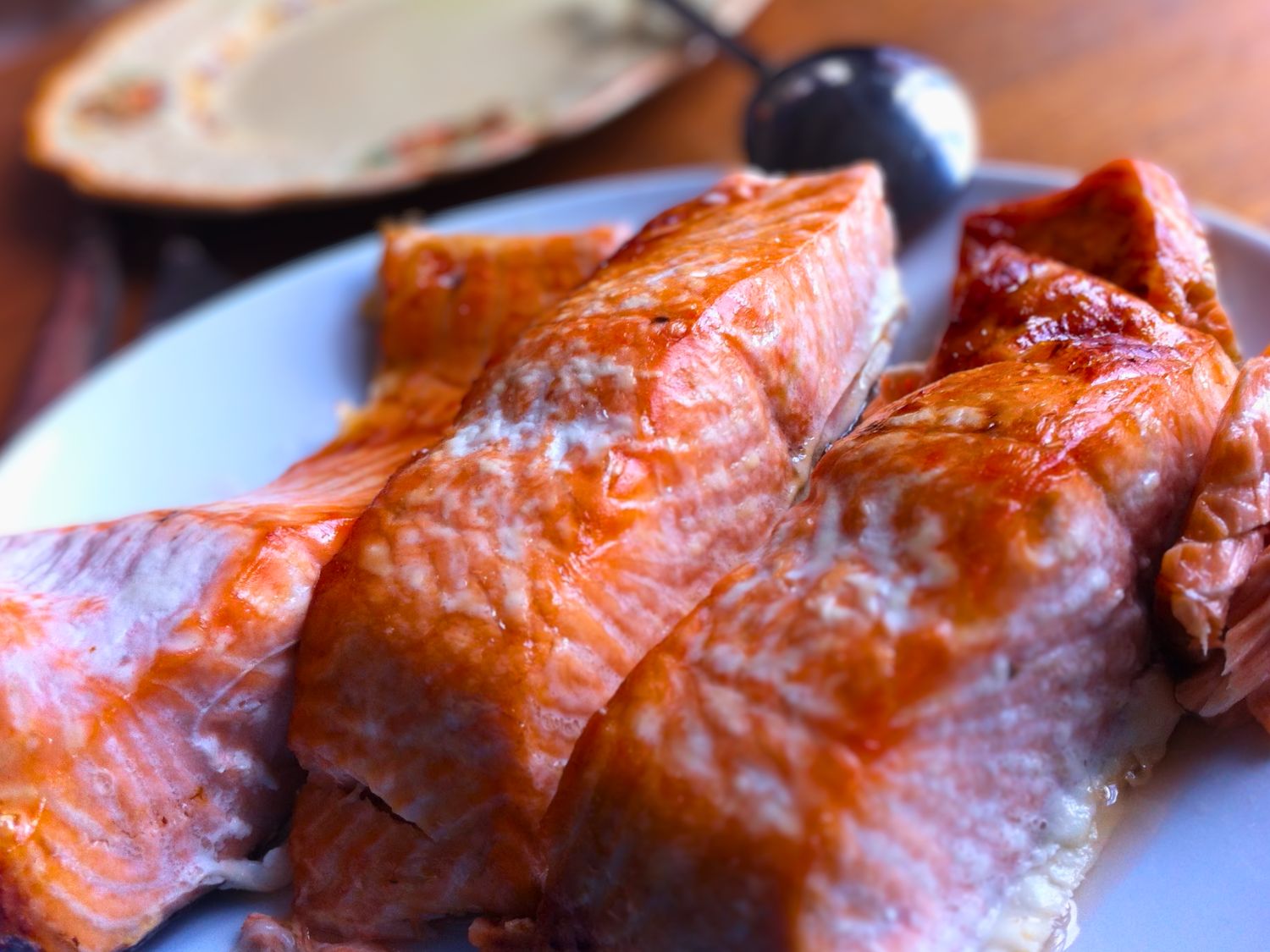
On this Friday the menu was: salmon steaks, baked crisp in the oven without any fuss. Fresh cheese with garlic and chives (handmade). Spinach mishmash. Scrambled eggs with rice. Wholegrain flatbread (made with whey). Organic butter. Peanut butter. Brown whey cheese. Sparkling water. Lemon balm. In that order (that is, produced in that order).
Well, you can't really teach anyone anything about salmon. Oily fish holds a large share of the oils we are so eternally dependent on to thrive and grow and be and love and live. Oily fish contains protein, and if the salmon had lived in God's free nature, they would also be rich in vitamins and minerals. Now that most salmon are farmed, they are perhaps a bit more middle-class – but still to be counted as a superfood. You should buy your salmon fresh from a fishmonger you trust. Windsor on Peter Bangs Vej is my favourite, but there are of course other skilled merchants. It's just important that the salmon hasn't been frozen.
Forget the supermarkets completely (I don't know about the fresh fish from supermarkets, though – haven't tried it or researched it). As far as I've understood, frozen salmon portions are produced in the following totally idiotic way: farmed salmon is flash-frozen and sent by container ship to China, where it is thawed and prepared, packed into portion packs, then refrozen and sent back again by container ship to Europe. Guess how tasty that is. Of course, I don't know exactly to what extent frozen salmon is produced this way. But I know for certain that I have never, never ever had frozen salmon that didn't taste of water and freeze-dried protein. I believe it's about these drawn-out production methods; about food that has been deep-frozen for a really long time. Because you can easily buy fresh salmon yourself and freeze it for a week or three. It doesn't suffer (much) from that.

Fresh cheese with chives has its own article. This time I ran it in my Magimix, because the cheese itself had become very firm. A cheese like that behaves a bit differently each time when you're not a dairy maker. Fresh cheese, when it's homemade, is a probiotic food. That means it contains natural lactic acid bacteria. Lactic acid bacteria are the Good Team in our gut flora, and everything suggests that Western food, medicine and lifestyle have created an imbalance in our inner bacterial states that is so common it's hard to detect.
If you want better biotic balances, eating probiotic foods is a healthy thing. Anything that contains natural, living bacteria is a probiotic. Supplemented with fibre from vegetables, which these bacteria cling to and hitch a ride on, this in itself will improve our health in many areas. Especially the invisible ones. Things like how thoroughly we absorb protein, how our mood swings, whether we feel fresh, whether we can absorb vitamins properly. You can google it yourself. But probiotic foods and their army of vegetables are a healthy, healthy, healthy and, luckily, also gastronomic experience. When chives flower, the torn-up blossoms make a gorgeous garnish on the food.

Spinach mishmash is definitely a dish. It consists of mild-tasting vegetables and a bag of spinach, cooked in chicken broth. Today it was a large onion, finely chopped, a handful of potatoes and a pinch of salt. A little curry and nutmeg suit the dish. So does whipping cream, definitely.
Chicken broth is *not* a bouillon cube! Because chicken broth made from an organic chicken (carcass) draws gelatin and minerals out of the bones. Our Western diet is far too refined; we have refined many basic foods, of which wheat flour and sugar are the very biggest culprits. I'm not against wheat or sugar; both are a regular part of our diet and I'm fine with that. But I also know that the price is that a wealth of vitamins and minerals is used up when these purified foods are digested.
The enzymes the body needs to burn such 'pure' or 'empty' carbohydrates need the vitamins and minerals the plants (wheat, sugar beets, sugar cane) were actually born with. It's pure mathematics, this. If we eat a pile of refined carbohydrates, we end up short of vitamins and minerals – and since the food has to be broken down, they will be drawn from muscles, organs, bone and teeth. According to Ramiel Nagel, who wrote "Cure Tooth Decay", this process is among the most important reasons why cavities are such a widespread problem in the Western world. You can google your way to it yourself, you can form your own opinion on these matters. The website for the book is here: http://www.curetoothdecay.com/.
You can also just choose, quite practically, to believe a basic knowledge that flourishes in our – and in most other – culture(s): chicken soup is the thing. Chicken soup is what you need to get back on your feet when you're ill and weak, because it is profoundly healthy. Job done.
That's why my spinach is cooked in chicken broth. In fact, this book is one of the three most important reasons why I eat meat again (in practice only organic chicken). There is something to be had in animal foods that is more complicated to find in plant foods.
And then there's the nitrite thing. I recently read that the story about nitrite from spinach being carcinogenic is an old myth. It comes from a study from the eighties that has never been repeated. The article was really about how nitrite in bacon and salami simply isn't worth being afraid of. A portion of spinach has as much nitrite as 426 sausages. Or something. I'll put in a link when I find it again. But anyway, in this context: there is no reason whatsoever to be afraid of eating spinach. Not even spinach from the day before.
Scrambled eggs with rice. The long version. Four eggs, 1 dl chicken broth (cold) and 1 dl cooked rice (cooked in chicken broth instead of water) are whisked with a little salt and fried in butter. Again. Eggs are good vitamins, minerals, oils, protein. Eggs are something I know my three youngest children eat. That's why I add these optimized elements: the rice and the broth. There has recently been a story about arsenic and rice in the media, and the Danish Health Authority has said we should be careful with rice. These days you have to be careful with everything. And our food *is* indeed polluted, muddied and watered down. But at the same time it's part of the big mass-media story that everything is dangerous, which you shouldn't buy into.
But you can choose to respect old knowledge. Which I think is a fine, healthy thing in general. And all rice eaters traditionally rinse their rice in many changes of water before cooking it. Best of all (also because the husk parts soften, and enzymes develop and make the rice easier to absorb) is to soak the rice for at least four hours with something acidic (a splash of apple cider vinegar, a splash of lemon juice, a little kefir or kombucha). And then rinse it in two more changes of water before cooking it in chicken broth (which of course you have a couple of litres of in the fridge, because you use it all the time). Then rice is a blessed gift from God to our diet. Like everything else, it should be part of a constantly varied diet.

The wholegrain flatbread has risen for at least four hours, for the same reason the rice had to soak. Recipe: 7.5 dl whey. 10 g yeast. 1 tbsp salt. 200 g wholegrain rye flour. 400 g dalar wheat (wholegrain wheat). 400 g organic durum wheat. Beat it around until it's a slightly wet dough, and let it rise for at least four hours. I used about half the dough to make four flatbreads, which got the full blast in the oven (together with the salmon) until they were done.
Organic butter, especially here in summer when the grass is growing and the cows are outdoors, is eternally blessed for health. Just go for it. Of course with an eye on total calorie intake, but still with respect for the fact that here are some oils and vitamin structures that are completely unique and indispensable. Now (June) is a good time to stock up on butter for the whole winter. It has to be from Osted (strong flavour) or Naturmælk or Irma's own organic brand. Quality in that order, Osted's the best.
Peanut butter. Good protein. Vitamin B12. Healthy, filling fat. Brown whey cheese. Because it tastes good.
Sparkling water and lemon balm. We have a SodaStream; we've always preferred sparkling water. This water can easily be turned into all sorts of lovely drinks. Add a little orange juice, or lemon. A little apple juice or some lemon balm leaves, mint leaves or sliced strawberries. Sparkling water with a little cordial, when it needs to be fancy. Elderflower cordial (in Danish) or raspberry cordial from Søbogård or homemade. With a little kombucha on green tea or with kefir (in Danish). Yum. That's why we never – never – drink soda. It's just a bad habit, in my eyes.
Update 2023: Vegan and gluten-free
Life is long and we are constantly developing as people – for many years now we have lived vegan and gluten-free, but we have chosen to leave all our old recipes online so they can bring joy to others – we don't edit our past :)
Written by Cecilie Conrad. Translated from Danish. The original article is available at CecilieConrad.dk.











Comments