

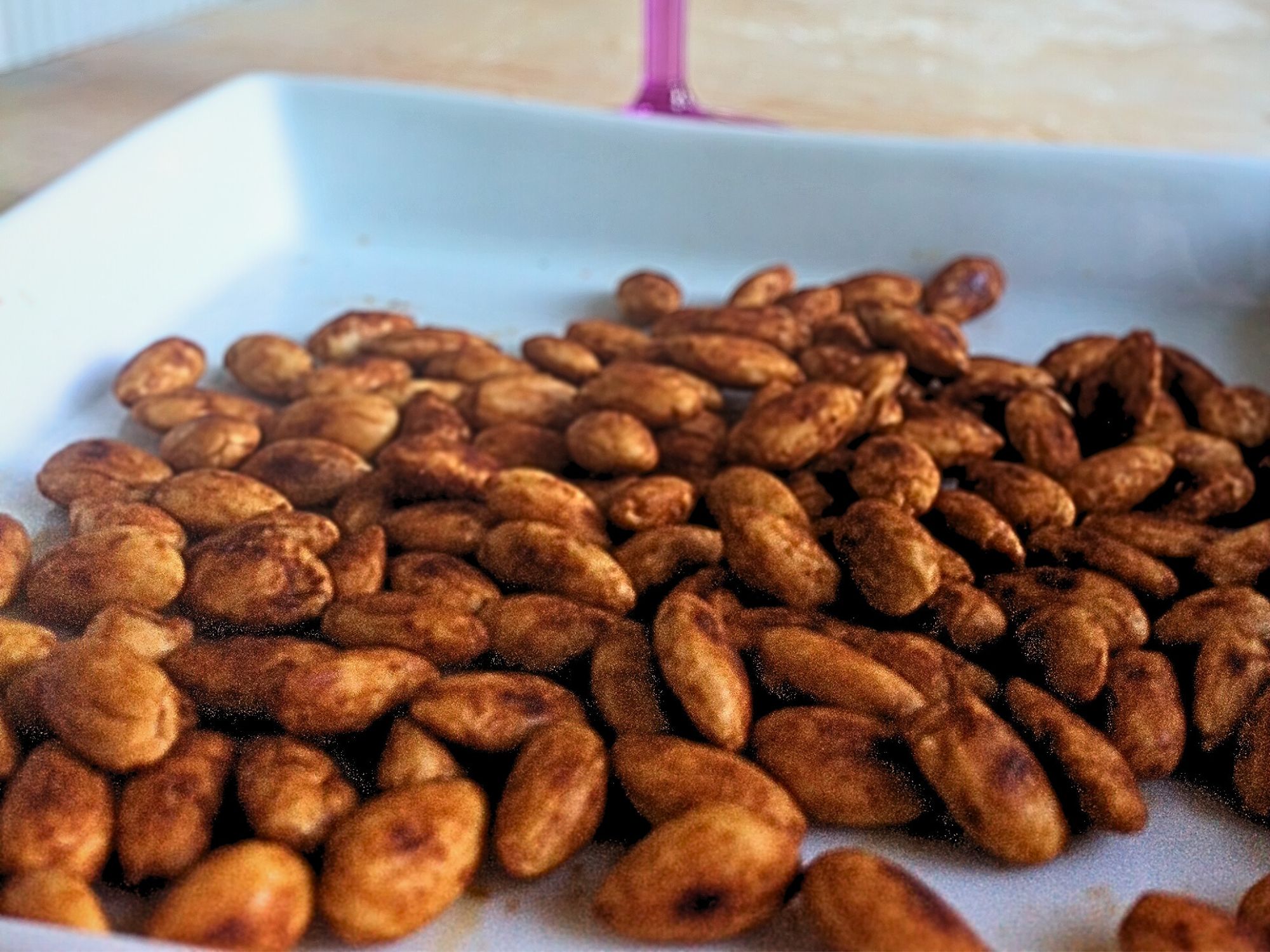
We love almonds – especially the organic health nut writing this loves almonds
Almonds are a cornerstone of my diet. I can't be bothered to be very health-preachy; everyone has to form their own opinion about what good food is. But there ARE a lot of really good reasons to eat almonds. I'm happy to list them.
In short: protein, vitamins, minerals AND oils. All of the good kind, in a reasonable balance. What more could you actually want?
Per 100 g, almonds contain: 20.5 g protein (that is quite a lot, just slightly more than there is in meat), 39 g fat (of which only 3.1 g is saturated), 29.5 g carbohydrate, 9.2 g dietary fibre. And then there are plenty of good vitamins (especially the Bs) and minerals. There is no reason to copy out the whole list; we can all look it up.
If you are the type who likes to look things up in this category, I can recommend Naturens vitaminer og mineraler (Nature's vitamins and minerals) by Lisbeth Hagerup – a Danish book. Maybe I should buy myself an updated edition; mine must be about ten years old by now. But they probably haven't found that many new proteins in almonds, you'd think.
Almonds for beginners
First, though, I want to be practical. I like almonds in their shells. But I also really like them without, and I'm fine with buying them already shelled. The Spanish ones are without a doubt the best, the most varied, the crunchiest. The Turkish ones are also really good, if a little softer (so far – I haven't checked the whole market yet) and smaller. The Californian ones taste good, of course, but a bit too alike. The reason is that in California they 'propagate' the almond trees from cuttings, so all the trees are genetically identical (is that even what you call it with trees? I suppose it is). That is why nearly all Californian almonds taste the same (at least the ones that are exported). The same goes for Californian raisins, by the way. To my mind, very, very boring. But clearly better than white toast, granted. You shouldn't get too fancy for good almonds from lovely California. But IF I can get them from Spain or Turkey, I prefer it. Because there, you plant an almond when you want a tree, and you let chance play, let nature rule, let luck strike. I like the trust in that, the gamble, the freedom – and also the varied taste, the feeling that it isn't one long line of exactly the same thing going into my mouth. It is simply more interesting.
There are surely many people who know far more about almonds than I do, and there are no doubt interesting books written on the subject. This was the short version, the little bit I have taken in.
Recipe: Nana's soy almonds
My favourite almonds are Nana's soy almonds, which were close to the only thing I could imagine eating during my very first round of chemo. Until the chemo hit my mucous membranes, I ate them with great pleasure. After that, they became too hard to chew and swallow. But that is another story.
Soy almonds are super lovely, much better than salted almonds.
Here is how you do it:
Dry blanched/skinned almonds in the oven at 100 degrees (Celsius) until they 'crack'. It can also be done in a pan, but then you have to stay on top of them. So I think it's easiest to do the first twenty minutes in the oven and then finish in a pan. When they start to split and make a cracking sound, you splash in a dash of soy sauce so it sizzles up right away. That is, enough to coat them properly, but not so much that it lowers the temperature and the almonds end up boiling. It has to sizzle, and then they have to come off the heat. Stir a little, and tip the whole lot out onto a plate to cool (so they come off the heat, and so the liquid can steam off instead of soaking in).

Ingredients: Use blanched almonds – skin them yourself if you can be bothered. I don't really; I think it's clearly worth the money to buy them already skinned.
The soy sauce MUST be good soy sauce. That cheap Chinese dishwater is no good at all. Kikkoman is the minimum; personally I prefer tamari, which has a really strong taste. Genuine Tamari from Urtekram is good – and none of that low-sodium or sweet soy or light soy or anything else watered down. Then you might as well not bother. It has to be a good soy sauce, but of course one you like. Just as I like very dark-roasted espresso, I'm also fond of a fairly 'heavy' soy sauce. So use a favourite. But don't waste your time on bad, cheap products.
Afterwards, into a jar. Lovely.
Written by Cecilie Conrad. Translated from Danish. The original article is available at CecilieConrad.dk.












Comments