

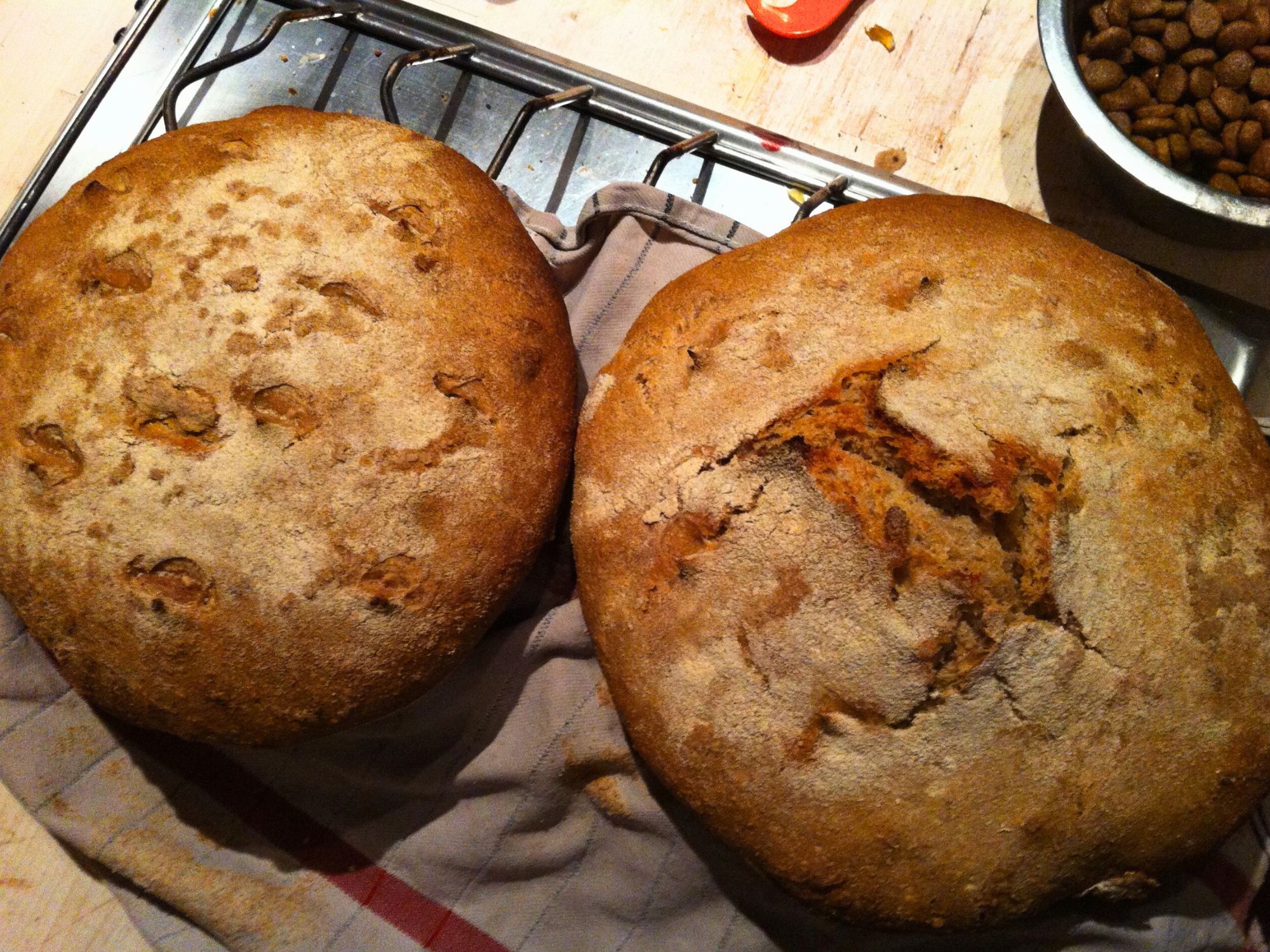
It feels completely out of my comfort zone to write about how to bake bread, so I will try to write about what makes it no problem for me. I am neither Camilla Plum nor Claus Meyer nor any other kind of baking expert in any way whatsoever. But I am a practical mother of four who manages to bake all our bread myself, and yes: it is usually organic and with spelt and cold-proofed and all the things some people apparently think are very advanced.
What I find easy is to just make a dough, keep it in the fridge and bake it whenever there is time and a need for it. Everyday bread runs on this model, and we use the same dough for rolls, loaves, pizza, cinnamon swirls, crescent rolls, the whole lot. Usually just rolls, because that is the easiest.
And it has to be low-effort. A simple routine while you do the dishes; doable with one hand if the other is busy with a baby or something else.

So I take a bowl, a measuring jug and a scale. Into the bowl go, roughly and in this order:
- 100 g oats
- 250 g (that is, until the scale says 350) wholegrain flour of some kind
- 550 g wheat flour (preferably one with germ and bran, but anything goes, a mix of whatever too) (that is, until the scale says about 900 g)
- 1 tbsp salt (which I measure in a cupped hand)
- Into the measuring jug go:
- 7.5 dl (750 ml) water
- a little yeast, maybe 5–7 g
and if it is going to be fancy: a little honey, a little sourdough, maybe a little yogurt – so that it all adds up to 7.5 dl
some seeds or grains of some kind (flax, pumpkin, whole buckwheat, whole rye or wheat, sunflower, whatever); if they are whole, I have cooked them first – but only if it is going to be fancy or I happen to have them in stock. Cooked rice, by the way, is also great to use up this way. 2 dl max. Well, anyway. The wet into the dry, and then a spin in the stand mixer until it holds together nicely, or you can stir it together with a spoon or your hands. Then a wet tea towel over it, and into the fridge. Somewhere between 8 and 24 hours later, I bake. I shape rolls with big spoons or my hard dough scraper, without pressing the air out. Usually straight from the bowl. Otherwise by tipping it all out on the table and cutting it into pieces with a big knife. Totally un-fancy and chaotically uneven and lopsided. Let them rise if there is time – an hour max, otherwise I find they collapse. It makes two trays, so I bake with the fan on at 200 degrees Celsius for 20 minutes. If there is no time to let them rise, a cold oven and 25 minutes works well. A splash of water in a roasting tin at the bottom of the oven right at the end, if I pass by and remember. Otherwise fine without.

Cool them wrapped in wet (not damp, really wet) tea towels, so the otherwise lovely crisp crust becomes manageable for the smallest members of the household. That's it. No sweat. And not that it has to be the most advanced biodynamic ancient-grain-type flour, but I do want to put in a word for quality here. You can't bake very good bread from really bad flour. You have to buy something that is at least a bit good. Otherwise it just won't work; you just get baked paste with air and salt.
Update 2023
Life is long, and we are constantly developing as people – for many years now we have lived vegan and gluten-free, and we still bake loads of bread, just without wheat and yogurt. We have chosen to leave all our old articles online – even though today we would disagree with ourselves :) You can't edit your past :) And if you eat wheat, this is a really good recipe!
Written by Cecilie Conrad. Translated from Danish. The original article is available at CecilieConrad.dk.












Comments