

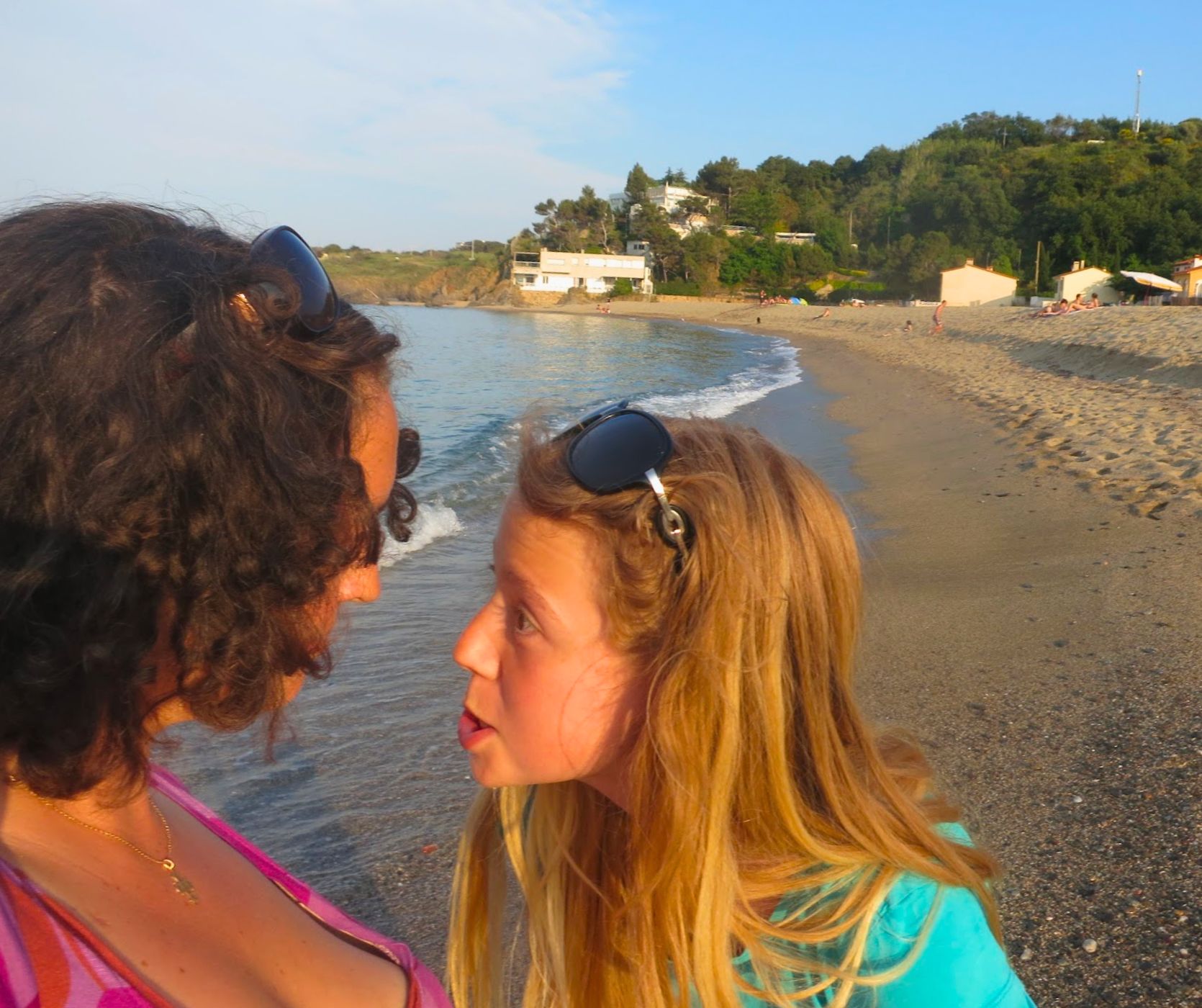
(Thank you to Natasja, who gave us hope)
On resistance and defiance, and on unreasonable parents, screaming scenes, the gathering of the self, the sense of what matters and who we are. On roads and wrong turns, and on that thing about push and push-back.
Do you know this one?
Something completely ordinary awakens an unreasonable and impossible resistance in your child. Very often it is about things like getting dressed in the morning, brushing teeth, going to bed, going for a wee, going home (from kindergarten or from Grandma's), putting on a hat when it is freezing. You get it. Something completely ordinary and everyday, which usually works fine and is just part of the autopilot, suddenly becomes an enormous problem.

The child twists and turns, protests, cries, maybe even screams, stamps on the ground and refuses. And something about this pushes some buttons in you that make you frustrated and furious. Often it spins out of control and ends in a lot of anger and sadness.
Sometimes it is just something unreasonable, something the child simply WANTS or does NOT want, and which is unreasonable or impossible or hopeless. Like yesterday, when Silke was very tired at the supermarket (never a lucky combination) and wanted a go on the little coin-operated pram ride. We got a ten-krone coin and put it in the machine, but THAT was wrong. SHE wanted to do it. HERSELF. FIRST. So it was no good that we took the coin out again so she could do it herself. Huge scene, howling and screaming.

It is completely normal, it is incredibly annoying, it is very sad for the children when they feel like that, and it is certainly also sad for the adults, who are about to tear their hair out and have no idea what to do. Or who desperately try all sorts of strategies, consequences, methods and agreements (almost the worst) to calm things down.
What works?
There are many ways to relate to this. One is to give up. Drop whatever it is, and then see what happens. I am a very big fan of letting go, but with these very irrational and violent defiance reactions in particular, I think something else is at stake, and that another strategy is needed.
And then there are always limits to freedom and open-mindedness. There are. There are plenty of "musts" in our family too.

But to approach it in the right spirit, here is what I have to share about defiance and resistance:
First, there is respect.
I have to respect my child's resistance; something in what is happening really does not work for the child. The child is not out to annoy, tease, provoke or manipulate (it CAN be, but that is a slightly different story, and for now let us assume it is not). The child is in an inner limbo, fighting to get things in order, in balance – to feel in control, respected, whole, loved and .... hmm, yes, quite a lot is at stake here. Depending on age, personality and pace of development, different constellations of feelings and needs drive children to these reactions. Together with – of course – (un)reasonable demands and reactions from the world around them.
I also have to respect my own reaction: If I get really annoyed, I have to put words to that and work through it, so I do not have to let it out on my child. I talk with the children and my husband about what is happening for me – and that makes it so much easier. Frustration, irritation and anger simmer down, and my children's resistance simmers down considerably, when I speak up for myself in these situations. Then it is no longer all about the children and the demands on them and their resistance to the demands and the whole fuss. Then they discover that other people are involved too.

Because, as we know, there has to be a push before there can be push-back. If my child resists, it is resisting something, and in the end that something is often me (or my husband): our grown-up force and speed, our low-level stress and our bossy, tired (now-they-just-have-to-go-to-bed-so-I-can-be-done-for-the-day) behaviour. As soon as I drop that mood, it becomes so much easier.
Second, there is presence. I have to let go of everything else I am doing (and of some tight time frame or long to-do list), and give the child and "the problem" space. I have four children, so it is not as if one of them can easily get 100% of my attention – but you can focus even with a baby on your arm. It is about sitting down and talking with the child. Seeing the child.
Because I said so and That's just the way it is are really bad arguments. When a three-year-old declares at ten o'clock at night I'm not tired, "I" may well know better somewhere deep down, but I have to take my child's position seriously. The child does not feel tired, or at least needs something before being ready to go to bed. Maybe my presence.
Silke has developed this kind of behaviour over the last few days, with the toothbrush in particular as the battlefield. Maybe because it is the last bastion before bed. Silke has cavities, so her teeth are looked after very carefully, and she knows that if her teeth are not brushed, she cannot be put to bed. It is very unpleasant to meet this resistance in your child, and the creeping anger in yourself. When Storm and Silke (3 and 6) are going to bed, we adults are usually pretty tired and not quite finished with the dishes and so on, so there is very little energy left for a conflict.

Third: The solutions
Stop being the boss and speak up for yourself
To be concrete. Yesterday we started blowing soap bubbles instead of going to bed, when Silke checked out at the demand that now was now. We asked Silke what she wanted and needed before going to sleep. Yesterday the answer was that Silke was craving something sweet. Okay – so she got something nice while she sat on my lap (Storm had actually gone to bed by the time we got there, and my husband had Fjord, six months old, on his arm, so we had a little starry moment, my daughter and I).
When the cake was eaten, I was completely absorbed in something we were talking about, and I felt a little poke on my upper arm:
– Look, Mummy! And ten little girl fingers were held up.
– Are you sticky?
– No, I'm done with the cake.
As in: I would like to brush my teeth and go to bed now. Fantastic. There were no problems from then until she fell asleep. We scrubbed her teeth, she had a wee, we washed her and put ointment on her sores, tucked her in next to Daddy, and shortly after she was sound asleep.
The whole operation delayed bedtime by maybe a quarter of an hour. A fight would probably have done the same, but with anger, grief, sadness and guilt to follow. Far from an ideal end to a day.

The terrible twos are an urban legend: Resistance is about children saying no – and yes.
I do not believe in that whole "defiant phase" thing. It is rubbish. The idea that there is defiance in certain clearly defined periods, and you just have to put up with it (or crack down hard on it, depending on who is telling the story), and then it passes and everything is fine again.
It is rubbish.
As I said. Just needed to say it again.
Defiance is resistance against unreasonableness, and defiance is boundaries set around big personalities in small bodies.
Children are – each in their own way – thankfully quite good at saying no. When they do, they usually have a good reason. They need to learn to speak up for themselves, and a clear way to do that is to say no to something you do not want. Children also react clearly and strongly to moods they do not like, and they say no to being steamrolled by grown-up projects, to not being seen and heard. They put up fence posts around their selves, set boundaries around their personalities. At the same time, with all their impossibility, they are calling for our attention and presence, begging us adults to see who they are.
And they should! It would be damn sad if we taught them not to.

Resistance is a gift
Being able to show resistance and defiance is a good thing. It is a quality I want my children to become really, really good at. To sense themselves, and say yes and no in complete harmony with who they are. Not without consideration for the people they care about, and ultimately for the greater community – but well and truly rooted in knowing who they are.
While the children are small, this boundary-setting and these choices for and against come out in ways that could be luckier, easier, simpler, more respectful and better put. Granted. But we are talking about small children here. And I see it as a central parenting task to teach my children to communicate clearly, respectfully, wholeheartedly and articulately – but I would say that this is a completely unreasonable demand to place on a three-year-old.
I am lucky enough to be the mother of the most wonderful teenager in Copenhagen. My big daughter is beautiful and clever, articulate, respectful, present, attentive, social, private, full of self-confidence, easygoing, funny and, yes .... well-balanced. As I said, she is a very private person, and not just because of her age; she has always been a very private person. But it is clear that she is in no way afraid of being herself, or worried about saying yes and no, and it is very rare for Liv to be in doubt about what she wants and does not want. Mission accomplished. Super!

When my daughters are nineteen and out at a bar, I expect to feel completely safe, because I know they know their own limits, take themselves seriously, and know they are loved, understood and respected – whether they say yes or no. That goes for my sons too, really.
The price of this trust is that I handle their "defiance scenes" with respect, care and love; that I see it through the complicated, empathetic, long-term way now. Actually, I think that is preferable to the commander role, the agreement systems, the reward charts, the shouting and the "because I SAY so" arguments. But it is emotionally harder, tougher, more costly.
And precious. A gift, an opening to get to know both yourself and your child. To air out your categories a little, your systems and rules of thumb, your "musts" and "shoulds", so you can sort the wheat from the chaff, values from habits.

Acknowledgement, acknowledgement, acknowledgement
These defiance scenes are about many things. More than I can write about here – partly because they are also always about a specific story. But I can say this much:
When there are defiance scenes, my husband and I try to stop them at our very first flicker of irritation. When we adults start getting cross, raising our voices, steamrolling and bossing – we slam on the brakes. Something is at stake, and we are the adults. It is our job to make room for the good mood and for all the personalities and processes that are present.
Then we have to entwine our toes in the sunset again, as we say in our family, smiling and with a bit of self-irony. SEE each other, SEE each other's experiences, FEEL each other's feelings. And put words to all of it. In that spirit of acknowledgement, where we remember to say the obvious: That we are deeply moved by each other, inspired by each other, and that we listen to each other's stories. And that of course there is room for everyone's processes and projects. Even when it is difficult.

The objections and the solutions
I know the objections: What do you do when they won't put on a snowsuit in winter? Or what do you do if they have to get to school on time? Or what do you do if they won't take their medicine?
The answer is: The same. I listen to them, stop what I am doing and give it space, take their position seriously, speak up for myself, tell them what it does to me – and find a solution. Often a solution that is not the one I imagined at first, often an out-of-context solution, often one where my categories, rules and frameworks have to be broken to make room for my child.
As far as possible, I avoid solutions where the adults just decide.

To come back to the image: I try to loosen the yarn, to allow the trouble WITHOUT being the one who creates it by pushing my children beyond their limits so they can fit inside mine. I try to meet resistance with openness, love, language and respect, to teach my children to speak up for themselves with openness, love, dialogue and respect.
Often the whole mess simply starts because you have no clue what the child is actually resisting – what is the problem? Children are often told that they are unreasonable or illogical or unfair or naughty (how old-fashioned is that?). Really, it is just unexplored. Not yet understood.

I think it works. I think I see things moving in the right direction. Liv is the guiding star, 13 and too lovely in this context (resistance and defiance are certainly also a theme for thirteen-year-old girls). But Silke, almost four, has gone from pure tantrum-on-the-floor NOOOOOOOOOOO (in response to the words: time for bed now) to: "I really don't feel tired, Daddy."
I think we are on the right track. Actually, I feel sure of it.

Written by Cecilie Conrad. Translated from Danish. The original article is available at CecilieConrad.dk.











Comments