
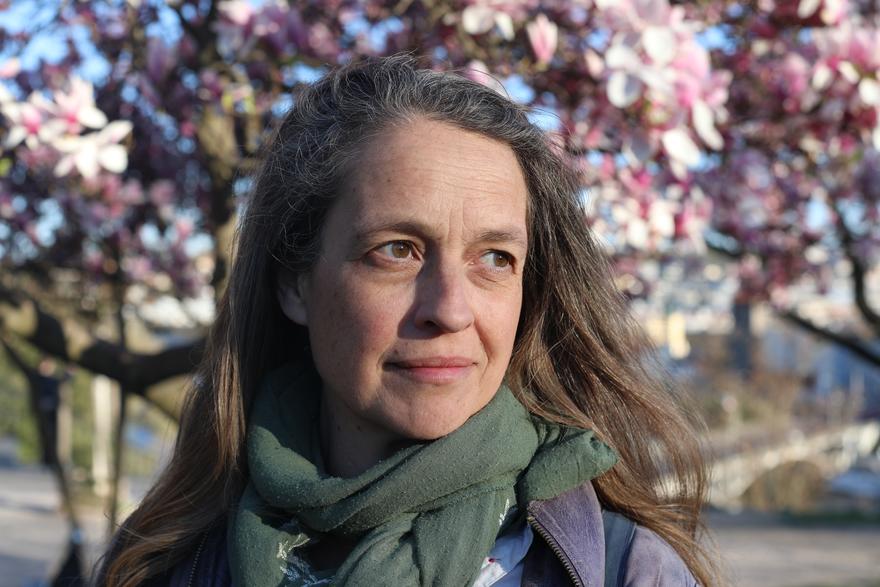
The magnolias are blooming in Prague in April, and the apple trees, and the cherry trees. After a week in the city, we have landed. It is obvious that we do not speak the language, although some words are easy to distinguish, especially in writing. It is obvious that there is something in the national character, the form of communication, or a small bug when Czech becomes English, which is a bit difficult for Scandinavians to contain: a shift between open, humorous friendliness and aggressive, demeaning dominance.
The sun is shining on us, and we take long walks and get to know this beautiful city while getting to know ourselves. In that way, Prague is no different from any other context. One should not get drawn into dialogues that do not work; one should not be bothered by a bit of honking in traffic. There is some kind of bug in the system; the Czechs are surely all lovely and it is probably just cultural differences that make it difficult to hear a co-host in the Airbnb system talk about cleaning five times in two days and to be honked at while following the speed limits in city driving. Take it easy; it is not about us. Not at all.
The sun’s rays stream in through the windows of our rented apartment in a newly built area in Prague 8, near Palmovka metro station. There are trees and canals and paths outside, birdsong, morning runners, dog walkers. The city center is an overcrowded nightmare of tourists and everything that comes with it; the beauty drowns in the pressure of the crowds. We are strong people, all five of us, and experienced travelers, and yet the city center becomes too much for us, it is simply overwhelming, too much. One can of course block it out mentally, but then one is not really there. To experience the beauty, one must get up early and walk in the morning hours, before the shops open, before one can buy souvenirs and chimney cakes and coffee and beer; while the sun rises over Charles Bridge and the astronomical clock and all the beauty. Now we have landed in the city and the first morning walk is planned for Thursday morning.
In the meantime, we enjoy living a bit outside the city. Public transport is cheap and easy to use, and we are happy to walk through the parks and along the river. Everything is as it should be.
Above Letná Park swings the motorized metronome, reminding us that time passes and everything changes. It stands where a Stalin monument once stood, reminding us that every regime is gone one day. It stands and slowly points toward the blue sky. Letná Park is completely wonderful: lots of greenery and a fantastic view. Up by the metronome, skaters hang out, and we did what we always do when we visit monuments. We simply went there and hung out. Even though only one of us skates. We watched the young people both with and without skateboards; we watched the other tourists passing by; we watched dogs and beer cans and flowers, took off our shoes and enjoyed the sun.
It is and remains a good strategy to go out with a single purpose. In reality, it is everything one happens to experience on the way there, while there, and on the way home that creates the adventure. Letná Park and the metronome gave us a skate hangout for our family’s skater, it gave us an experience of another skater spot in a tunnel under some large roads, a spot that was too much and where heavy joints were being smoked, there was massive graffiti, a cool swing structure to rest on and all facilities for skate culture. We got sunshine on the large glass facades of the new buildings and passed by one of the large communist structures whose aesthetics can still make a person feel small and insignificant. We saw a beautiful Great Dane; we saw the low sun over the river; we enjoyed the flowers; we walked on our legs past a film set that was shooting something about the Second World War; saw old beautiful cars and actors in dignified clothing from the 1930s and reacted emotionally to those who were dressed as Hitler Youth, even though we knew they were actors.
And then we are back to the thing about emotions. About noticing them, letting them be what they are, learning to give them space without letting them take over, learning to temper them, learning to be a resonance box for each other, learning to listen when they speak, and to have peace in that. A walk through a city can be just as good a backdrop as any other context for unfolding these inner realizations.
On a completely different level, it is much more fun: the adventure. The magnolias are blooming in Prague, and the metronome points straight up into the sky while the young people fall on their skateboards and get back up again. And again. We talk about handling emotions not because there is anything special, but because it is an interesting conversation. And just as regimes disappear one day, emotions are also something that evaporates. While they last, they can almost be experienced as a regime, almost like a dictator, and one must learn to step aside and think of the metronome: it swings from side to side, and that is okay. Even though it points at something, it is also in motion. Sometimes one just has to let time pass.
One of the things that makes the nomadic life so appealing is that it is so easy to create these synergies between the experiences out there in the world and the reflections, the learning processes, the conversations in the space of understanding, even the emotional space. The metronome and our city walk supported the theme of the conversation in the most beautiful way, almost as if there were a higher meaning.
We have had teenagers in the family for thirteen years; our experience as parents of teenagers has itself become a teenager, and we love and respect teenagers’ lives and inner journeys. We love talking with our teens and being part of the framework and the starting point for them.
Now the magnolias are blooming in Prague and we walk, the metronome measures time slowly and steadily, and we learn and learn and learn. While we experience, while we walk, while we talk, while we are surprised, while we take it all in.

Comments