

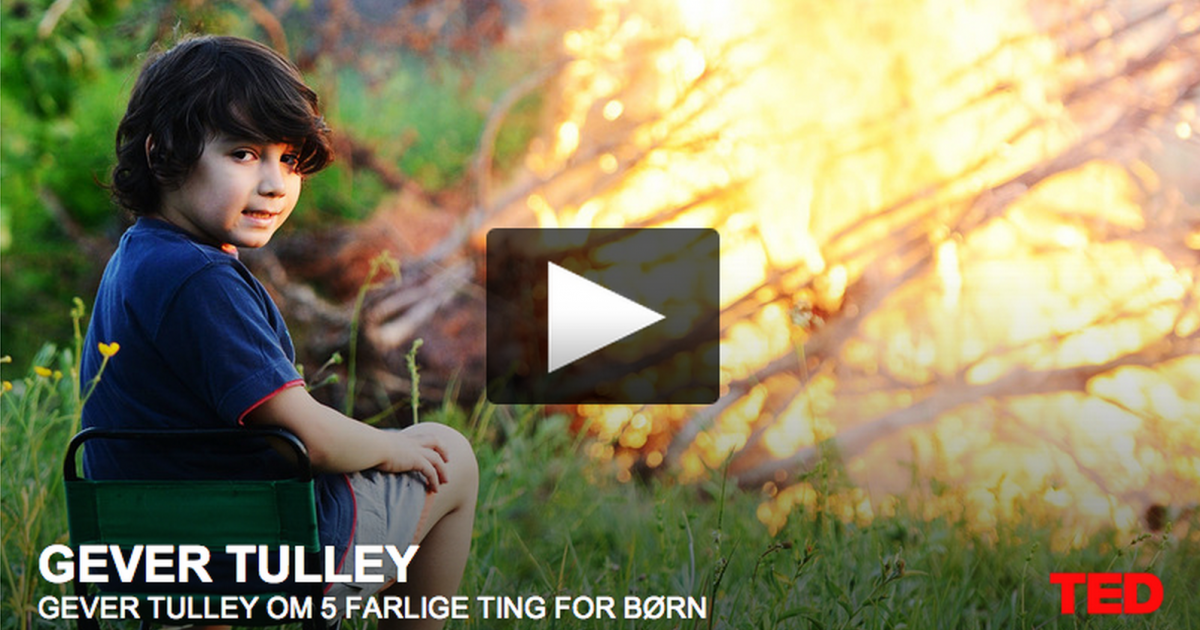
An argument for teaching children to do (some of) all the dangerous things.
Gever Tulley has a good, old-fashioned, hearty attitude to certain parts of childhood, and a fine sense of humour about all the (especially American) safety rules that surround children. For my taste, he argues perhaps a little too much about why it is good for children's development; so maybe a bit too results-oriented – BUT I probably say that because I have just written the article: Your child is not a machine. Watch his TED and judge for yourself.
My summary – that is, of what I think makes sense in his recommended activities – is:
1. Play with fire.
Fire was tamed and made a colossal human development possible. Fire is the centre of focus, of presence, the foundation of all human culture in its own way. Being able to light a fire, tend it well, get something good out of it, is a fundamentally life-giving, present, healing process, which all children should get going with learning to take part in as soon as they can crawl over to the fire.
2. Carry a knife.
A knife is an incredible tool, and when you can use a knife, you just get SO much further on your own. Everyday knife safety is about cutting away from yourself, always (preferably) sitting down, making sure no one is in the direction you are cutting, always having a sharp knife, not fooling around with it, always storing the knife safely when it isn't in use. As simple as that. I think they can learn to use a knife in the kitchen from around the age of three (sharp knives – butter knives can be used from the time they can stand, and then they can start by cutting bananas). A pocket knife or a dagger .... well: you know your own children, and you have to invest some time in teaching them to use it. But what can I say? 5–7 years, depending on temperament. Then it's fine to get started using a knife.
3. Throw spears.
Says the man. In my reality, it's more balls. But spears are probably fine too. Something about throwing and hitting. All kinds of balls are fun, and there are loads of games with them that aren't team sports. Just get going. Start with wool balls and knitted balls when they are tiny, carry on with small bouncy balls and tennis balls and plastic soccer balls, basketballs, foam balls. The cool thing about knitted balls is that you can play with them indoors without smashing anything. Pretty good in our rather cold country.
4. Take things apart.
My beloved brother, Thomas Felumb, who has taken many of the photos for this site, has always taken everything apart. Pretty annoying when we were little – tape recorders, mechanical toys, radios, robots, the Commodore 64 – pretty much anything got deconstructed. It took a good few years before he got really good at putting them back together, but I agree with Gever Tulley: It is HEALTHY – for everyone – to understand what goes on inside things, so they aren't little black boxes. Like my coffee machine and my car and my dishwasher and my computer. We do it to some extent at home – mostly because we 'hack' the machines and try to repair the small parts when they start to break. We always involve the children in these processes – or, well: they think it's quite fun to help get the dishwasher (or whatever it is) working again. But otherwise, yes. A good piece of advice from Gever – take machines that are completely broken apart to understand their components. Try to work out some of the functions. It's fun. Like a backwards mechanical puzzle.
5. Do something forbidden.
Hack something, or drive a car, or something else forbidden. I don't really know .... watch his TED yourself and make up your own minds. Anyway, I think it's perfectly fine to talk about the law with children – about what is regulated, and why it is, and how we can and should relate to it.
But first and foremost, this talk, this focus, argues for removing the overprotection and letting children take part in something real. That, especially, I think is really lovely.
Enjoy.
Written by Cecilie Conrad. Translated from Danish. The original article is available at CecilieConrad.dk.







Comments