

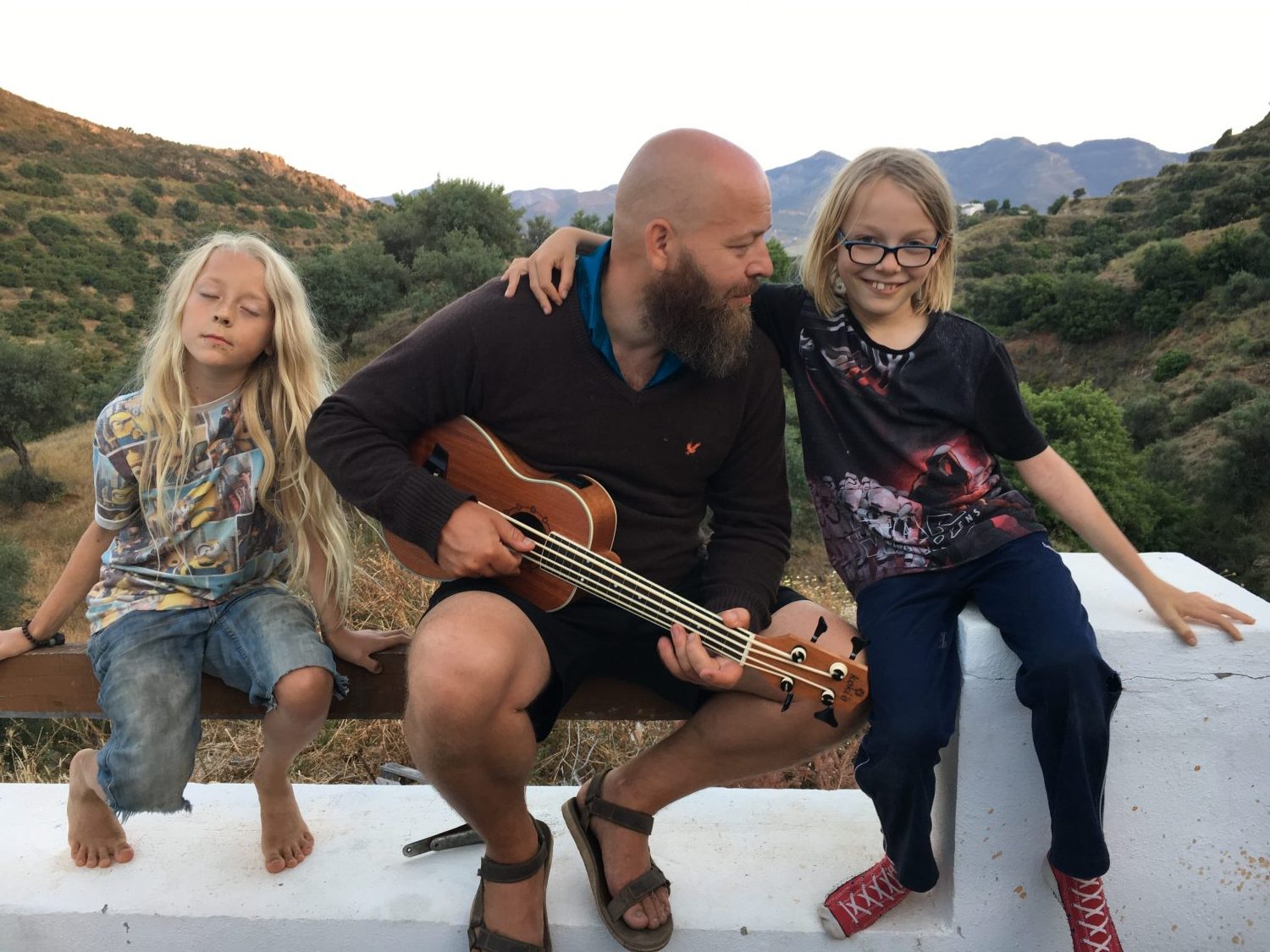
Some call it upbringing and socialization – I think that sounds patronizing, and that there is an unfortunate power relation in those concepts. Here are some of my experiences and reflections around the theme that is sometimes labelled with the muddy concept of "the social", that is talked about pseudo-scientifically as "socialization", but that is really just the life task of being a social being. With a built-in sneak peek into our unschooling reality.
Reflections on unschooling
Over the years I become a more and more convinced unschooler. Unschooling should not be confused with non-school. Unschooling is actually a slightly annoying term, because it refers negatively. In our life – with all the things we opt out of (school, curriculum, gluten, meat/milk/eggs, computer games, TV, holidays, additives, the list is longer) – it is central for us to keep our focus on what it is we choose (life together, true motivation, nutrition that benefits our organisms and suits who we are, adventures and experiences and so on). It is not the movement away from something that motivates our life; it is not what we have chosen NOT to do that is the content of our life, and so the term unschooling is a little annoying. It is not about opting out of school. It is about opting in to life. In reality. For everyone.
So – maybe it is more correct to say that the unschooling movement, the unschooling philosophy, appeals to me, and that the way of thinking rhymes really well with the life we live at home. It is a bit like calling myself a vegan, because it is the shortest way to describe the way I eat. It rhymes. But it actually isn't the same. I don't like dogmas, systems, sets of rules, methods – neither when it comes to food choices nor educational considerations nor other areas of lifestyle.
But. Well. The term unschooling describes a lifestyle where you opt out of the school system and trust the child's innate and lifelong desire to learn, and therefore, as parents (responsible adults), have no agenda, no curriculum, no project for the child's education. The child has the freedom to organize their own time, their own life, their own effort. There is no kitchen-table school or other kinds of external demands.
It is actually rather tricky to describe what unschooling is about. I'll try anyway. Again. I have written about it before, both on the Speltmor blog, in Worldschool Magazine and here on CecilieConrad.com.
For us, the central thing is that learning follows life as such: if you do something that is meaningful and fun, learning will follow as a side effect.
Learning is not the focus. Life is the focus.
On having something at heart

The central thing about unschooling for this article is that I don't have an agenda. There is nothing I think in advance that my children ought to learn. And yet. That isn't quite true. Because there are some main themes, academic ones, that I would like to introduce them to, to the extent it makes sense for them. And there is an enormous field of knowledge that I think it is, among other things, my responsibility to help them work with – while growing in it myself as we live life together. And that is what is often just labelled: the social.
When I open with reflections on the term unschooling, it is because I want to stress that our work with the whole social field is precisely not systematized, not put into a formula, not part of a training programme – but, like everything else we "work with", is something that just happens in the life we live together.
And now I am telling you about it, and it may end up sounding as if I "teach". I don't. We talk about these things together. Think about them together. We have a whiteboard where we draw and explain. And when it comes to psychology in particular, there is the context that I am a psychologist.
So what we have chosen is the freedom to dive into what makes sense, or not to dive in at all. Lately it has especially been a theme to talk about relationships, feelings, handling feelings, social phenomena, social considerations, diagnoses, personal development.
Being a social being
Being social is a human condition. We need each other. We aren't really anything without each other. As I see it, we are most of all what we are by virtue of our complicated connections to people, both in the present and in our history. We may be subjects, but our true identity – what we are and what we can do – exists and plays out to a great extent in the matrix of connections to other subjects.
Being a social being is a lifelong task. For strange cultural reasons, we are preoccupied with whether children are learning what they need to with "the social" – but the truth out here outside the box is that being a social being, developing in it and adapting to changing contexts, is a task for all people, regardless of age, and that the difference is mostly that children need adults when they acquire social codes.
Notice that adults often need other adults too when they have to find their way in new social contexts, so the difference is rather that for children, more contexts are unknown and new. And the maturing of their own emotional life is really a gathering of experience.
Maybe we are so preoccupied with children's social skills because most children grow up in artificial and extremely pressured social contexts, in enormous groups of children, under extensive compulsion and with almost no contact with adults during the day – so "finding your way" comes to be about being able to manage on your own, emotionally and socially, even though you are only six (or only sixteen, or somewhere in between). As I see it, the whole system is skewed, and I am happy that my children don't have the challenge of having to handle a social field of that kind, and I am just as happy that the social influences they miss out on – well, we are spared them.
At the same time, my children of course also need a social field to move in. What we have opted out of by opting out of school is an artificially created social field marked by compulsion, one no child would choose voluntarily – not the social field as such. What we have chosen is a life in reality, with situations and people and contexts in general that in most cases we have chosen to take part in ourselves, and that in all cases we have the freedom to move away from if they don't make sense or are too strange.
Being a social being, being human, also contains an emotional life; something that at first glance is best understood as something going on inside the individual (whether it really is, you might well consider). Handling and working with your emotional life is part of human life. There is no sensible way around it.
On empathy – resonance in your own feelings
Empathy is the ability to read other people's feelings with your own feelings. Being empathic means, among other things, that you are able to put yourself in the other person's place in such a way that you can feel what the other person feels, while at the same time feeling the difference between what is your own feeling and what is the empathic mirror feeling. This is very hard. This is something many adults are incredibly bad at.
Recently we met a boy with big challenges in this area, and it led to many reflections on empathy and psychological talents, developments, possibilities – and how glad you should be to have the capacity for empathy.
Empathy is a central part of our connection to each other, a cognitive muscle in daily use, which we continually "educate" ourselves in when we are together, no matter how we are together.
On finishing feelings
It is a fact that pain is not nice. Negative feelings of any kind – you want as few of them as possible, and you want none of them for your children. The reality is just that grief, frustration, anger, disappointment, fright, worry, insecurity, uncertainty – all of that exists as part of life. And even though on the one hand you shouldn't wallow in your feelings and feel and feel and feel until you have created a self-reinforcing negative spiral, on the other hand you shouldn't run away from every unpleasant inner experience either. It is central and mentally healthy to finish your feelings.
It starts with daring to feel the feeling, or the emotional chaos. Giving it room. For parents it can be an important lesson to learn that all feelings are allowed. It is okay to get angry, sad, frustrated, furious, miserable – whatever the reason. There is a tendency in adults themselves to try to avoid the negative emotional experience, and – especially in "upbringing" – a valuing or dismissal of feelings that can be insanely unhealthy in the long run.
Example.
The child gets frustrated about not being able to take part in something. The anger is unreasonable from the adult's point of view (it could be: you can't help with the dishes, I'll do it, it's faster). The adult says: "You have no right / no reason to be angry about that." But since the adult is also The Social Teacher, the reaction needs to be: "I can see you are getting angry and frustrated. Tell me what you are experiencing?" Whether the reaction is adequate, reasonable, morally okay, considerate of the community, is a conversation that follows AFTER the child has been given room to have their emotional experience. It is okay to feel what you feel. All feelings are allowed.
When the feeling is allowed, it is also possible to work with it. Reflect on it. Why do I feel what I feel? What happens inside me when I feel it? How do I show others that I feel it? How can I move on from the feeling? How can I hold myself with this feeling? How can I help the people around me understand me better? How can the people around me best help me with what I am experiencing in my emotional life?
Especially "Why do I feel what I feel?" lays the ground for some fantastic conversations you can have with your children. Very relevant. Very surprising. Sometimes mirroring your own demons. Sometimes with connections you simply hadn't seen.
The value of emotional work in a family context
Conversations of this kind – the ones that follow in the wake of the difficult feelings – build on and at the same time create great trust in the relationship, and you get children who are truly competent both emotionally and socially, with self-respect, the experience that their being is valuable, the experience of being okay, the experience of being listened to as equals, the experience of being unconditionally loved, and able to handle difficult situations too.
As a bonus you get a strong and stable relationship with your children. As an extra bonus, you get wiser about yourself.
But the price is that you have to shut up with your parental reactions of the type: "No, now you're being really annoying", "What is all this fuss/whining/hysterics/nonsense?", "Big boys don't cry", "Now you're making a drama" – it is The Great Spaciousness you need to have. And when you can't manage that, you have to be super childish, flip out completely and be wildly irritated, shout: "Now you stop it, for heaven's sake, with all that crap" – and then afterwards calm down a bit and ask for forgiveness.
Progress, not perfection.

It is okay to be a child inside. It is okay to run out of steam. It is just insanely important that every kind of emotional flip-out, whether from children or adults, is dealt with, finished, talked about, tied off.
In its wake always comes learning to say yourself out loud. You learn a great deal about yourself when you say yourself out loud. You also learn to listen. If you were pedagogically inclined, you might call it empathy training, but the hairs on my arms stand up just writing it. It sounds so damn strategic! Remember my unschooling intro. This is about reality. It is about working properly with what we experience. And that is valuable both here and now, but also in our relationships and on our way on into the world, as readiness for whatever life may bring from here.
Notice. You can talk about all of this with a five-year-old. Even a three-year-old. The only thing it takes is the patience that, under all circumstances, is one of the most important psychological muscles to train if you want deep and healthy relationships (for instance with your children).
When I invest hour after hour in conversations of this kind, it is because as a parent I take on the responsibility for my children's emotional and social development; I want to make it possible for them to work with these things in a fine and wise way. But it is not a project. There is no plan. There is a focus, a value.
Unschooling and the emotional field revisited
You see, there is a strong connection between the fact that we have chosen freedom and the family as the context for our lives and that we choose to engage deeply in the emotional and the social. Because we want to live life. Fully. Full throttle. Fully engaged. Fully present. And this is where we carry our presence, our experience, with the mind. Where we are inside – the state we are in – comes to colour what happens in our presence. That is why it is ALWAYS important. Because the individual is, and because the community is. The emotional. The mental. The soulful. That is where life happens. That is where there is a pulse. That is why we are here. Because it is in that space that love unfolds.
Done and dusted. Now it is said.
Written by Cecilie Conrad. Translated from Danish. The original article is available at CecilieConrad.dk.







Comments