

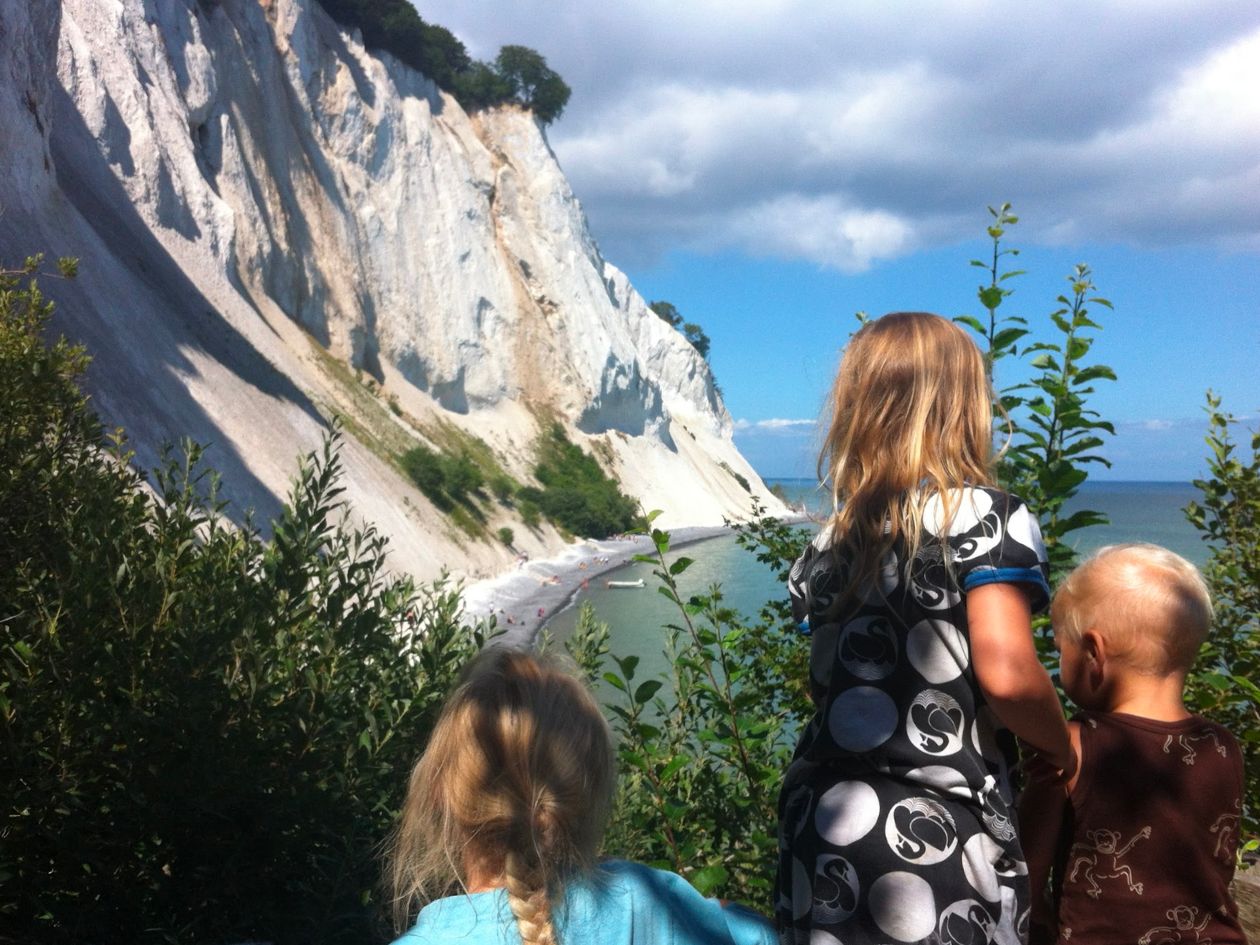
Møns Klint. Magnificent nature. Wonderful afternoon. Enchanting reality. Come along on a little walk in nature of just three kilometres. But what three kilometres. Completely unique, centimetre by centimetre.

Off on an adventure. What might be waiting down below?
To experience Møns Klint, you either have to come from the sea or tackle the hardship of the thousand steps. We chose the latter. Since we don't sail ourselves, the first option would have been too complicated. So we parked in the shade, played a bit at the playground, packed water and crackers and started down the many stairs. Already here it is overwhelming, because the forest covering the slope is truly beautiful, and the stairs are endless, steep at times, and the experience of the springs running downhill so lovely and cleansing. There are stairs and stairs and stairs.

Small springs run down the cliff – taste the water – so clean and lovely
Almost at the bottom, the spring runs in under the staircase, and you can cool your hands and get a sip of completely clean, lovely cold water. It is a big nature experience, a waterfall like that, however humble it is in size. The beech forest thins out at the end, and we come down onto the stony beach.
There isn't really anything to say that pictures don't say many times better. About the light. About the beauty. About the distinctive rock formations and their sharp white way of folding around in the summer light. So I will say something other than what you can see.

Møns Klint – a magical place
We turned right and walked a couple of kilometres along the beach to the next staircase. And it was a wonderful walk with many, many experiences. You walk on big stones and wet chalk and dry chalk. The first spring is the biggest, and there it is easy to drink. Of course there is no point in me describing the coastline too much, because new landslides happen regularly, and the beach changes all the time. We experienced the springs, and a place with a big, recent landslide. A tree you can climb right out by the water. A small spot with a sandy beach (where we swam). A big lump of earth to pick apart. A very large, almost rotted-away fish. The swallows that live inside the cliff, and we also saw the tree where the peregrine falcon has its nest.

Looking for belemnites
It was a long way to walk, and we got tired. No mobile coverage, no maps, other than the leaflet's physical, old-fashioned map. Recommended for that very reason. Every time we came around a corner, it was overwhelming. The formation of the cliffs, the sense of how the glaciers pushed enormous masses around, so that what was once horizontal is now an arc. The chalk washes out into the otherwise completely blue, blue sea and looks murky in the water closest to the shore. Mostly, of course, where the landslide is recent. By the springs the chalk is wet and a bit slippery to walk on, but not impossible. Just a bit greasy.
We took a long break. A really long one. Found a fossilized sea urchin and some other fossils. Gazed out over the water and studied the sailing ships and the pleasure boats and the birds. Meditated and paddled a bit. Threw stones in the water. Drank water. The dog had a good nap.

We find belemnites
Around the next corner was the next staircase, and we went up. Or rather. Storm and Silke, seven and four, ran up. Fjord, one and a half, preferred to walk himself, and was only carried a little by Daddy. I puffed along after the two S's with shaking knees and a dog that was tired too.
There are WILDLY many steps up that staircase. At the top lies a radiantly beautiful beech forest with the characteristic curved trunks, and the endless green that you have only really experienced when you have experienced a beech forest in sunshine.

Managing the stairs all by yourself is a big achievement
We met woodlice and strange beetles, caterpillars and birdsong. The terrain is wild, with stairs, slopes, tree roots. It is just as far back, so we had to fight a bit for it. Up and down and around. Fjord and Silke held hands. Silke would rather run with Storm, so it wasn't always easy for the littlest guy. But that is our personal story. But it is a really lovely forest. The walk ends in luxury on a boardwalk, which I suppose is used for getting wheelchairs and strollers out to the first viewpoint, where you can more or less see the cliff.
What can we learn? Go down the stairs. There isn't much to Møns Klint if you don't go down to the beach. Overcome the tiredness. There isn't much to a walk where you go there and back. It is just more fun to walk a loop. And you miss the forest if you just walk a bit along the beach and turn around. Take plenty of time. I suppose that is what it is all about.
By the car park, before you get to the stairs, the museum tempts you: Geocenter Møns Klint is a marvel of a museum when it comes to explaining things, and can definitely be recommended. But really: we were very happy to have set aside a day for each: one in nature. One at the museum. No rush. Just a calm and quiet holiday with room to digest all the experiences. And if you have to choose, choose nature. It was unique. On the level of the great caves we have experienced.
See more pictures from the day here

A tree that has fallen down from the cliff is now a lovely climbing frame

Exploring together

The remains of a dead bird

Dear ladybird – fly up to the Lord and ask for good weather.

Searching for fossils

Strong and funny

Love – always love

Møns Klint makes you want calm and meditation

The water and the light

The cliff is beautiful up close, but majestic seen from a distance
Practical info: On YouTube you can find films from National Geographic about the Cretaceous period and the prehistoric ocean and dino finds, if you search for Sea Monsters, for example. I would rather not share them on the site here, as I am not quite sure whether they are legal uploads. You can also find a little Claus Meyer film about Møn, which tells a bit, and one, I believe from VisitDenmark, which tells something else – about the island, including the cliff.
The Danish Forest and Nature Agency has a nice leaflet you can download and print if you want to read up beforehand. It is also available for free on site.
There is also the publication/site jordihovedet.dk, which communicates geology based on Danish areas of geological interest, including Møns Klint. It is excellent material (in Danish), and we are far from finished with it in our family. Yet.
Written by Cecilie Conrad. Translated from Danish. The original article is available at CecilieConrad.dk.




Comments