

The Top of Denmark – a trip to Grenen
There is something euphoric about the Top of Denmark, something that reminds me of Pisa and the leaning tower, something silly and overwhelming. Grenen is, of course, a huge tourist attraction in all its simplicity. North of Råbjerg Mile, the traffic starts getting heavy, and the signs for roadside stalls, flea markets and B&Bs thicken along the verge. But never mind. You have to make a trip to Grenen, and you have to set aside time and energy for it. Whatever the weather.
Rainbow and roadside lunch

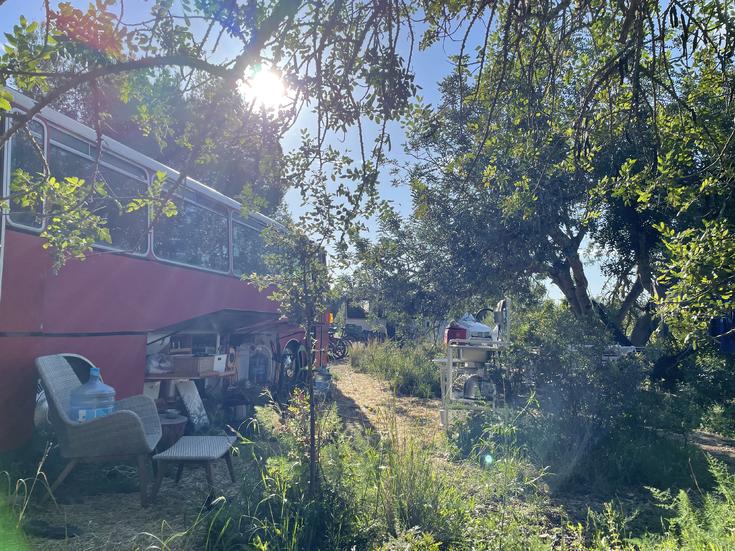
We drove to Grenen despite rain and tiredness, and despite not quite knowing where we would sleep. In the flipper bus we have a fridge and a little burner, so most basic needs can be met by the side of the road. When we parked, right around dinnertime in Denmark, the parking lot was packed and it was raining. While we fried sausages and made coffee in our coziness, the good Lord put a full rainbow over the dunes, and the idyll was complete. We ate salad and avocado and tuna, drank water and washed our hands and got completely ready for the walk to the Top.
If you don't have a flipper bus or a well-packed cooler, there is both a restaurant and a hot dog stand by the parking lot, so really, you don't have a problem. It is lovely up here in the light at the top of our country.
Parking is free after six p.m., by the way. Very handy for us.
The walk up through the dunes and all the way to the tip is actually fairly long. Especially when you have a two-year-old along who practises standing on his head every time he finds some really soft sand. But the weather had turned, so the sun was shining down on us, and we quickly figured out to park shoes and hoodies in the sand so we wouldn't have to drag so much.
Learning in the middle of real life

We saw plants and birds we didn't know, and will have to go home and look them up. In the sand I drew the outline of Denmark and drew the waves lapping from the two seas – and then the hunt for the right spot began. Even though I go running almost every morning, I find my children are very fast in the sand, and Storm, eight, came in first by a mile.
We studied the container ships on the horizon, saw how maaaaany there were, and talked about all the countries and enormous ports you can reach once you get into the Baltic Sea. The children know Helsingør really well, since we have very good friends there and often sit on the beach staring at the ships sailing past. At Kronborg Castle you can see a fine – really fine – exhibition about the history of the Sound passage at Helsingør and the importance of the way in.
We found loads of stranded jellyfish, which we sorted by sex according to colour (light red are girls, blue are boys – they are conservative, those jellyfish), and a single starfish, which had, strangely, washed up on land right at the very tip.
The chaotic sea

First and foremost, we were in the big blue. I can clearly recommend forgetting all inhibitions and feelings of cold and just jumping into your swimsuit and out into the mysterious sea, where two seas slosh together and confuse and disturb and splash. It is really, really fun – especially, of course, if you have a water dog in the family.
The classic photo

Just like in Pisa, you have to take pictures at Grenen. You have to wade out with your trouser legs rolled up (not in swimwear) and take pictures while your trousers get wet. Of each other. And of the others. It is great fun to take family photos of the other tourists and create a kind of folksy atmosphere around it. We were here ten years ago with just one child, and now we are taking home funny pictures of the whole crew, dog included.
The Sandormen: from scepticism to practical transport

I have a lot against tourist trains. Especially those annoying little electric trains with a bell that drive around everywhere. Except maybe in Pisa – I didn't see them there. And at first I thought the Sandormen, the tractor-pulled "sand worm", was annoying too. But actually it is a long way from the parking lot to the tip, and actually it had started raining again by the time we had to go back, and actually the children were getting really tired, and actually it only cost ten kroner per child, and actually it was even a real tractor pulling the sand worm – so now we are wiser and less against tourist trains. They can have their place.
I myself got to run along the water's edge like a foam-born Venus (plus ten years and plus four children) back to our pile of shoes and hoodies.
The German bunkers at the water's edge

Honestly, I do wonder why we don't remove those simply hideous concrete blocks from the Danish landscape. But I suppose someone has some good reason to think they are worth preserving. There is a museum about the bunkers here at Grenen, where you can no doubt find the answer. We skipped the museum and drove on down to the Buried Church – a classic outing at the very top of the country.
The Buried Church: sunset and the wings of history

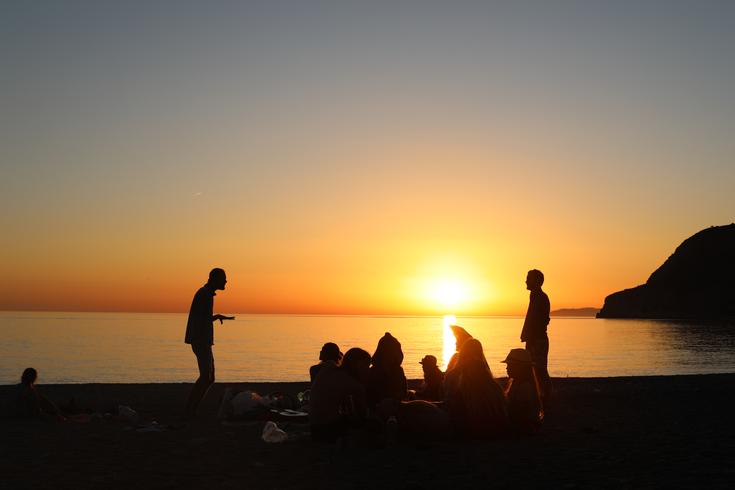
Visiting the Buried Church is a really good experience. We came at sunset, around half past nine, and went for a walk in the hilly landscape, climbed around a bit in the wilderness and met the church just as the sun went down. In reality, the church isn't there any more, so in that way it is a bit of a cheat. It was closed when it proved impossible to keep it free of drifting sand, and the materials were sold for other buildings. The tower still stands; it was kept as a landmark for ships – and is now a bit of an icon. It is beautiful. And the walk is nice. There is some sort of kiosk thing by the parking lots, closed of course, since we came so late. And a nice little playground, so you can hang out at the tables, drink a bottle of water and play a little before you drive on.

Written by Cecilie Conrad. Translated from Danish. The original article is available at CecilieConrad.dk.







Comments